




US Stocks End Lower as Chipmakers Lead Slump; SpaceX Rises 4% to $138
TradingKey - High uncertainty remains over the prospects of reopening the Strait of Hormuz, driving oil prices up 5%. Meanwhile, Cleveland Fed President Beth Hammack stated that the Federal Reserve may still need to raise interest rates multiple times to bring down inflation. Against this backdrop, the three major U.S. stock indexes fell under slight pressure, with chip stocks pulling back while oil stocks led the market gains.
At the close, the Dow Jones Industrial Average fell 0.11% to 53,975.98; the Nasdaq Composite Index fell 0.32% to 26,605.36; and the S&P 500 Index fell 0.06% to 7,753.11.
Tech Stock Performance
SpaceX (SPCX) jumped 4.23% in late trading to $138.74.
According to the latest 13F filing, Google holds approximately 550 million Class A common shares of SpaceX, with a reported market value of up to $94.176 billion, accounting for 95.05% of the entire 13F portfolio. Google's Q2 earnings report showed that approximately $80 billion worth of SpaceX shares are subject to short-term sale restrictions, and another $14.1 billion worth of shares are subject to long-term sale restrictions, with the lock-up period extending to the third quarter of 2027.
Intel (INTC) fell 4.06% to $97.52.
Intel plans to issue $15 billion worth of common stock. The proceeds will be used for general corporate purposes. The company stated: 'The robust progress made in emerging areas such as physical AI, custom silicon, advanced packaging, and external foundry services has brought significant, historic-scale growth opportunities to Intel.' 'This offering is designed to further strengthen Intel's ability to capture future robust growth opportunities, while maintaining a strong balance sheet and continuing to honor its key commitment to maintaining an investment-grade credit rating.'
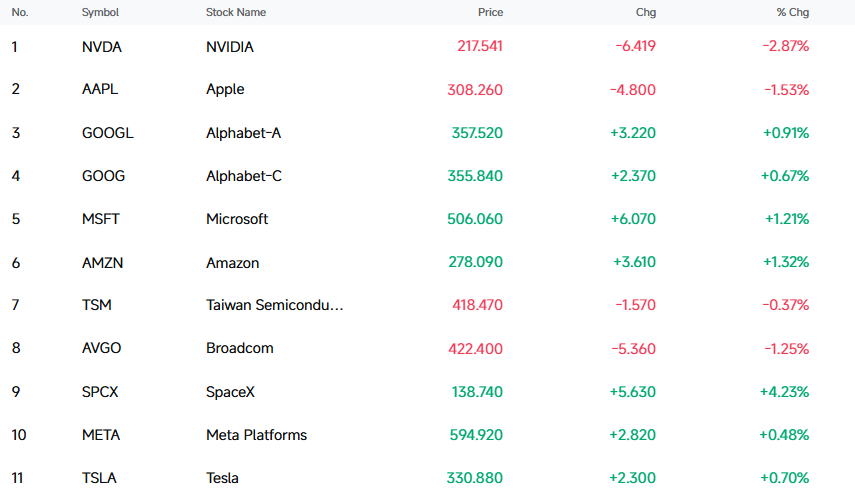
Among mega-cap tech stocks, SpaceX (SPCX) rose 4.23%, Amazon (AMZN) rose 1.32%, Microsoft (MSFT) rose 1.21%, Google (GOOGL) rose 0.91%, Tesla (TSLA) rose 0.70%, and Meta Platforms (META) rose 0.48%; on the downside, Nvidia (NVDA) fell 2.87%, Apple (AAPL) fell 1.53%, Broadcom (AVGO) fell 1.25%, and TSMC (TSM) fell 0.37%.
[Source: FutuBull]
The Philadelphia Semiconductor Index fell 2.94% to 11,993.86 points, with all 30 components declining.
Among chip stocks, Arm Holdings (ARM) fell 5.21%, Intel (INTC) fell 4.06%, Qualcomm (QCOM) fell 3.39%, Nvidia (NVDA) fell 2.86%, and AMD (AMD) fell 2.86%.
Corporate News
Microsoft Reportedly Plans to Boost Production of Next-Generation AI Chips
According to a report by The Information, two people familiar with the matter revealed that Microsoft plans to release its next-generation proprietary AI chip, the Maia 300, this fall, with a public debut possible as early as next month. The company is also in talks with TSMC for a capacity contract to deliver over 300,000 chips in 2027—an order-of-magnitude leap compared to the current-generation Maia 200's output of just tens of thousands. Meanwhile, Microsoft is actively negotiating with large cloud customers such as Anthropic to use the Maia chips.
Meta Releases New AI Model Muse Glimmer
Meta announced that it will soon resume releasing some open-source AI models and introduce a new lightweight model, Muse Glimmer, while calling on the US government to ease policy restrictions on open-source AI. The new model, named Muse Glimmer, is a streamlined version of Meta's Muse Spark 1.2 model. It has 30 billion parameters, requires only a single graphics card to run, and is primarily aimed at agent tasks such as calendar management and file organization. The model weights will be available for download on the Hugging Face platform, and Meta also plans to open-source the weights of the more powerful Muse Spark version.
Nvidia Reportedly Partners with Wall Street Giants Including Blackstone and BlackRock to Plan $500 Billion AI Infrastructure Financing
A coalition of financial groups, including Apollo Global, Blackstone, BlackRock’s Global Infrastructure Partners, Brookfield, Goldman Sachs, and KKR, is working with Nvidia to prepare a $500 billion AI infrastructure financing plan, which could be announced as early as Monday, the Financial Times reported, citing people familiar with the matter. This partnership indicates that Nvidia is strengthening its financing footprint to raise funds for itself and its customers to build core infrastructure for the AI era, including chips, power supplies, and data centers. Meanwhile, private capital giants are planning to channel trillions of dollars of assets, including insurance funds and institutional capital, into the AI infrastructure sector.
OpenAI Launches GPT-5.6-Cyber, Opening Stronger AI Capabilities to Security Personnel
OpenAI announced the launch of GPT-5.6-Cyber and the expansion of its cybersecurity initiative, Daybreak, to provide vetted cybersecurity defenders with AI models better suited for advanced security work. OpenAI stated that it hopes to place frontier AI capabilities in the hands of trusted defenders before attackers deploy autonomous cyberattacks at scale. Daybreak is divided into two tiers: Daybreak Blue provides access to GPT-5.6 Sol without system-level cybersecurity protection restrictions; Daybreak Red provides access to GPT-5.6-Cyber for exploit validation and advanced vulnerability research. Testing shows that GPT-5.6-Cyber responded to 95% of advanced cybersecurity task requests, including exploit chain development, authentication bypass, and privilege escalation. OpenAI noted that high-risk capabilities will only be accessible to approved users and will be accompanied by additional controls and monitoring measures.
Industry and Macro News
US Strategic Petroleum Reserve (SPR) crude inventories fell below 300 million barrels, the lowest level since 1983
Data released by the US Department of Energy on August 10 showed that SPR inventories decreased by 6.1 million barrels last week to 298.7 million barrels, the lowest since January 1983. The data reflects that, against the backdrop of the war in Iran disrupting crude oil shipments through the Strait of Hormuz and global inventories continuing to face pressure, the US is accelerating the drawdown of emergency reserves to stabilize the market. In March this year, US President Trump ordered the release of 172 million barrels of strategic crude oil to cope with supply disruptions triggered after Iran blocked the Strait of Hormuz. This is also part of a coordinated reserve release plan by the International Energy Agency, under which member countries plan to release a combined 400 million barrels of crude oil to the market, a record high for the organization.
Trump Demands Reparations From Iran, Saying They Will Be Included in Future Negotiations
US President Trump stated on social media that Iran is demanding reparations for damages caused by military conflicts over the past five months, a demand that has never been raised in bilateral negotiations before. Trump said, however, that it is an interesting idea because he now similarly demands that Iran pay reparations for casualties caused in multiple conflicts, including victims of the USS Cole incident and other combat deaths. Trump also demanded that Iran compensate the families of protesters suppressed over the past 50 years, stating that 52,000 people died in conflicts over the past five months. Trump said he has instructed US representatives to formally raise these reparation demands in all future negotiations.
Goldman Sachs Expects Global AI Investment to Exceed $1 Trillion by 2026
Goldman Sachs expects global artificial intelligence investment to exceed $1 trillion by the end of 2026, with US AI investment projected to approach $600 billion. Goldman Sachs noted that the most frequently cited estimates for AI investment currently are capital expenditure (CAPEX) forecasts for mega-cap US tech companies. According to this consensus expectation, these tech giants are projected to spend approximately $800 billion on AI this year.
Morgan Stanley Expects Global Cloud Capex Growth to Reach 29% in 2027
Morgan Stanley stated that capital expenditure by the world's largest hyperscale cloud providers shows no signs of slowing down, with year-on-year growth expected to reach 29% in 2027. Morgan Stanley pointed out that the consensus market expectation for 2027 cloud capex is $1.2 trillion, but this forecast may be conservative, and actual spending could climb to $1.4 trillion.
Recommended Articles


