




AMD's Data Center Business Is Skyrocketing. The Stock Is Falling. Here's Why.
Key Points
AMD's Q2 was going up against weak year-over-year comparisons.
Nvidia is still the king in the AI computing space.
- 10 stocks we like better than Advanced Micro Devices ›
AMD (NASDAQ: AMD) has been on an absolute tear this year. The stock has more than doubled, although it's showing signs of weakness following the company's second-quarter earnings. This may be shocking to some investors, as AMD is doing exactly what investors hoped it would do.
So, why is the stock falling? I think it has nothing to do with the success of the business. Instead, it has more to do with how the market values the stock.
Missed Nvidia in 2009? This Rare Signal Is Flashing Again. In 2009, a "Double Down" signal flashed for a little-known chipmaker called Nvidia. For the first time in years, that same "Total Conviction" signal is flashing for a company 1/100th the size of Nvidia. Continue »
Image source: The Motley Fool.
AMD's Q2 was everything investors hoped it would be
AMD has been playing second fiddle to Nvidia (NASDAQ: NVDA) throughout the AMD arms race. However, there was some hope that AMD's latest generation of GPUs could gain ground on Nvidia and start to steal some market share. Investors got some evidence of that, and the bull case for the stock started to take a bit more shape.
In Q2, revenue from AMD's data center division skyrocketed 107% year over year. That's a huge acceleration from last quarter's 57% growth rate. However, there's something that's affecting that year-over-year growth rate.
Last year, in late April, the U.S. government banned chip sales to China, which harmed both AMD and Nvidia. This made Q2 2025 a bad quarter for AMD, making comparisons easier on a year-over-year basis. Still, it's hard to deny the strength of 16% quarter-over-quarter growth. In Nvidia's latest quarter, its data center revenue rose 92% year over year -- so it appears AMD has the edge. But if you look at quarter-over-quarter results, Nvidia's revenue rose 21%. Those are the results from Nvidia's Q1 of fiscal year 2027 (ended April 26, 2026), so we'll get better comparisons at the end of July, but this solid quarter from AMD isn't enough to declare AMD a winner over Nvidia.
But an Nvidia comparison isn't all there is for AMD; it's still a solid company in its own right.
During Q2, AMD's margins improved, something investors have been waiting for for a long time. The company posted a 17% operating margin -- up from a 2% loss last year. As AMD's operating margin improves, so does its potential to produce more profits. AMD's bulls have long made an argument that if AMD improves its margins, the stock will look a lot more attractive, so this is a step in the right direction.
All of this looks like a solid quarter for AMD. But there's one problem: It didn't wow the market. As a result, the stock is selling off. It's pretty simple why: All of this success has already been priced into the stock.
AMD's stock is very expensive
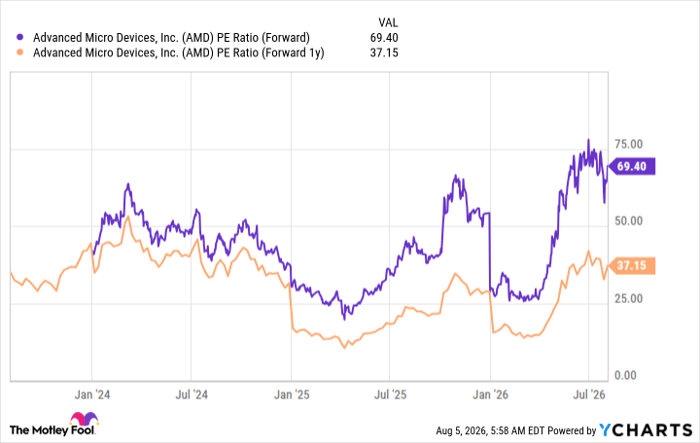
Heading into earnings, there was already a ton of success priced into AMD's stock.
AMD PE Ratio (Forward) data by YCharts
At nearly 70 times forward earnings and 37 times 2027 earnings, AMD's stock is far from cheap, even after a year and a half of growth is priced in. Now, let's compare it to Nvidia.
Nvidia trades for 32 times trailing earnings, meaning it has already generated these profits. Investors have to price in a year and a half of strong growth to get the same price tag that you can pay for Nvidia right now. That pricing mismatch makes investors choose Nvidia over AMD. The only way AMD was going to come out of this quarter ahead was if it blew expectations out of the water and impressed investors. It didn't do that, so the stock sold off.
So, is AMD a buy following the sell-off? I'd say no. Nvidia is still a much better value and will likely surpass AMD's overall growth rate in the coming quarter. AMD isn't a bad company by any means, but its stock was mispriced over the past year, and it could take a serious correction to get it to the right level before it's an attractive buy again.
Should you buy stock in Advanced Micro Devices right now?
Before you buy stock in Advanced Micro Devices, consider this:
The Motley Fool Stock Advisor analyst team just identified what they believe are the 10 best stocks for investors to buy now… and Advanced Micro Devices wasn’t one of them. The 10 stocks that made the cut could produce monster returns in the coming years.
Consider when Netflix made this list on December 17, 2004... if you invested $1,000 at the time of our recommendation, you’d have $397,405!* Or when Nvidia made this list on April 15, 2005... if you invested $1,000 at the time of our recommendation, you’d have $1,344,091!*
Now, it’s worth noting Stock Advisor’s total average return is 953% — a market-crushing outperformance compared to 214% for the S&P 500. Don't miss the latest top 10 list, available with Stock Advisor, and join an investing community built by individual investors for individual investors.
See the 10 stocks »
*Stock Advisor returns as of August 8, 2026.
Keithen Drury has positions in Nvidia. The Motley Fool has positions in and recommends Advanced Micro Devices and Nvidia. The Motley Fool has a disclosure policy.
Recommended Articles


