




SpaceX Stock Is Down 50% From Its Peak. Here's 1 Reason to Buy the Dip, and 1 Reason to Run for the Hills.
Key Points
Space Exploration Technologies is Elon Musk's rocket launch, satellite internet, and artificial intelligence company.
SpaceX went public on June 12, and it has already taken investors on a wild ride.
SpaceX has a huge opportunity in front of it, but its stock is trading at a sky-high valuation, which could limit its potential gains in the near term.
- 10 stocks we like better than Space Exploration Technologies ›
Elon Musk's Space Exploration Technologies (NASDAQ: SPCX) went public on June 12. SpaceX stock quickly rallied to a record high of $225, but it has since lost 50% of its value and is trading at about $110 (as of Aug. 6).
SpaceX has the potential to create tremendous long-term value for shareholders through its rocket launch, satellite internet connectivity, and artificial intelligence (AI) businesses, but its stock is plummeting right now for a perfectly logical reason: valuation.
Missed Nvidia in 2009? This Rare Signal Is Flashing Again. In 2009, a "Double Down" signal flashed for a little-known chipmaker called Nvidia. For the first time in years, that same "Total Conviction" signal is flashing for a company 1/100th the size of Nvidia. Continue »
Here's one reason investors might want to buy the recent dip and one reason to steer clear.
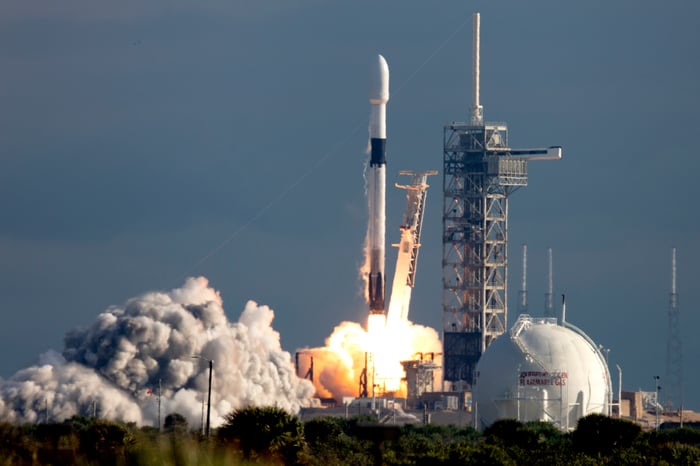
Image source: Getty Images.
The reason to buy SpaceX stock: A $28.5 trillion addressable market
SpaceX believes it has a $28.5 trillion opportunity across its three core businesses, broken down as follows:
- Space transportation: $370 billion. SpaceX currently uses its Falcon 9 and Falcon Heavy reusable rockets to launch commercial payloads into space on behalf of other businesses.
- Satellite connectivity: $1.6 trillion. The company launches its own Starlink satellites into orbit, which provide internet connectivity to paying customers here on Earth.
- Artificial intelligence: $26.5 trillion. SpaceX acquired a series of AI data centers when it bought Elon Musk's xAI start-up earlier this year. It uses them to further develop the Grok AI models, but it also rents spare capacity to other businesses for lucrative fees.
On the space transportation side, SpaceX currently launches about 2,500 tons worth of commercial payloads per year into orbit using its Falcon rockets, which already gives the company a market share of almost 90%. But Musk thinks SpaceX will eventually launch between 1 million and 10 million tons per year into orbit, as companies race to send advanced satellites and even AI infrastructure into space. This presents the market leader with a huge opportunity.
Connectivity is currently SpaceX's largest business by revenue (which I'll discuss further in a moment). As of June 30, Starlink satellites were beaming internet access to 12 million paying customers, double the 6 million people who were using the service at the same time last year. The company will begin launching its V3 Starlink satellites into orbit later this year, which offer 10 times the bandwidth of its current V2 satellites. This could accelerate uptake among businesses and consumers.
But SpaceX's biggest opportunity could be in AI, spanning infrastructure, consumer subscriptions, and enterprise applications. The infrastructure piece is the most compelling, in my opinion, because SpaceX recently signed several multibillion-dollar deals to rent computing capacity from other AI companies, including Anthropic, Alphabet, and Reflection AI.
Using a variation of Nvidia's new Vera Rubin computing systems, SpaceX will soon host AI infrastructure in space using a new kind of satellite called Starmind. It will beam data back to Earth via the existing Starlink satellite network, so the company is miles ahead of any competitors trying to enter this part of the AI market, as it already has distribution infrastructure in place.
The reason to avoid SpaceX stock: Valuation
SpaceX generated $7.8 billion in revenue during the second quarter of 2026, which was a whopping 92% increase from the year-ago period. It was broken down as follows:
|
Segment |
Q2 Revenue |
Revenue Growth (Year Over Year) |
|---|---|---|
|
Space |
$0.96 billion |
29% |
|
Connectivity |
$4.29 billion |
66% |
|
AI |
$2.56 billion |
247% |
Data source: SpaceX. Table by author.
While connectivity was SpaceX's largest business by revenue, AI is rapidly closing the gap. In fact, the company recently signed a series of contracts to rent computing capacity to other AI developers worth $6.7 billion over six months starting in October -- on top of its existing revenue.
The AI business is growing so fast that SpaceX Chief Financial Officer Bret Johnsen believes it could reach a $100 billion annual revenue run rate by the end of 2026. If that happens, the valuation problem I'm about to highlight might not be a problem.
Right now, SpaceX's trailing-12-month revenue is just $23 billion. Against a market capitalization of almost $1.5 trillion, that translates to a price-to-sales (P/S) ratio of 65. That makes SpaceX 10 times more expensive than the Nasdaq-100, which has a P/S ratio of 6.4, so it's heavily overvalued from that perspective.
But SpaceX's forward P/S ratio could be as low as 10 if we assume the AI business will generate $100 billion in revenue in 2027 and the space and connectivity businesses deliver modest growth. That valuation looks more reasonable, but investors who buy the stock today have to believe the AI forecast will actually come to fruition. Not even Alphabet's Google Cloud has generated $100 billion in annual revenue from renting AI capacity yet, and it's one of the biggest names in the business.
As a result, SpaceX's valuation might be one reason to wait on the sidelines for a few more quarters as the AI story unfolds.
Should you buy stock in Space Exploration Technologies right now?
Before you buy stock in Space Exploration Technologies, consider this:
The Motley Fool Stock Advisor analyst team just identified what they believe are the 10 best stocks for investors to buy now… and Space Exploration Technologies wasn’t one of them. The 10 stocks that made the cut could produce monster returns in the coming years.
Consider when Netflix made this list on December 17, 2004... if you invested $1,000 at the time of our recommendation, you’d have $400,155!* Or when Nvidia made this list on April 15, 2005... if you invested $1,000 at the time of our recommendation, you’d have $1,345,502!*
Now, it’s worth noting Stock Advisor’s total average return is 955% — a market-crushing outperformance compared to 214% for the S&P 500. Don't miss the latest top 10 list, available with Stock Advisor, and join an investing community built by individual investors for individual investors.
See the 10 stocks »
*Stock Advisor returns as of August 7, 2026.
Anthony Di Pizio has no position in any of the stocks mentioned. The Motley Fool has positions in and recommends Alphabet and Nvidia. The Motley Fool has a disclosure policy.
Recommended Articles


