




No Forward-Looking Guidance Needed: Fed Chair Kevin Warsh Just Outlined His Inflation Plan in 9 Words
Key Points
Kevin Warsh has wasted little time implementing sweeping reforms as head of the Federal Reserve.
Warsh has ended a more-than-two-decade-long tradition of including forward-looking guidance in Federal Open Market Committee (FOMC) meeting statements.
Despite this reduced transparency, Warsh recently shared his inflation game plan with the press.
- 10 stocks we like better than S&P 500 Index ›
This has been a history-filled year on Wall Street, and there are still nearly five months to go. We've watched the Dow Jones Industrial Average (DJINDICES: ^DJI), S&P 500 (SNPINDEX: ^GSPC), and Nasdaq Composite (NASDAQINDEX: ^IXIC) launch to new highs, and borne witness to the largest initial public offering in the stock market's storied history.
But the milestone moment that's reverberated throughout Wall Street is Kevin Warsh being sworn in as only the 17th chair since the Federal Reserve's founding in December 1913.
Where to invest $1,000 right now? Our analyst team just revealed what they believe are the 10 best stocks to buy right now, when you join Stock Advisor. See the stocks »
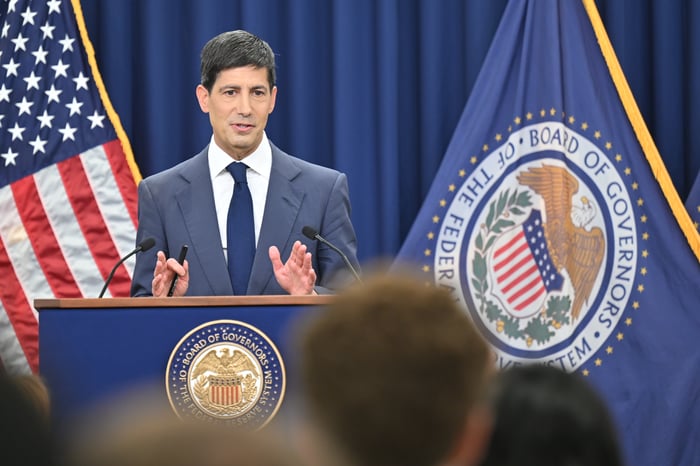
Fed Chair Kevin Warsh is making significant changes at the central bank. Image source: Official Federal Reserve Photo.
During Warsh's swearing-in ceremony at the White House, he promised to lead a reform-oriented Fed, and he's begun delivering on that promise. Although one of his key central bank reforms has minimized transparency, this hasn't stopped the new Fed chair from showing his proverbial cards to Wall Street on inflation.
Kevin Warsh has ditched forward-looking guidance in FOMC statements
During Warsh's testimony before the Senate Banking Committee in April, he outlined several changes he'd make as head of the Fed. He criticized the Fed's bloated balance sheet and intimated that it needed to be deleveraged, and argued that policymakers should change how they think about inflation.
Since being sworn in on May 22, Warsh has made a few notable changes. He launched five independent task forces to help the Federal Open Market Committee (FOMC) improve its monetary policy oversight, and, perhaps most importantly, he ditched forward-looking guidance in FOMC statements.
BREAKING: Fed Chair Kevin Warsh announces that the Fed has "dropped" forward guidance.
-- The Kobeissi Letter (@KobeissiLetter) June 17, 2026
"Forward guidance is not the business we should be in," he says.
Providing guidance as to whether FOMC policymakers are leaning toward easing or hiking interest rates has been a staple of FOMC meeting statements for more than two decades. Wall Street and investors have come to appreciate this transparency.
However, Fed Chair Warsh believes that forward-looking guidance can restrict the FOMC's policy decisions. Instead, he prefers that equity and bond markets react to economic data and not rumors.

Image source: Getty Images.
The new Fed chair just spilled the beans on his inflation plan
As you might imagine, there's been some pushback against this lack of transparency from America's foremost financial institution. But while we may not be getting as much commentary as we're historically accustomed to, it doesn't mean that Kevin Warsh hasn't spilled the beans about his plan to tackle above-average inflation.
Warsh has spent the better part of his first 11 weeks in charge reiterating that he and his colleagues will "deliver price stability" amid several so-called "economic shocks." During his press conference after the July 28-29 FOMC meeting, he responded to a question from CNBC's Steve Liesman about the absence of forward guidance by stating the following:
The message from markets is the message from markets... Letting buyers and sellers meet at prices for Treasuries, for the foreign exchange value of the dollar, and then trying to judge for ourselves, what does that mean about our remit?
These nine words, "Letting buyers and sellers meet at prices for Treasuries," sum up the Warsh's current wait-and-see approach to inflation.
While three FOMC policymakers dissented at the latest meeting in favor of raising the federal funds target rate by 25 basis points, the rapid rise in yields at the long end of the yield curve (10-year and 30-year Treasury bonds) is increasing borrowing costs and doing some of the legwork for the central bank in fighting inflation.
Although rate hikes remain firmly on the table, the new Fed chair appears content to let the bond market dictate the path forward in the fight against inflation.
Should you buy stock in S&P 500 Index right now?
Before you buy stock in S&P 500 Index, consider this:
The Motley Fool Stock Advisor analyst team just identified what they believe are the 10 best stocks for investors to buy now… and S&P 500 Index wasn’t one of them. The 10 stocks that made the cut could produce monster returns in the coming years.
Consider when Netflix made this list on December 17, 2004... if you invested $1,000 at the time of our recommendation, you’d have $400,155!* Or when Nvidia made this list on April 15, 2005... if you invested $1,000 at the time of our recommendation, you’d have $1,345,502!*
Now, it’s worth noting Stock Advisor’s total average return is 955% — a market-crushing outperformance compared to 214% for the S&P 500. Don't miss the latest top 10 list, available with Stock Advisor, and join an investing community built by individual investors for individual investors.
See the 10 stocks »
*Stock Advisor returns as of August 7, 2026.
Sean Williams has no position in any of the stocks mentioned. The Motley Fool has no position in any of the stocks mentioned. The Motley Fool has a disclosure policy.
Recommended Articles


