




SK Hynix Raises $26.5 Billion in the Second-Biggest Share Sale Ever
Key Points
The South Korean company's historic U.S. debut highlights surging AI demand.
SK Hynix supplies Nvidia and controls more than half of the HBM market.
Despite robust AI demand, memory stocks have recently entered a bear market.
- These 10 stocks could mint the next wave of millionaires ›
The South Korean memory-chip powerhouse SK Hynix (NASDAQ: SKHY) made a splashy arrival on American markets last Friday, raising $26.5 billion in a Nasdaq share offering that ranks among the largest of all time.
The company sold 177.9 million American depositary receipts -- a way for U.S. investors to own a foreign stock in dollars, with every 10 receipts representing one Seoul-listed share -- at $149 apiece. Demand was ferocious; orders reportedly ran to roughly seven times the shares on offer, and early indications pointed to the stock opening about 17% above its offering price.
Missed Nvidia in 2009? This Rare Signal Is Flashing Again. In 2009, a "Double Down" signal flashed for a little-known chipmaker called Nvidia. For the first time in years, that same "Total Conviction" signal is flashing for a company 1/100th the size of Nvidia. Continue »
So is it too late to get in or is this still a good opportunity for investors? Let's have a look.
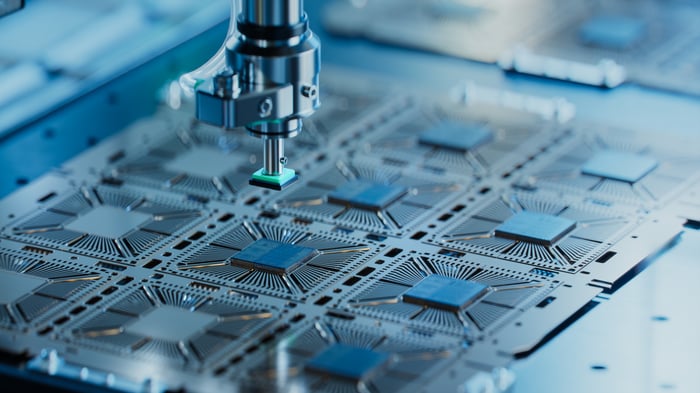
Image source: Getty Images.
A record-breaking debut
For a company that most American investors have never traded directly, this is a remarkable entrance. The deal stands as the biggest first-time U.S. listing ever by a foreign company, eclipsing Alibaba's landmark 2014 debut, and it trails only a small handful of the largest share sales in history, including last month's blockbuster listing from Space Exploration Technologies, known as SpaceX.
What I find more interesting than the raw size, though, is what it signals. SK Hynix has effectively reopened an Asia-to-Wall-Street pipeline that had gone quiet for years. Tokyo-based memory maker Kioxia Holdings is reportedly lining up its own U.S. receipts, and bankers expect more Asian technology names to weigh the same move. American listings tend to command richer valuations -- Taiwan Semiconductor Manufacturing trades at a notable premium to its Taiwan shares -- and that gap is a powerful lure.
Why SK Hynix matters to the AI trade
The reason this listing is a must-watch comes down to one product: high-bandwidth memory, or HBM. Think of an AI accelerator like a chef in a busy kitchen. It doesn't want to run to the pantry for every ingredient; it wants the most-used items stacked right next to the stove. HBM is that countertop. It is specialized memory placed alongside the processor, so data moves almost instantly, which helps keep power-hungry AI models from stalling.
SK Hynix is the leader in making it, controlling more than half the HBM market by its own account, and it's a crucial supplier to Nvidia. Only two other companies compete at the top tier, Samsung Electronics and Micron Technology, and all three count Nvidia as a customer. That tight, three-player structure is part of why memory has been one of 2026's hottest corners of the chip world.
The awkward timing: a memory bear market
Here's the twist that makes this debut so intriguing. Just days before SK Hynix rang the opening bell, memory stocks tumbled into a bear market. Micron, Samsung, and SK Hynix's own Seoul-listed shares all fell from their recent highs, and roughly $1.5 trillion in chip-sector value evaporated in a couple of weeks. The strange part is that the sell-off arrived the same week Samsung reported one of its best quarters ever, a reminder that in deeply cyclical industries, investors often sell on great news because they're already looking ahead to the next slowdown.
The counterpoint is that this looks more like a healthy reset within a longer memory up cycle than the start of a real downturn. The HBM shortage that's squeezing everyone from data center builders to game console makers is expected to persist into 2027, keeping the fundamental story intact even as stocks wobble.
The takeaway for investors
SK Hynix's arrival hands U.S. investors direct access to the clear leader in AI memory, and that's a genuinely useful addition to the market. But access is not the same as a green light. Memory is a boom-and-bust business, and this stock's Seoul-listed shares have already soared several hundred percent over the past year -- the kind of run that leaves little cushion if sentiment sours.
The bear market that greeted the listing is a live example of how quickly this group can turn. My honest suggestion is to watch how the new shares actually trade for a while (similar to the guidance on SpaceX's IPO), understand that you're buying into a cyclical industry near a euphoric moment, and let the business results, not the debut-day headlines, guide any decision.
A record-setting IPO is exciting, but excitement has never been a substitute for doing the homework.
Where to invest $1,000 right now
When our analyst team has a stock tip, it can pay to listen. After all, Stock Advisor’s total average return is 929%* — a market-crushing outperformance compared to 211% for the S&P 500.
They just revealed what they believe are the 10 best stocks for investors to buy right now, available when you join Stock Advisor.
See the stocks »
*Stock Advisor returns as of July 13, 2026.
Micah Zimmerman has no position in any of the stocks mentioned. The Motley Fool has positions in and recommends Micron Technology, Nvidia, and Taiwan Semiconductor Manufacturing. The Motley Fool recommends Alibaba Group. The Motley Fool has a disclosure policy.
Recommended Articles


