




Micron (MU) Price Prediction: $250B US Bet, SKHY Listed at +14%, Cowen Says ‘It’s Different This Time’
TradingKey - At the end of the week, Micron Technology (NASDAQ: MU) closed at $979.30, and $982.75 in after-hours, as the stock traded in the $954 - $998 range. Micron made headlines in two different ways. First, Micron decided to expand their US Manufacturing with an investment of $250 billion by 2035 and broke ground on their megafab in New York, and second, Micron made a $3 billion dollar investment to strengthen the US Semiconductor supply-chain.
In the same timeframe, on July 10, SK Hynix began trading on the Nasdaq with the ticker SKHYV and had a record-breaking $26.5 billion IPO with a foreign company and traded up 13-14% on the first day of trading. MU is trading at $979, with an RSI of 47.47, which is neutral. Earnings are on September 22 for Q4 FY2026.
The price target is $1,014 for the week, which would push the price target to $1,103. TD Cowen stated, “it’s really different this time.” SK Hynix’s CEO stated that the memory shortage will persist beyond 2030.
The $250 Billion US Manufacturing Commitment; What the New York Concrete Pour Signals
Micron’s July 9 announcement that they would expand their commitment and invest more than $250 billion in the US by 2035 marks the largest single commitment to domestic manufacturing by any semiconductor company. This amount covers the New York megafab, where the first concrete was poured this week, Idaho fab investments, and the $3 billion strategic investment to improve the US semiconductor supply chain.
Micron’s $250 billion commitment covers nine years and, on a yearly basis, is approximately $27.8 billion for US manufacturing investments. This is significantly higher than any of Micron’s prior fiscal years and will be funded through the company’s own cash generation, CHIPS Act grants, and prepayments from multi-year Strategic Customer Agreements.
The timing is intentional. Samsung in South Korea, and SK Hynix in South Korea and China, and TSMC in Taiwan, comprise the majority of the production of advanced memory chips and logic in South East Asia, and the manufacturing of memory chips is one of the most strategically layered manufacturing operations in the technology supply chains. Micron has positioned itself to be the primary beneficiary of the MIC with its $250 billion investment, and from a politically aligned perspective, Trump’s personal stock divestiture of $1.67 million in MU supports the same thesis.
TD Cowen’s “it’s really different this time” report said that the take-or-pay non-cancelable Strategic Customer Agreements were a change from prior agreements, and because of that a cyclical memory company deserved a new valuation framework from what they had historically applied. The Cowen report also relies on supply structural constraints and is further supported by comments from the SK Hynix CEO, who said the memory chip shortage is going to last beyond 2030.
SK Hynix Listed at +14% and MU Held $979 — The Capital Rotation That Didn’t Happen
Since article 4, which described the $28 billion sale, we have analyzed the listing risks of SK Hynix and discussed the potential capital rotation headwind for MU. On July 10, SKHYV began trading, and MU dropped 1.24% to $979.30 on the same day. The listing of SK Hynix marked the largest listing of a foreign company on the U.S. markets, with a $26.5 billion sale. The 13% to 14% increase in share price for SKHYV made the event noteworthy.
A sector-wide phenomenon, and not a capital rotation from MU to SKHYV, could have been the reason for the MU decline. Concerns over an enormous capital migration and a 900% increase in the float were, at best, speculative, as no significant evidence on the listing day supported those claims. On July 8, two days prior to the listing of SKHYV, Jim Lebenthal, on the CNBC Trade Tracker, stated that he was buying more shares of Micron. Meanwhile, ClearBridge Investments took Micron as their leading AI investment and sold their positions in Microsoft and Amazon.
The cause of the failure of the rotation is more structural than incidental. SKHYV and MU cannot be viewed as substitutes for US institutional investors because SKHYV and MU offer different risk profiles for US investors. SKHYV is a Korean ADR and therefore is subject to Korean corporate governance and currency (KRW/USD) and ADR fee risks, and MU is a domestic large-cap stock with the greatest memory of any US stock in the S&P 500. A five-star TipRanks analyst has issued a price target of $1,600 on MU because of the expected impact of supply on the stock price through 2028. BofA said on July 9 that “the market is underestimating Micron stock.” MU's guidance for Q4 of $50 billion in revenue and 86% gross margin means MU will earn more in the next quarter than the total revenue the Company earned in fiscal 2024.
MU Technical Setup — Channel at $982, Trigger $1,014 for the Week Ahead
Looking at the 4H chart, MU is trading at $982.75 (after-hours) and is breaking the ascending channel with its EMA200 at $743.02, RSI at 47.47 has no bearish divergence. The channel looks to extend to $1,033 to $1,103 should the bullish scenario play out. There’s support at $951 to $889. A confirmed close above $1,014 will extend to $1,103 with a stop set below $951.20.
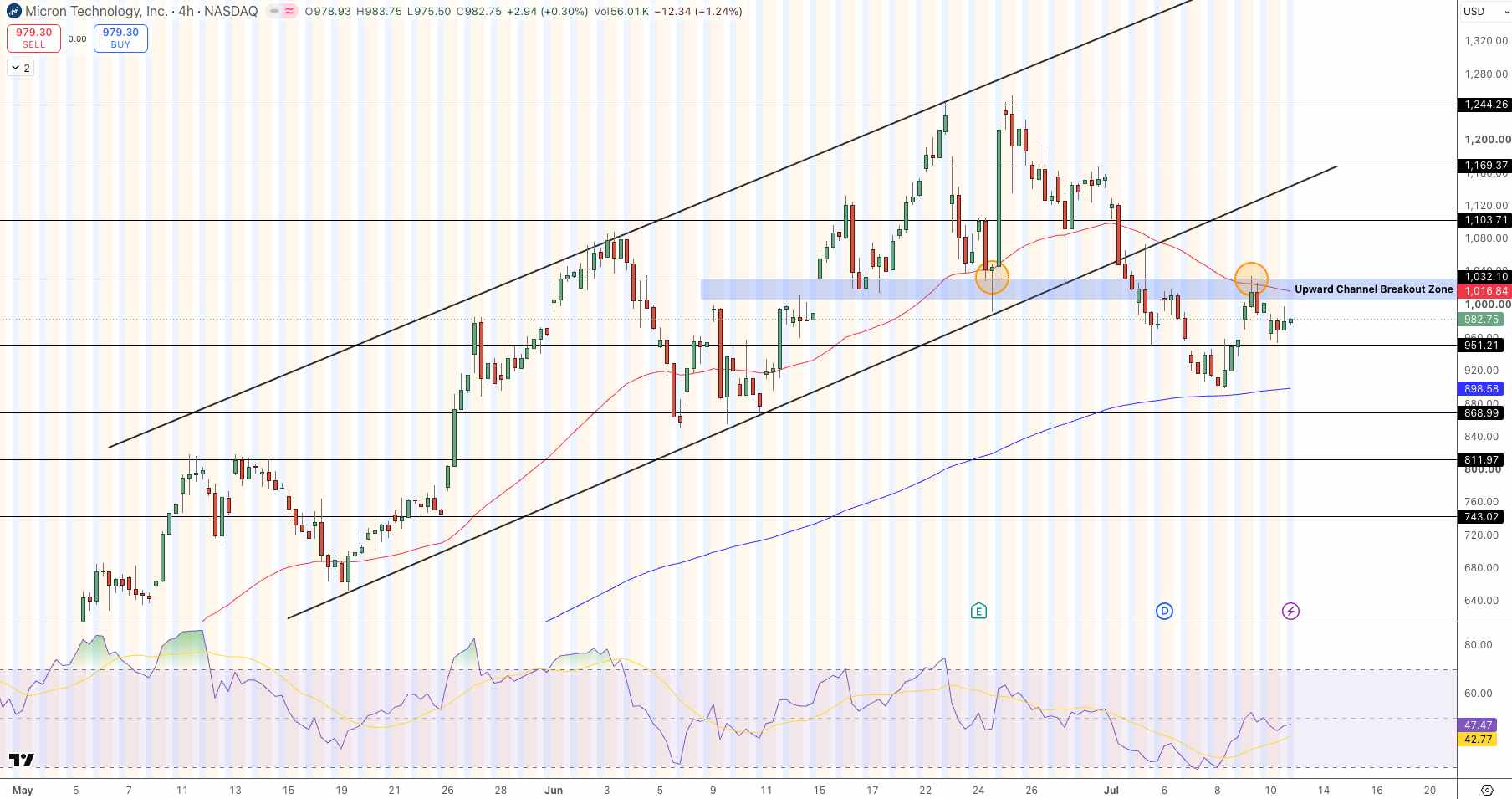
MU Price Chart - Source: Tradingview
- Trigger: Confirmed close above $1,014 for the week ahead
- Target: $1,103 — channel extension
- Stop Loss: Close < $951.20 — channel support lost
- $250B US Bet: First concrete at NY megafab. $3B supply chain investment
- SKHYV debut: +13–14% on listing day. MU fell 1.24%. No rotation
- Q4 guide: $50B revenue, 86% gross margin, $31 EPS. Q4 on Sept 22
What Is Micron’s $250 Billion US Manufacturing Commitment?
On July 9, Micron committed to an investment exceeding $250 billion in the next decade to expand its semiconductor manufacturing to the U.S. This includes the first recently poured concrete at the New York megafab, other new fabrication plants in Idaho, and a $3 billion strategic investment to begin to fill the U.S. semiconductor manufacturing supply chain for semiconductor materials, wafers, and chemicals, and tools for the fabrication and assembly of semiconductor manufacturing. Micron will fund this initiative primarily from its own cash generation and CHIPs Act grants and prepayments of strategic customers. With a commitment of nearly $28 billion a year, this is the largest commitment in U.S. history to build domestic semiconductor manufacturing.
Why Did MU Hold $979 Despite SK Hynix Listing at +14% on Nasdaq?
SK Hynix debuted on Nasdaq July 10 under SKHYV, after a $26.5 billion listing, with a first-day range of 13% to 14%. During the listing, MU only fell 1.24%, and was simply in line with overall sector weakness, and not their tilted capital outflow. This capital outflow was not expected, since SKHYV and MU cater to investors with completely different risk profiles. SKHYV is a Korean ADR and MU is a domestic large-cap stock with US operations and is included in the S&P 500. Jim Lebenthal went on CNBC and said he doubled his MU, with ClearBridge selling Microsoft and Amazon shares to buy Micron as their primary AI bet.
What Does Cowen Mean by ‘It’s Really Different This Time’ for Micron?
According to TD Cowen, with Micron there is a 'really different this time' event, which is caused by HBM Canadian customers, who sign contracts to buy Micron's entire supply, creating a shortage that may remain beyond 2030, and $50 billion in revenues for Q4 with 86% margins. Previous memory cycles had collapsing prices and contracting supply after demand, but the Strategic Contracts provide a guaranteed minimum that did not exist in prior cycles. This is the primary difference Cowen is basing his thesis on.
Bottom Line
Micron closed Friday at $982.75 and managed to contain its channel. The debut of SK Hynix on Nasdaq, with a $26.5 billion valuation, created the capital rotation that the industry was fearful of, and thus, a 1.24% decline of MU on the listing day happened instead of a structural selloff. Cowen’s argument that “this time it’s different” considers that the $250 billion US investment in manufacturing by 2035 (with the first concrete of the New York megafab already being set in place) would be a geopolitical and industrial policy anchor. The channel is intact. MU closed the week above the EMA200 at $743. The week ahead trigger is a confirmed close above $1,014, aiming at $1,103 with a stop at $951.20. A more robust catalyst is the September 22 earnings with a $50B guidance for Q4.
Recommended Articles


