




VUG vs. IWO: Can This Small-Cap ETF Keep Outperforming Major Growth Stocks?
Key Points
Recent research from Fidelity says that small-cap stocks are undervalued compared with large-cap stocks.
The iShares Russell 2000 Growth ETF delivered a 41.7% total return in the past year, strongly outperforming the S&P 500.
The Vanguard Growth ETF has delivered 18% annualized returns for 10 years, but might be too tech-heavy for investors who are concerned about valuations and want diversification.
- 10 stocks we like better than iShares Trust - iShares Russell 2000 Growth ETF ›
Which stocks do you think are delivering the biggest gains right now: the major tech stocks that are driving the artificial intelligence (AI) boom, or smaller companies that most people might not know by name? The answer might surprise you: Small-cap stocks have been on a hot streak.
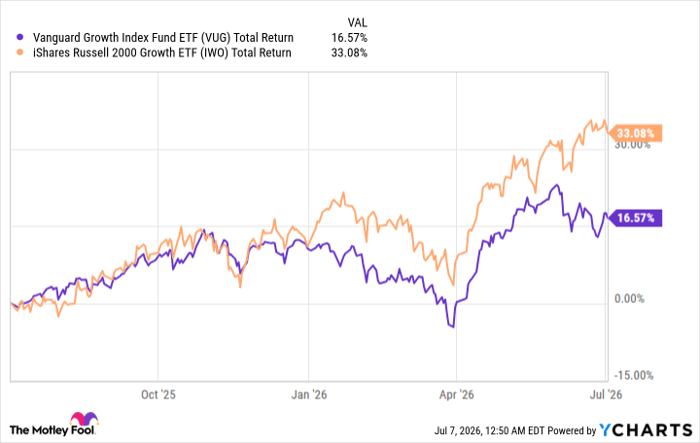
The Vanguard Growth ETF (NYSEMKT: VUG) focuses on large-cap growth stocks. Its portfolio is heavily weighted toward the tech sector and household-name tech companies. Although this fund has a strong track record, in the past year it's been strongly outperformed by the iShares Russell 2000 Growth ETF (NYSEMKT: IWO), which holds more than 1,100 small-cap growth stocks.
Where to invest $1,000 right now? Our analyst team just revealed what they believe are the 10 best stocks to buy right now, when you join Stock Advisor. See the stocks »
VUG Total Return Level data by YCharts
The small-cap ETF has delivered almost 2-to-1 returns compared with the large-cap ETF. There's no guarantee that this trend will continue, but recent research suggests that small-cap stocks could have staying power.
Let's look at these two growth stock ETFs and see whether the iShares small-cap growth ETF could be a better choice for the future.

Image source: Getty Images.
Vanguard Growth ETF (VUG): 69.6% tech stocks, 10 years of 18% annualized returns
The Vanguard Growth ETF is not as broadly diversified as some other popular Vanguard ETFs, but it holds a targeted portfolio of 154 large-cap growth stocks. The fund's portfolio is tech-heavy: 69.6% of the fund's assets are in the tech sector. The top five stock holdings are well-known tech businesses:
- Nvidia (NASDAQ: NVDA): 13.1% of the fund
- Apple (NASDAQ: AAPL): 12.3%
- Alphabet (NASDAQ: GOOG)(NASDAQ: GOOGL): 10.63% combining Class A and Class C shares
- Microsoft (NASDAQ: MSFT): 8.99%
- Broadcom (NASDAQ: AVGO): 5.17%
About 50.2% of this fund's assets are in these five stock holdings. Buying this fund involves taking a concentrated position in just a few companies, such as Alphabet, Nvidia, Microsoft, and Broadcom, that are closely involved with the AI trade.
Despite its recent underperformance against small-cap growth stocks, the Vanguard Growth ETF has a strong track record for long-term investors. It's delivered average annual returns by net asset value of 13.2% in the past five years, 18.02% in the past 10 years, and 12.08% in the past 22 years since the fund's inception in January 2004.
If you believe that major tech names are going to continue their strong momentum, this Vanguard growth ETF could be a good buy. It charges an ultralow expense ratio of 0.03% and offers an easy way to invest in a mix of the biggest names in tech. It ranks among the best growth ETFs. But if you want to put your money into some different companies that other investors might have overlooked, the iShares small-cap growth ETF could be a better choice.
iShares Russell 2000 Growth ETF (IWO): 19.4% tech stocks, 10 years of 11.5% annualized returns
Small-cap stocks don't always underperform large-cap stocks. Even though major tech names such as the stocks held by the Vanguard Growth ETF have been market leaders for most of the past decade, smaller companies might be poised to do better for the near future.
April research from Fidelity found that U.S. small-cap stock valuations are looking historically cheap compared with large-cap stocks. Small companies are showing strong expectations for higher sales and earnings. As a result, Fidelity's research projects that small-caps now have higher than usual odds of outperforming large caps in the next five to 10 years.
The Fidelity research didn't recommend any specific ETFs, but if you believe small caps are cheap relative to large caps, the iShares Russell 2000 Growth ETF could be a good choice. This fund owns a portfolio of 1,122 stocks and charges a modest expense ratio of 0.24%. Its price-to-earnings (P/E) ratio is 25.05, trading at about a 25% discount to the Vanguard Growth ETF earnings multiple of 33.46.
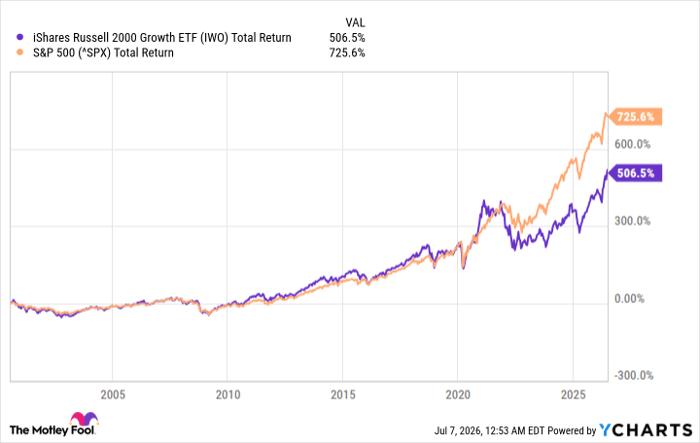
In the past 10 years, the iShares Russell 2000 Growth ETF has delivered average annual returns of 11.5%. And in the past year, it's delivered a total return of 41.7%, strongly outperforming the S&P 500 index.
But if you look at the fund's performance during some other long-term timeframes, the risks of small-cap growth stocks are clear. This small-cap growth ETF has delivered 5.72% average annual returns over the past five years and 6.84% over the (nearly) 26 years since its inception on July 24, 2000. That's significant underperformance compared with the S&P 500.
IWO Total Return Level data by YCharts
Another reason to consider the iShares Russell 2000 Growth ETF is that it's less tech-heavy. The fund's top holdings by sector are healthcare (29.2% of the fund), information technology (19.4%), industrials (16.7%), financials (9.6%), and consumer discretionary (8.7%). With this small-cap fund, you can invest in promising companies without taking such a concentrated position in the tech sector.
Why buy small-cap over large-cap growth stocks
I don't own either of these funds. But if I had to choose between the Vanguard Growth ETF (154 large-cap stocks) and the iShares Russell 2000 Growth ETF (1,122 small-cap stocks), based on valuations and overall market trends, the small-cap ETF seems like a better choice for long-term investors.
Small-cap growth stocks might have more upside. Large-cap growth stocks have had a strong run, but there's no guarantee that the same major tech names are going to beat the rest of the market for the next five to 10 years. If you believe in growth stocks, you might want to use the iShares Russell 2000 Growth ETF to diversify your portfolio into up-and-coming stocks of the future.
Should you buy stock in iShares Trust - iShares Russell 2000 Growth ETF right now?
Before you buy stock in iShares Trust - iShares Russell 2000 Growth ETF, consider this:
The Motley Fool Stock Advisor analyst team just identified what they believe are the 10 best stocks for investors to buy now… and iShares Trust - iShares Russell 2000 Growth ETF wasn’t one of them. The 10 stocks that made the cut could produce monster returns in the coming years.
Consider when Netflix made this list on December 17, 2004... if you invested $1,000 at the time of our recommendation, you’d have $410,833!* Or when Nvidia made this list on April 15, 2005... if you invested $1,000 at the time of our recommendation, you’d have $1,208,693!*
Now, it’s worth noting Stock Advisor’s total average return is 917% — a market-crushing outperformance compared to 209% for the S&P 500. Don't miss the latest top 10 list, available with Stock Advisor, and join an investing community built by individual investors for individual investors.
See the 10 stocks »
*Stock Advisor returns as of July 9, 2026.
Ben Gran has no position in any of the stocks mentioned. The Motley Fool has positions in and recommends Alphabet, Apple, Broadcom, Microsoft, Nvidia, and Vanguard Growth ETF. The Motley Fool has a disclosure policy.
Recommended Articles


