




If a Recession Is Coming, History Shows This 1 Vanguard ETF Has Never Let Investors Down.
Key Points
Many investors are feeling conflicted about the stock market right now.
History shows that an S&P 500 ETF is a fantastic long-term buy.
However, there's one key drawback to this type of investment.
- 10 stocks we like better than Vanguard S&P 500 ETF ›
The stock market is in an interesting place right now. Major indexes just closed out their best quarter in years, with the S&P 500 (SNPINDEX: ^GSPC) soaring by more than 14% since early April, as of this writing. However, investor sentiment is also growing increasingly fearful.
The Fear and Greed Index measures investor sentiment on a scale from 0 to 100, with lower numbers indicating "fear" and higher figures suggesting "greed." Since May, this index has plunged from 71 to 34, suggesting investors are exercising greater caution.
Where to invest $1,000 right now? Our analyst team just revealed what they believe are the 10 best stocks to buy right now, when you join Stock Advisor. See the stocks »
Image source: Getty Images.
To be clear, recession odds remain relatively low, despite a weakening economy. Nearly 90% of chief economists expect global growth to slow over the next year, according to the World Economic Forum's May 2026 survey, but close to 60% believe a recession is not imminent.
While a recession may not be around the corner, it's only a matter of time before we face some type of downturn -- and right now is the best time to prepare.
The powerhouse ETF with a fantastic track record
If you're looking for a consistent long-term performer, the Vanguard S&P 500 ETF (NYSEMKT: VOO) could be a fantastic choice.
This investment tracks the S&P 500, holding stocks from 500 of the largest U.S. companies. Because only large, profitable organizations are eligible to join the S&P 500, this index is well-positioned to recover from economic rough patches over time.
In fact, throughout the S&P 500's history, the ETF has ended every single 20-year period with positive total returns, according to analysis from Crestmont Research. In other words, you could have invested in an S&P 500-tracking fund at any point in history, and as long as you held it for 20 years, you'd have made money.
^SPX data by YCharts
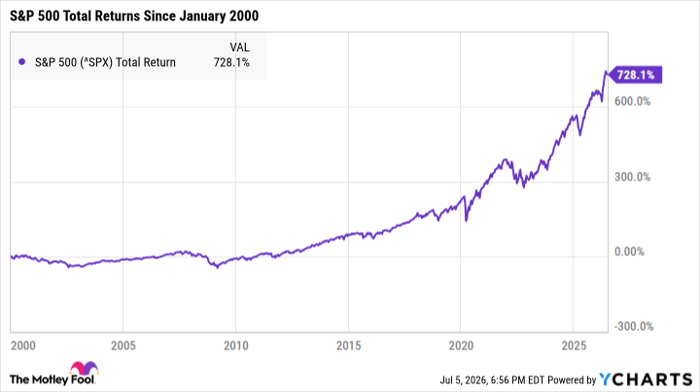
The S&P 500 has seen its fair share of volatility, too. Since 2000, for example, it's faced the dot-com bubble (leading to one of the longest bear markets in history), the Great Recession (the most severe economic downturn post-WWII), the COVID-19 crash in 2020 (the fastest market crash on record), and many more downturns along the way.
Despite all of this volatility, though, the S&P 500 has earned total returns of more than 700% since January 2000. If you'd invested $5,000 in an S&P 500 ETF back then, you'd have more than $41,000 by today.
The Vanguard S&P 500 ETF, in particular, is a smart choice for its rock-bottom fees. Its 0.03% expense ratio is among the lowest in the industry, and it could save you thousands of dollars in fees over decades compared to higher-priced ETFs.
The biggest drawback of an S&P 500 ETF
No investment is perfect, and perhaps the main downside to an S&P 500 ETF is that it will only ever earn average returns. Because it tracks a major market index, it can't beat the market itself.
Historically, the S&P 500 has earned an average annual return of around 10%. If you were investing in, say, a growth ETF earning slightly higher average returns of 12% per year, here's the difference that could make in approximate overall earnings, assuming you're investing $200 per month.
| Number of Years | Total Portfolio Value: 10% Avg. Annual Return | Total With Portfolio Value: 12% Avg. Annual Return |
|---|---|---|
| 20 | $137,000 | $173,000 |
| 25 | $236,000 | $320,000 |
| 30 | $395,000 | $579,000 |
| 35 | $650,000 | $1,036,000 |
Data source: Author's calculations via investor.gov.
For investors seeking stability and consistency, the S&P 500's average returns might be a worthwhile trade-off. Investors seeking more out of their investment, however, may prefer a growth fund or a selection of individual stocks designed to beat the market.
No one can say exactly when the next recession will begin, but it pays to prepare early. The Vanguard S&P 500 ETF is a low-cost investment option, and history suggests it's extremely likely to recover from future downturns.
Should you buy stock in Vanguard S&P 500 ETF right now?
Before you buy stock in Vanguard S&P 500 ETF, consider this:
The Motley Fool Stock Advisor analyst team just identified what they believe are the 10 best stocks for investors to buy now… and Vanguard S&P 500 ETF wasn’t one of them. The 10 stocks that made the cut could produce monster returns in the coming years.
Consider when Netflix made this list on December 17, 2004... if you invested $1,000 at the time of our recommendation, you’d have $409,970!* Or when Nvidia made this list on April 15, 2005... if you invested $1,000 at the time of our recommendation, you’d have $1,200,223!*
Now, it’s worth noting Stock Advisor’s total average return is 916% — a market-crushing outperformance compared to 210% for the S&P 500. Don't miss the latest top 10 list, available with Stock Advisor, and join an investing community built by individual investors for individual investors.
See the 10 stocks »
*Stock Advisor returns as of July 8, 2026.
Katie Brockman has positions in Vanguard S&P 500 ETF. The Motley Fool has positions in and recommends Vanguard S&P 500 ETF. The Motley Fool has a disclosure policy.
Recommended Articles


