




Earnings Surge 19-Fold Fails to Stop Profit-Taking, Samsung’s Results Drag Down Micron With Pre-Market Drop of Over 5%
TradingKey - In pre-market trading on Tuesday, Micron Technology ( MU) shares fell over 5%, dragged down by sharp declines in the stock prices of South Korean memory giants Samsung Electronics and SK Hynix.
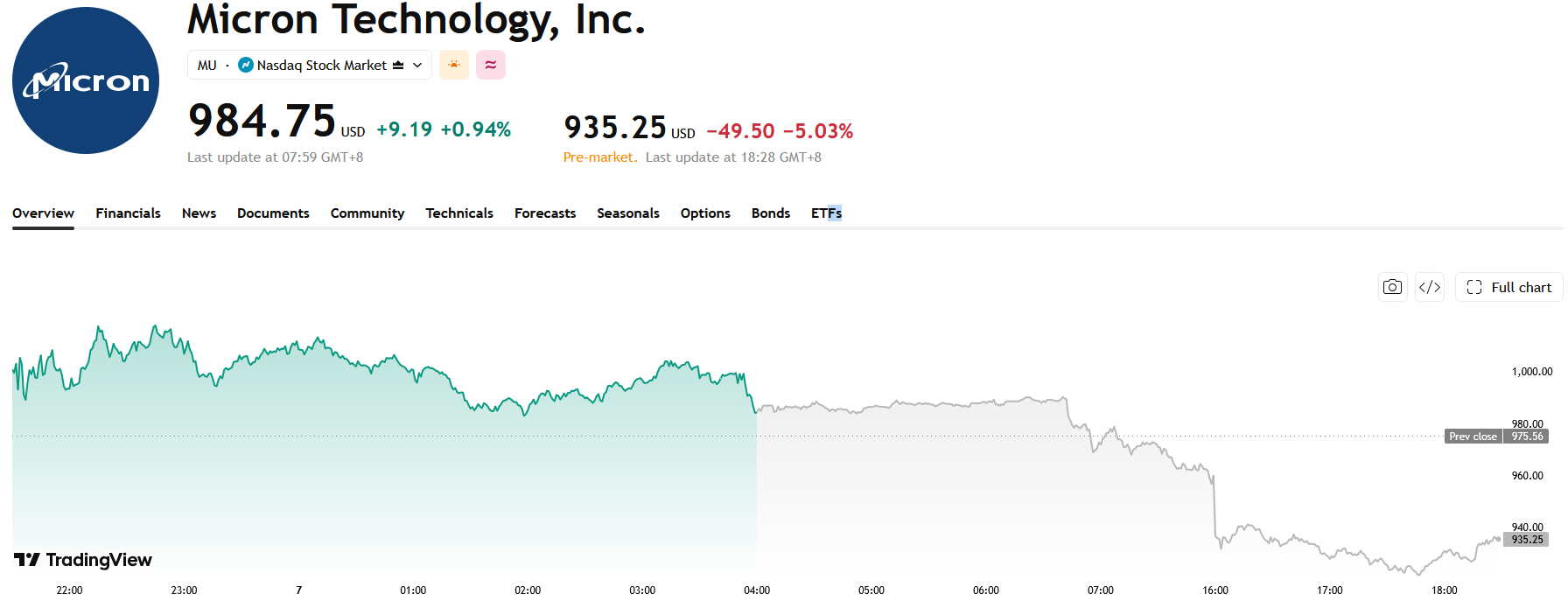
Source: TradingView
The trigger for this sector correction was Samsung Electronics' second-quarter earnings guidance, which far exceeded expectations—yet despite a staggering 19-fold year-on-year surge in operating profit, it failed to reverse the market's "sell the news" momentum.
Samsung Electronics announced that its operating profit for the April-June period is expected to reach 89.4 trillion won (approximately $58.44 billion), far higher than the 4.7 trillion won in the same period last year and beating the 87.3 trillion won projected by LSEG SmartEstimate; revenue rose 129% year-on-year to 171 trillion won.
This stellar performance was driven by the explosion in demand for memory chips fueled by artificial intelligence, particularly strong sales of High Bandwidth Memory (HBM) and server DRAM.
However, the market reacted coldly, with Samsung's stock price plunging nearly 10% intraday, while SK Hynix fell sharply in tandem, directly dragging down the share prices of peers such as Micron.
This phenomenon of "selling off despite positive earnings" is not new. Data shows that since the beginning of 2019, Samsung has beaten operating profit expectations in 16 quarters, but its stock price fell after the announcement in 10 of those instances. The market had already priced in the recovery of the memory chip industry and the explosion in AI demand well in advance. When performance milestones are realized, investors tend to take profits, leading to a "sell-on-the-fact" correction in stock prices.
Currently, Samsung is the world's largest memory chip manufacturer, and its earnings performance is viewed as an industry bellwether; this stock decline has triggered a chain reaction across the entire sector.
Beyond profit-taking, investors are also concerned about future oversupply triggered by the chip industry's aggressive expansion plans. Samsung and SK Hynix have announced combined investments of $2 trillion to expand chip capacity in South Korea, with Samsung's investment plan set to run from 2026 to 2040.
Although analysts expect the supply shortage to persist into next year, as major manufacturers gradually release their capacity, the market fears a potential oversupply in the future, which could lead to falling memory chip prices and impact corporate profitability.
Meanwhile, the latest views from Michael Wilson, Chief U.S. Equity Strategist at Morgan Stanley ( MS ), have further heightened market concerns.
In his weekly report, he explicitly advised investors to underweight the semiconductor sector and rotate into hyperscale cloud computing providers. Wilson believes the current correction in memory and chip stocks is not yet over, noting that their trajectory highly resembles that of silver—both have experienced parabolic price run-ups and are tightly linked to the commodities market, which historically suffers from severe price volatility.
This perspective suggests that the memory chip sector may have entered a temporary consolidation cycle, and the previous valuation surge driven by the AI boom faces corrective pressure.
Recommended Articles


