




Could SpaceX Surge When It Joins the Nasdaq-100? Maybe, but History Says the Bounce Won't Last.
Key Points
SpaceX's share price could jump on July 7 due to the law of supply and demand.
However, a surge isn't guaranteed -- as evidenced by recent stocks added to the Nasdaq-100.
The initial expirations of SpaceX's staggered lockup schedule could ensure that any increase is short-lived.
- 10 stocks we like better than Space Exploration Technologies ›
Have you considered buying shares of Space Exploration Technologies (NASDAQ: SPCX)? Even if you haven't, you could soon own a stake in the high-profile company. On Tuesday, July 7, 2026, millions of Americans will become SpaceX investors -- whether they wanted to or not.
SpaceX will be included in the Nasdaq-100 index only 15 trading days after its initial public offering on June 12 -- the largest IPO in stock market history. Could the space stock surge when it joins the technology-heavy index? Maybe. Even if it does, history suggests the bounce won't last long.
Where to invest $1,000 right now? Our analyst team just revealed what they believe are the 10 best stocks to buy right now, when you join Stock Advisor. See the stocks »

Image source: Getty Images.
The law of supply and demand is at work.
The logic is straightforward about why SpaceX's share price could enjoy a nice bump once the company is added to the Nasdaq-100. It's basically the law of supply and demand at work. This law states that if a product has high demand and low supply, its price will increase -- and vice versa.
SpaceX's inclusion in the Nasdaq-100 will definitely boost demand for the stock. Every exchange-traded fund (ETF) and mutual fund that seeks to track the index will have to buy shares of SpaceX. The biggest of these funds is the Invesco QQQ Trust Series 1 (NASDAQ: QQQ). This fund has roughly $481 billion in assets under management. It's also the second most-traded ETF in the U.S.
Overall, funds representing more than $800 billion in assets track the Nasdaq-100. SpaceX's initial weight in the index is estimated to be between 0.47% and 0.7%. The high end of that range means that around $7 billion of the company's shares must be bought by funds.
Now, for the supply side of the law of supply and demand. SpaceX has a remarkably low float (the number of shares available for public trading on the open market) of around 281.2 million shares. The forced buying resulting from the stock's inclusion in the Nasdaq-100 will increase demand for those shares quite a bit.
High demand. Low supply. Those are the textbook ingredients for a price increase.
More to the story
So will SpaceX's share price surge on July 7? Not necessarily. Although the law of supply and demand is ironclad, there's more to the story.
ETFs and mutual funds that track the Nasdaq-100 won't buy SpaceX stock until it's part of the index, but that doesn't mean other investors can't. Some institutional investors and arbitrageurs can buy a stock in the days and weeks between Nasdaq's (NASDAQ: NDAQ) official announcement of a new addition to the Nasdaq-100 and the change's effective date. This drives the share price up before the stock is added to the index. On the actual day the stock joins the Nasdaq-100, these early buyers sell their shares at a profit -- but the transaction price could be lower than the prior-day share price.
We don't have to look back very far to see examples of this phenomenon. On June 11, 2026, Nasdaq announced that five companies would be added to the Nasdaq-100 effective June 22, 2026: Astera Labs (NASDAQ: ALAB), CoreWeave (NASDAQ: CRWV), Nebius Group (NASDAQ: NBIS), Rocket Lab (NASDAQ: RKLB), and Teradyne (NASDAQ: TER). Four of the five stocks increased by a double-digit percentage between the two dates.
However, on the actual date the companies were added to the Nasdaq-100, three of the five stocks fell. Over the next few days, all of them declined. Shares of three of the new index members dropped significantly.
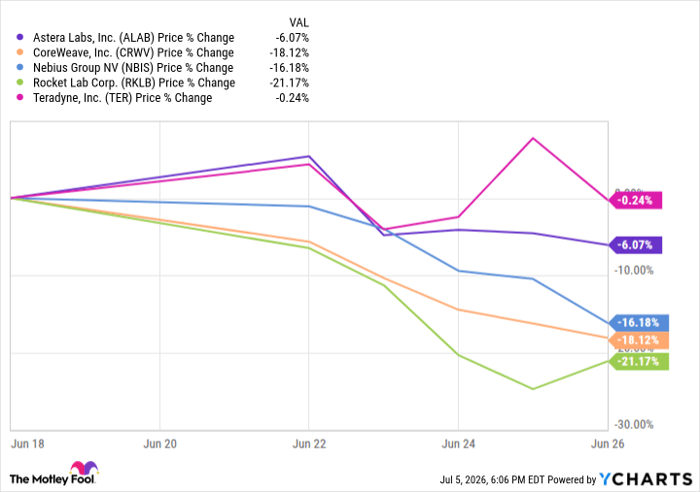
ALAB data by YCharts
If history is any guide, any SpaceX bump following its addition to the Nasdaq-100 will be short-lived. There's also another factor that could cause history to repeat itself with gusto. SpaceX's staggered lockup expiration schedule begins allowing insiders and pre-IPO investors to sell some of their shares after the company's second-quarter earnings are announced. The Q2 update could come as early as mid-July.
Is SpaceX stock a buy?
Investors hoping to score a quick gain from SpaceX's inclusion in the Nasdaq-100 are rolling the dice. That will also be true when the stock is eventually added to the S&P 500 (SNPINDEX: ^GSPC) index.
But could buying SpaceX now be a smart move for long-term investors? Again, the answer is "maybe." The company appears to have tremendous growth prospects in the satellite internet services, launch, and artificial intelligence (AI) markets. However, with the stock trading at more than 31 times projected 2027 sales, expectations of sizzling growth are already baked into the share price. Other Nasdaq-100 stocks could offer more attractive risk-reward propositions.
Should you buy stock in Space Exploration Technologies right now?
Before you buy stock in Space Exploration Technologies, consider this:
The Motley Fool Stock Advisor analyst team just identified what they believe are the 10 best stocks for investors to buy now… and Space Exploration Technologies wasn’t one of them. The 10 stocks that made the cut could produce monster returns in the coming years.
Consider when Netflix made this list on December 17, 2004... if you invested $1,000 at the time of our recommendation, you’d have $418,761!* Or when Nvidia made this list on April 15, 2005... if you invested $1,000 at the time of our recommendation, you’d have $1,195,804!*
Now, it’s worth noting Stock Advisor’s total average return is 918% — a market-crushing outperformance compared to 208% for the S&P 500. Don't miss the latest top 10 list, available with Stock Advisor, and join an investing community built by individual investors for individual investors.
See the 10 stocks »
*Stock Advisor returns as of July 6, 2026.
Keith Speights has no position in any of the stocks mentioned. The Motley Fool has positions in and recommends Rocket Lab and Teradyne. The Motley Fool recommends Astera Labs and Nasdaq. The Motley Fool has a disclosure policy.
Recommended Articles


