




He Predicted the Dot-com Bubble Burst. Now He's Saying SpaceX Could be a Fresh Warning Sign.
Key Points
Jeremy Grantham is a well-known investor, at least partly because he correctly identified the end of the Dot-com bubble.
Humans love to listen to people they consider authorities.
Grantham is warning that the AI bubble could be nearing its end.
- 10 stocks we like better than Space Exploration Technologies ›
Wall Street was fascinated by the initial public offering (IPO) of Space Exploration Technologies (NASDAQ: SPCX). Not only was it huge, raising $75 billion from investors (nearly $86 billion if you include the underwriters' overallotment), but the business seems to come straight out of a science fiction novel. According to Jeremy Grantham, that IPO could be a sign that the AI-driven rally is about to break.
Who is Jeremy Grantham?
Jeremy Grantham is the co-founder of investment firm GMO. However, his real claim to fame is that he publicly called the top of the Dot-com bubble. The market decline following that top was long and painful, with the Nasdaq dropping nearly 80% over several years. It took about 15 years for the Nadaq to regain all the ground it had lost. When Grantham is worried about a market bubble, there's a good reason to listen.
Missed Nvidia in 2009? This Rare Signal Is Flashing Again. In 2009, a "Double Down" signal flashed for a little-known chipmaker called Nvidia. For the first time in years, that same "Total Conviction" signal is flashing for a company 1/100th the size of Nvidia. Continue »

Image source: Getty Images.
He recently warned that the market is the most expensive in history during an interview with CNBC. The big story is the massive investment in artificial intelligence (AI), which is driving up AI stocks. That's similar to the overzealous investment in the internet at the turn of the century. And while SpaceX isn't technically an AI stock, it is investing in AI, and CEO Elon Musk has pitched the idea of building AI data centers in space. Grantham sees the massive IPO as another sign of a potential top, noting that internet stock IPOs were similarly big news toward the end of the 1990s.
Grantham is probably right, but what should you do about it?
The interesting thing about bear-market predictions is that they are wrong until they suddenly become correct. Bears can be wrong for a long time before quickly looking prescient, with Grantham admitting that the timing of the top he foresees is uncertain. So what is an investor to do? The quick answer is don't panic and sell everything you own, becoming a de facto market timer.
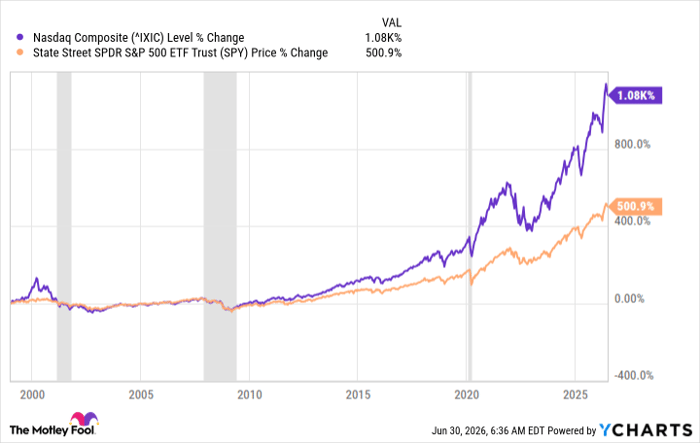
^IXIC data by YCharts
History is very clear. If you bought an S&P 500 Index (SNPINDEX: ^GSPC) fund, like SPDR S&P 500 ETF (NYSEMKT: SPY) or Vanguard S&P 500 ETF (NYSEMKT: VOO), or even the Nasdaq Composite index and simply held tight through the Dot-com crash, you would have eventually seen your investment recover and then go on to new highs. Even the Great Recession wasn't enough to stop the broader indexes from continuing their long-term upward climb.
That said, the AI bubble is a potential risk that you might want to address if you have material exposure to AI stocks. That, however, can be achieved by shifting some assets into historically resilient sectors such as consumer staples or utilities. Or, if you are worried about the market's valuation, you can simply invest in a value-oriented ETF.
Grantham is an expert, but be careful how you react
You should consider expert opinions when making investment decisions. Grantham qualifies as an expert in investing. However, you shouldn't blindly follow any advice. You need to make sure you invest in a way that makes sense to you and aligns with the market's long-term history. A buy-and-hold approach has been a long-term winner for most investors.
You may want to make changes at the edges, like reducing AI exposure, but dumping your stocks in the hope of avoiding the downturn (and knowing the right time to buy back in) is likely to be a mistake. That's market timing, which very few investors have managed to do profitably over the long term.
Should you buy stock in Space Exploration Technologies right now?
Before you buy stock in Space Exploration Technologies, consider this:
The Motley Fool Stock Advisor analyst team just identified what they believe are the 10 best stocks for investors to buy now… and Space Exploration Technologies wasn’t one of them. The 10 stocks that made the cut could produce monster returns in the coming years.
Consider when Netflix made this list on December 17, 2004... if you invested $1,000 at the time of our recommendation, you’d have $418,761!* Or when Nvidia made this list on April 15, 2005... if you invested $1,000 at the time of our recommendation, you’d have $1,195,804!*
Now, it’s worth noting Stock Advisor’s total average return is 918% — a market-crushing outperformance compared to 208% for the S&P 500. Don't miss the latest top 10 list, available with Stock Advisor, and join an investing community built by individual investors for individual investors.
See the 10 stocks »
*Stock Advisor returns as of July 3, 2026.
Reuben Gregg Brewer has no position in any of the stocks mentioned. The Motley Fool has positions in and recommends Vanguard S&P 500 ETF. The Motley Fool has a disclosure policy.
Recommended Articles


