




Should You Buy Gold After Its Recent Dip Below $4,000?
Key Points
Gold soared by 64% last year, as investors flocked to safe-haven assets amid rising economic and political uncertainty.
The shiny yellow metal has since plummeted by 27% from its all-time high amid the looming threat of tighter financial conditions.
Gold is probably still a good long-term investment, but investors should temper their expectations.
- 10 stocks we like better than SPDR Gold Shares ›
Gold is one of the oldest forms of currency, and it's still accepted as payment for goods and services in many U.S. states today. But you probably won't see anyone trading the shiny yellow metal for groceries or gas, given its steadily rising value. In fact, gold hit a record high of $5,418 per ounce in January after benefiting from a series of political and economic tailwinds last year.
But it has since plummeted by 27%, trading recently below $4,000 per ounce. While conditions favor more upside from here, some headwinds on the horizon could weigh on returns.
Missed Nvidia in 2009? This Rare Signal Is Flashing Again. In 2009, a "Double Down" signal flashed for a little-known chipmaker called Nvidia. For the first time in years, that same "Total Conviction" signal is flashing for a company 1/100th the size of Nvidia. Continue »
Buying physical metal is the surest way to profit from a potential rise in gold's value, but many investors opt for exchange-traded funds (ETFs) like the SPDR Gold Trust (NYSEMKT: GLD), which can be a more convenient alternative. But no matter which method investors prefer, is now a good time to buy the shiny yellow metal?

Image source: Getty Images.
Conditions favor more upside in gold, but there's a catch
Gold soared by 64% last year, outperforming the stock market and even Bitcoin. It benefited from heightened political and economic uncertainty, sparked by the Trump administration's widespread tariffs and surging government spending, which sent investors flocking to safe-haven assets.
Throughout history, the price of an ounce of gold has climbed almost in lockstep with the money supply, meaning gold doesn't necessarily increase in value on its own; rather, it benefits from the devaluation of paper currencies. After all, the yellow metal doesn't produce any revenue or earnings, so it isn't capable of generating internal growth the same way a company can.
Until 1971, the U.S. operated on the gold standard, which prevented policymakers from printing new dollars unless the government had an equal amount of physical gold to back them. Unsurprisingly, money supply exploded after this mechanism was abandoned, and the dollar has since lost around 90% of its purchasing power.
The chart shows the very clear relationship between the decline in the dollar and the rise in the value of gold (in dollar terms).
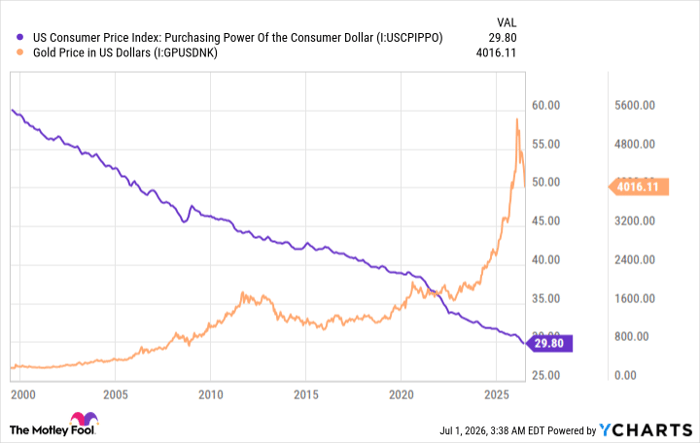
US Consumer Price Index: Purchasing Power Of the Consumer Dollar data by YCharts
The U.S. government ran a budget deficit of $1.8 trillion in fiscal 2025 (ended Sept. 30), and it's on track for another trillion-dollar deficit in fiscal 2026. As a result, the national debt is inching toward a record high of $40 trillion. Throughout history, many governments have resolved high debts by devaluing their domestic currency to make repayment more manageable. By stoking inflation, wages and corporate income rise, thereby increasing the tax base.
Many investors fear the U.S. will go down that road, which is why they flocked to gold last year. But sentiment shifted over the last few months because a spike in inflation forced the Federal Reserve to adopt a hawkish tone. According to the CME Group's FedWatch tool, Wall Street is now pricing in at least one interest rate hike this year.
Rising interest rates force everyone -- including policymakers in the U.S. government -- to tighten their belts. As a result, investors have started pricing in a less aggressive expansion in money supply, at least for now, which means they are paring their bets on gold.
Investors should manage their expectations going forward
It certainly isn't normal for gold to increase in value by 64% in a single year. In fact, it has only returned an average of 7.2% per year over the last 50 years, so investors actually would have been better off owning stocks, because the S&P 500 (SNPINDEX: ^GSPC) returned 11.9% per year over the same period.
A weak U.S. dollar lifts all assets, not just gold. Plus, stocks deliver internal growth because the underlying companies generate revenue and earnings; hence, the higher returns in the S&P 500. Stocks tend to perform poorly during periods of rising interest rates, just as gold does, but they should still do better than the yellow metal precisely because many companies continue to grow even when financial conditions are tight.
I'm not suggesting it's a good idea to disregard gold and own stocks exclusively. Most experts suggest a diversified portfolio in which gold makes up 5% to 15% of total assets, ensuring investors have some exposure during periods when safe-haven assets are in high demand.
Owning physical gold requires storage and insurance costs, and it can be tough to sell quickly in a pinch. Investing in the SPDR Gold Shares ETF might be a more convenient option for most people, as it can be bought and sold instantly on any major stock trading platform and has relatively low costs. It has an expense ratio of 0.4%, so an investment of $10,000 would incur an annual fee of just $40.
Should you buy stock in SPDR Gold Shares right now?
Before you buy stock in SPDR Gold Shares, consider this:
The Motley Fool Stock Advisor analyst team just identified what they believe are the 10 best stocks for investors to buy now… and SPDR Gold Shares wasn’t one of them. The 10 stocks that made the cut could produce monster returns in the coming years.
Consider when Netflix made this list on December 17, 2004... if you invested $1,000 at the time of our recommendation, you’d have $400,101!* Or when Nvidia made this list on April 15, 2005... if you invested $1,000 at the time of our recommendation, you’d have $1,212,683!*
Now, it’s worth noting Stock Advisor’s total average return is 911% — a market-crushing outperformance compared to 208% for the S&P 500. Don't miss the latest top 10 list, available with Stock Advisor, and join an investing community built by individual investors for individual investors.
See the 10 stocks »
*Stock Advisor returns as of July 2, 2026.
Anthony Di Pizio has no position in any of the stocks mentioned. The Motley Fool has positions in and recommends Bitcoin and CME Group. The Motley Fool has a disclosure policy.
Recommended Articles


