




New Fed Chair Kevin Warsh Recently Said 36 Words That Could Forever Change the Fed's Relationship With the Stock Market
Key Points
The market got its first preview of what the Kevin Warsh regime will look like at the Federal Open Market Committee's (FOMC) June meeting.
The Warsh-led FOMC issued a much smaller policy statement than normal.
Warsh also abstained from the FOMC's Summary of Economic Projections.
- These 10 stocks could mint the next wave of millionaires ›
From the moment the Senate confirmed Kevin Warsh as the newest chair of the Federal Reserve's Board of Governors, most Fed watchers could clearly see that change was coming.
However, it wasn't clear just how quickly things could change until Warsh's first meeting as chair of the Federal Open Market Committee (FOMC), which sets monetary policy.
Missed Nvidia in 2009? This Rare Signal Is Flashing Again. In 2009, a "Double Down" signal flashed for a little-known chipmaker called Nvidia. For the first time in years, that same "Total Conviction" signal is flashing for a company 1/100th the size of Nvidia. Continue »
Warsh took several notable steps at the FOMC's June meeting that have begun to lay the groundwork for what appears to be a clear-cut regime change. Warsh just said 36 words that could forever change the Fed's relationship with the stock market.
Warsh plans to run a lower-profile Fed
Since the Great Recession, the Federal Reserve has been much more communicative with the public, probably because the public lost much of its faith in the mainstream financial system after the events of 2008, which destroyed trillions of dollars in wealth and altered the trajectories of many people's lives.
But since then, many, like Warsh, argue the Fed has taken too active a role in the financial markets. There has been more communication about how the Fed is thinking about the economy and interest rates. The Fed's balance sheet has also ballooned, injecting trillions of dollars' worth of liquidity into the economy.
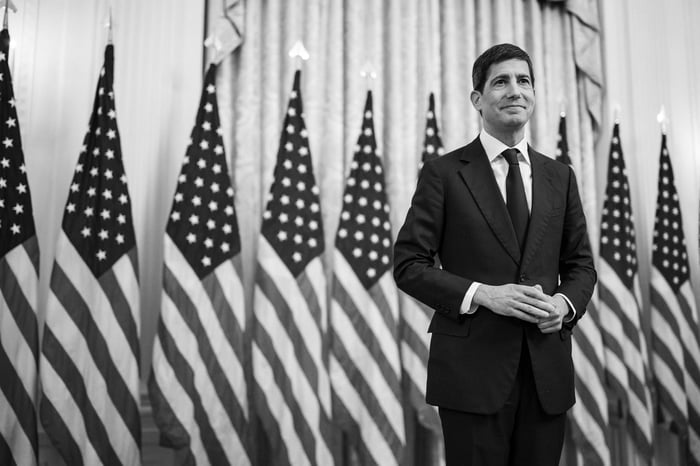
Official White House photo by Daniel Torok.
"So I think financial markets perform best when they react to incoming data," Warsh said during a press conference following the FOMC's June meeting on June 17. "I think the financial markets work less efficiently when they ask a question: 'How will the Federal Reserve react to that incoming information?'"
These 36 words could drastically change the Fed's relationship with the stock market and make the agency far less communicative than it has been in a long time.
Warsh has publicly said in previous congressional testimony that he believes interest rates are a monetary tool that can benefit the broader economy, whereas using the balance sheet as a monetary policy tool "disproportionately helps those with financial assets."
Warsh sent a clear signal that the Fed's buddy-buddy relationship with the market could be coming to an end, when the FOMC released a much shorter policy statement for the June meeting, at only 131 words.
The FOMC policy statement announces the Fed's interest rate decision, outlines high-level views on the economy, and often explains its monetary policy stance. The FOMC's April policy statement had been 341 words.
The shortened FOMC policy statement aligns with Warsh's desire to be less forthcoming to the market about the Fed's monetary policy stance.
For instance, in the April policy statement, the FOMC wrote, "The committee would be prepared to adjust the stance of monetary policy as appropriate if risks emerge that could impede the attainment of the committee's goals."
But in the June policy statement, the FOMC wrote, "The committee will deliver price stability."
Now, the statement made at the April meeting is often viewed as an easing bias, so it's possible the FOMC removed it because inflation has recently moved higher and it no longer views a rate cut as the Fed's next likely move. But overall, it seems we could see shorter, less detailed FOMC statements.
Other signs the Fed will be quieter
Not only was the FOMC statement shorter, but Warsh also did not participate in the FOMC's Summary of Economic Projections, breaking a 14-year precedent of the FOMC chair.
Warsh also announced several new task forces that will examine broad parts of the Fed, including communications. There could be more news on this front at the Fed's next meeting in late July.
Ultimately, these are significant changes for the Fed that will significantly affect the market. If the Fed is less communicative with the market, some of its decisions could become bigger surprises, increasing volatility. So investors should be more aware of the situation as they head into future FOMC meetings and decisions.
It's still early. Ultimately, this could be the beginning of many changes from Warsh.
Where to invest $1,000 right now
When our analyst team has a stock tip, it can pay to listen. After all, Stock Advisor’s total average return is 902%* — a market-crushing outperformance compared to 209% for the S&P 500.
They just revealed what they believe are the 10 best stocks for investors to buy right now, available when you join Stock Advisor.
See the stocks »
*Stock Advisor returns as of July 2, 2026.
The Motley Fool has a disclosure policy.
Recommended Articles


