




If a Stock Market Crash Is Coming, Should You Buy More Bonds? New Research Might Make You Think Twice.
Key Points
Recent research from the IMF says that bonds might not be a good way to diversify in case of a stock market downturn.
Buying precious metals and rare-earth ETFs could add commodities to your portfolio.
The iShares Silver Trust offers a better recent track record during stock market downturns.
- 10 stocks we like better than iShares Silver Trust ›
Are bonds still a "safe" place to invest in case of a stock market crash? According to recent research from the International Monetary Fund (IMF), maybe not. February research on stock-bond diversification found that bonds and stocks have become more positively correlated since 2019.
That means the old rule of thumb that "when stocks go down, bonds go up" might no longer apply. Many investors (including me) own bond exchange-traded funds (ETFs) such as the Vanguard Total Bond Market ETF as part of a diversified portfolio strategy. But buying bonds might not be an effective way to protect against a stock market downturn.
Missed Nvidia in 2009? This Rare Signal Is Flashing Again. In 2009, a "Double Down" signal flashed for a little-known chipmaker called Nvidia. For the first time in years, that same "Total Conviction" signal is flashing for a company 1/100th the size of Nvidia. Continue »
How should you invest if buying bonds is no longer a good strategy to diversify your portfolio? The IMF's research didn't recommend any specific investments or ETFs, but it did note that including commodities in an investor's portfolio could help protect against a potential shift in correlations.
An easy way to buy commodities like precious metals is to buy the iShares Silver Trust (NYSEMKT: SLV) or the VanEck Rare Earth and Strategic Metals ETF (NYSEMKT: REMX). These ETFs offer risks as well as upside. But if you're interested in diversifying your portfolio away from the usual mix of stocks and bonds, they could be worth a look.
Let's look at each of these precious metals ETFs and see which one could be a better choice.
Image source: Getty Images.
iShares Silver Trust (SLV): 21.75% annualized returns for five years
The iShares Silver Trust is not like a typical ETF of stocks or bonds. This fund doesn't hold any stocks. Instead, it tracks the price performance of silver bullion. Buying this fund is a way to invest in silver without having to hold silver bars or coins.
During the past five years, this fund has delivered average annual total returns of 21.75%, outperforming the S&P 500 index and the tech-heavy Nasdaq-100 index. It charges a sponsor fee of 0.5%.
Silver has had a massive price run-up recently. In 2025, this fund delivered a whopping annual total return of 147.9%. Strong recent demand for silver has been driven by investor concerns about higher inflation and increased levels of government debt; silver is also used in industrial processes such as building solar panels.
But what goes up can also go down. This precious metals fund has lost about 50% of its value since hitting an all-time high in January. Just like buying gold, buying silver can put investors at risk for high volatility and big price declines. And since the iShares Silver Trust ETF doesn't hold stocks, it doesn't pay dividends. Buying this silver ETF is purely a bet that the price of silver will go up. If it doesn't, investors will be disappointed.
VanEck Rare Earth and Strategic Metals ETF (REMX): -2.67% annualized returns for 15 years
The VanEck Rare Earth and Strategic Metals ETF offers a portfolio of stocks in companies involved in the production, refining, and recycling of rare-earth and strategic metals and minerals. This fund has delivered year-to-date returns of 17%, outperforming the S&P 500 and the Nasdaq-100. This rare-earth ETF has delivered average annual returns (by net asset value) of 10.9% in the past 10 years.
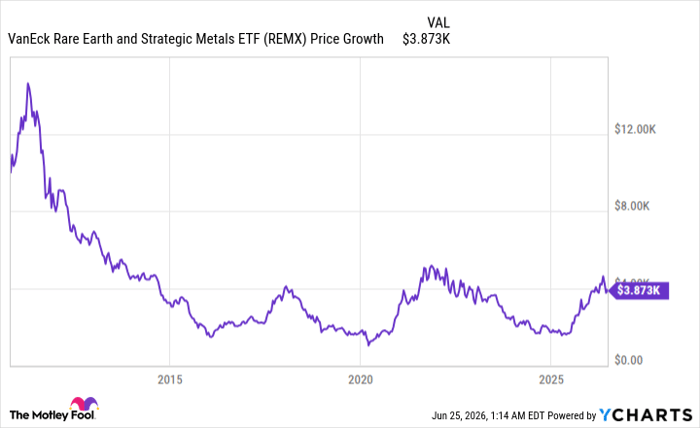
But over the longer term, its performance is less impressive. Since the fund's inception in October 2010, it has lost money -- with an average annual return of -2.67% over the past (nearly) 16 years. If you had invested $10,000 in this fund on its first day in October 2010, that investment would be worth $3,876 today.
REMX data by YCharts
But the future of rare-earth materials might be brighter. Many advanced technologies like electronic devices, electric vehicle batteries, motors, and wind turbines, include components like semiconductors and magnets that are made with rare-earth metals and minerals. The artificial intelligence (AI) boom also relies on rare-earth materials as part of its supply chain for data centers.
The VanEck Rare Earth and Strategic Metals ETF gives investors exposure to a portfolio of 37 stocks of companies that mine and refine these precious metals and minerals across 10 countries. It charges a gross expense ratio of 0.53%, which includes a management fee.
Why buy SLV or REMX: Hedge against a stock market crash
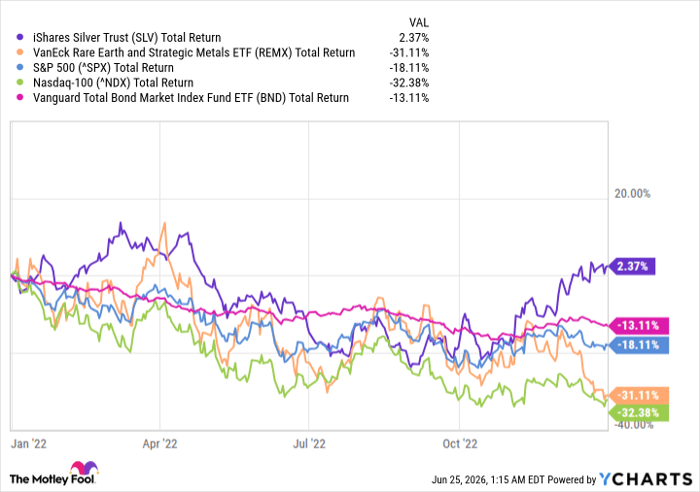
One of the best reasons to buy commodity and precious metals funds is to hedge against a stock market downturn. So, what can history tell us about how these funds perform in those conditions? The last time the stock market went into a serious bear market was in 2022. Here's what happened:
SLV Total Return Level data by YCharts
The S&P 500 lost about 18% of its value and the Nasdaq-100 delivered an even larger annual loss of more than 32%. Owning bonds in 2022 was no protection, either: The Vanguard Total Bond Market ETF lost 13% that year.
But this chart shows, the iShares Silver Trust delivered a 2.37% gain in 2022. Meanwhile, the VanEck Rare Earth and Strategic Metals ETF lost 31.1% -- almost as much as the Nasdaq-100. If a rare-earth ETF behaves similarly to major tech names, it's not going to offer much protection in case of a tech stock sell-off.
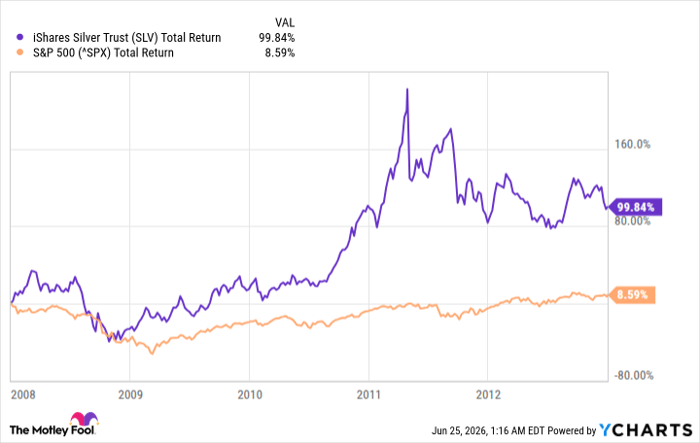
And the iShares Silver Trust has a track record of outperforming the S&P 500 during a longer-term downturn. During the recovery from the global financial crisis, this fund outperformed the S&P 500 for five years from January 2008 to January 2013.
SLV Total Return Level data by YCharts
I don't own either of these funds. Precious metals and rare-earth materials can be volatile and unpredictable, and these funds charge higher fees than the low-cost index funds I tend to prefer. But if I had to choose one to hedge against a tech stock crash, the iShares Silver Trust looks like a better risk-adjusted choice.
Should you buy stock in iShares Silver Trust right now?
Before you buy stock in iShares Silver Trust, consider this:
The Motley Fool Stock Advisor analyst team just identified what they believe are the 10 best stocks for investors to buy now… and iShares Silver Trust wasn’t one of them. The 10 stocks that made the cut could produce monster returns in the coming years.
Consider when Netflix made this list on December 17, 2004... if you invested $1,000 at the time of our recommendation, you’d have $398,052!* Or when Nvidia made this list on April 15, 2005... if you invested $1,000 at the time of our recommendation, you’d have $1,181,688!*
Now, it’s worth noting Stock Advisor’s total average return is 892% — a market-crushing outperformance compared to 205% for the S&P 500. Don't miss the latest top 10 list, available with Stock Advisor, and join an investing community built by individual investors for individual investors.
See the 10 stocks »
*Stock Advisor returns as of June 28, 2026.
Ben Gran has positions in Vanguard Total Bond Market ETF. The Motley Fool has positions in and recommends Vanguard Total Bond Market ETF. The Motley Fool has a disclosure policy.
Recommended Articles


