




This Nvidia-Backed Artificial Intelligence (AI) Infrastructure Stock Has Multibagger Potential. It Is Trading at an Incredibly Attractive Valuation Right Now
Key Points
Nvidia invested in CoreWeave earlier this year to help the neocloud infrastructure provider build AI factories.
The stock has multibagger potential owing to its massive backlog, cheap valuation, and phenomenal growth prospects.
- 10 stocks we like better than CoreWeave ›
Nvidia invested $2 billion in neocloud infrastructure provider CoreWeave (NASDAQ: CRWV) in January this year to help the latter build artificial intelligence (AI) factories powered by its chips. That investment has appreciated 11% since then despite bouts of volatility.
However, it won't be surprising to see this AI stock jump higher in the future, as it plays an important role in the AI infrastructure ecosystem by building dedicated AI data centers. Let's look at the reasons why this fast-growing company could be an ideal addition to your portfolio right now.
Missed Nvidia in 2009? This Rare Signal Is Flashing Again. In 2009, a "Double Down" signal flashed for a little-known chipmaker called Nvidia. For the first time in years, that same "Total Conviction" signal is flashing for a company 1/100th the size of Nvidia. Continue »
Image source: The Motley Fool.
CoreWeave's enormous backlog is going to fuel years of terrific growth
Cloud computing giants such as Meta Platforms and Microsoft have been spending heavily on building AI data centers. Microsoft reported remaining performance obligations (RPO) of $627 billion in the previous quarter, nearly doubling year over year due to increasing demand for its AI services. Meta, on the other hand, is spending big on data center infrastructure to build AI products for customers and advertisers.
CoreWeave has been the beneficiary of their aggressive capital spending, landing massive contracts to provide data center capacity for these companies. However, CoreWeave's customer base extends beyond these hyperscalers, as the likes of OpenAI and Anthropic have also turned to CoreWeave to build data centers.
In fact, CoreWeave noted in its May earnings call that it has 10 customers who have committed to spending at least $1 billion each to rent data center capacity from the company. Moreover, CoreWeave is diversifying its customer base by adding financial services clients, such as Jane Street and Hudson River Trading. It has also added other pure-play AI companies, such as Perplexity AI, to its client list.
Goldman Sachs predicts that data center power demand in the U.S. is going to double by next year, rising to 66 gigawatts (GW) from 31 GW in 2025. Not surprisingly, AI companies and hyperscalers have been quickly buying the available data center power capacity from the likes of CoreWeave.
This explains why CoreWeave's revenue backlog sits at a remarkable $99.4 billion, with the metric growing by 284% year over year in Q1. For comparison, the company's quarterly revenue rose 112% to $2.1 billion. That revenue growth rate will accelerate sharply as CoreWeave builds more data centers.
The company's active data center power capacity crossed the 1 GW mark in Q1. Importantly, it increased its contracted power capacity to 3.5 GW. The contracted capacity is the electrical power that CoreWeave has secured from utility providers to build AI data centers. This suggests CoreWeave can more than triple its active capacity in the future. What's worth noting is that CoreWeave aims to build 8 GW of active data center capacity by the end of the decade.
Of course, building AI data centers is a capital-intensive endeavor, which explains why CoreWeave has been taking on significant debt to fund its expansion. As a result, its interest expense doubled year over year in Q1 to $536 million. CoreWeave has raised $20 billion this year through debt and equity financing, suggesting that interest expenses will continue to weigh on its bottom line.
However, the company is trying to lower financing costs, with management pointing out that it is "broadening access to capital at lower blended cost will continue to be an important lever for CoreWeave as we convert backlog to revenue and operating cash flow." CoreWeave estimates that it will convert 36% of its backlog into revenue over the next two years, while 75% of the backlog is likely to be recognized as revenue over the next four years.
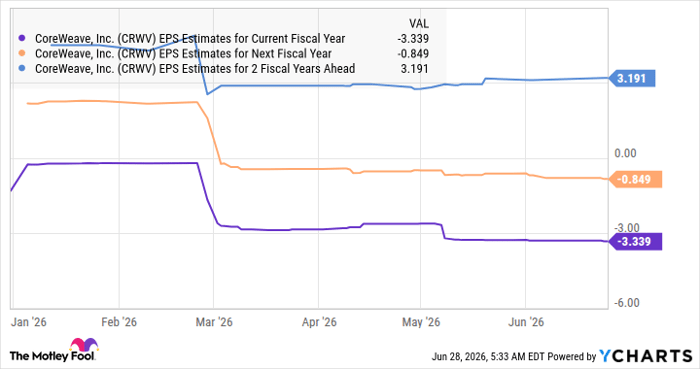
As a result, CoreWeave expects its annualized run rate revenue to jump from $18 billion at the end of 2026 to $30 billion at the end of 2027. The aggressive conversion of CoreWeave's backlog into revenue will also boost its bottom line.
Data by YCharts
Here's why this stock looks like a potential multibagger
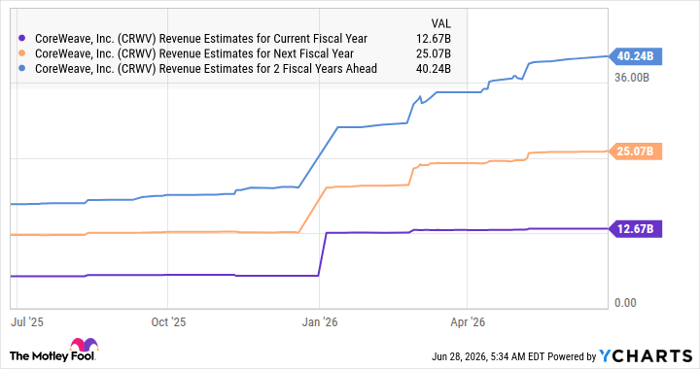
CoreWeave stock has jumped by 22% in 2026, which helps explain why it can still be bought at just under 8 times sales, which isn't very expensive considering that the tech-focused Nasdaq Composite index has a price-to-sales ratio of 5.2. The slight premium it trades at can be justified by its ballooning backlog, triple-digit revenue growth, and the ability to sustain solid growth in the future.
Data by YCharts
If CoreWeave's top line indeed jumps to $40 billion by the end of 2028 and it trades at the Nasdaq Composite's sales multiple, its market cap could increase to $208 billion. That's significantly higher than its current market cap of $53 billion, indicating that this growth stock could become a multibagger. That's why buying CoreWeave seems like a no-brainer right now, as it is pulling the right strings to capitalize on the booming demand for AI data centers.
Should you buy stock in CoreWeave right now?
Before you buy stock in CoreWeave, consider this:
The Motley Fool Stock Advisor analyst team just identified what they believe are the 10 best stocks for investors to buy now… and CoreWeave wasn’t one of them. The 10 stocks that made the cut could produce monster returns in the coming years.
Consider when Netflix made this list on December 17, 2004... if you invested $1,000 at the time of our recommendation, you’d have $398,052!* Or when Nvidia made this list on April 15, 2005... if you invested $1,000 at the time of our recommendation, you’d have $1,181,688!*
Now, it’s worth noting Stock Advisor’s total average return is 892% — a market-crushing outperformance compared to 205% for the S&P 500. Don't miss the latest top 10 list, available with Stock Advisor, and join an investing community built by individual investors for individual investors.
See the 10 stocks »
*Stock Advisor returns as of June 28, 2026.
Harsh Chauhan has no position in any of the stocks mentioned. The Motley Fool has positions in and recommends Goldman Sachs Group, Meta Platforms, Microsoft, and Nvidia. The Motley Fool has a disclosure policy.
Recommended Articles


