




SpaceX's Starfall Could Open a Brand-New Revenue Stream Beyond Rockets and Starlink. Is That Enough to Change the Bull Case?
Key Points
SpaceX has released a few scant details about its secretive Starfall delivery pod project.
By launching payloads into orbit, they could reach the other side of the Earth in just 45 minutes.
SpaceX conducted a test of the technology on Tuesday, but details are still incomplete.
- 10 stocks we like better than Space Exploration Technologies ›
In 1873, Jules Verne's novel Around the World in 80 Days became his first international success. The seemingly impossible prospect of circumnavigating the entire world in so short a timespan captured the global imagination.
That's because only a few years prior, it was impossible. It was only doable thanks to three engineering feats: the completion of the Suez Canal and the U.S. transcontinental railroad in 1869, and the linking of the Indian railways in 1870.
Where to invest $1,000 right now? Our analyst team just revealed what they believe are the 10 best stocks to buy right now, when you join Stock Advisor. See the stocks »
Now Elon Musk is proposing a new engineering feat that we might call Around the World in 80 Minutes. Is it a game changer for his Space Exploration Technologies (NASDAQ: SPCX), or SpaceX?
Here's the sounds-like-something-out-of-a-sci-fi-novel idea behind the "Starfall" project, and whether it bolsters the bull case for SpaceX.
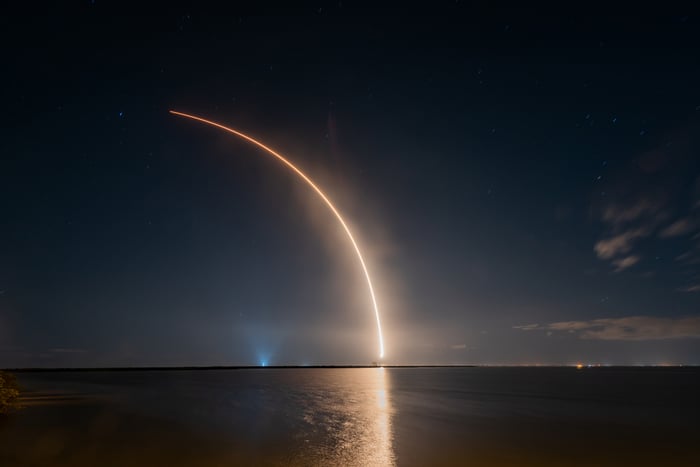
Image source: Getty Images.
Faster than a speeding bullet
Everything's faster in space.
That's the big idea behind Starfall. Traditional airplanes can travel at a poky 575 mph, and the now-retired Concorde supersonic jet had a cruising speed of 1,350 mph. The Earth's atmosphere and those pesky laws of physics prevent pretty much anything besides a missile from going much faster than that.
But in near-Earth orbit, satellites like the International Space Station travel at about 17,500 mph (5 miles per second). At that velocity, they make a complete orbit of the Earth in about 90 minutes. So if you wanted to deliver something to the opposite side of the globe as quickly as possible, you could launch it into space and then drop it out of orbit just 45 minutes later. That would deliver the payload well before any traditional delivery method (even the Concorde would take more than 9 hours).
But... can SpaceX actually pull this off? A new test suggests it can.
Stronger than a locomotive
Starfall was developed under a veil of secrecy, but we have a publicly available FAA environmental assessment that tells us a little bit about the program. It says that Starfall will "enable point-to-point delivery of critical cargo through space on rapid timelines." The FAA approved the program for testing, and the first test occurred on Tuesday.
One of SpaceX's Falcon Heavy rockets carried a Starfall reentry pod into near-Earth orbit. The rocket then separated, at which point the upper stage was scheduled to carry the pod in orbit around the Earth twice, then guide it back into the atmosphere, where it would achieve a parachute-assisted splashdown in the Pacific Ocean. I say "was scheduled to" because while SpaceX has confirmed the successful launch, separation, and return of the Stage 1 Falcon Heavy rocket, it hasn't provided details about the upper-stage rocket's flight or its payload.
All we know is that the Starfall pod weighs about 4,600 pounds, with a 2,200-pound payload capacity, and looks like a cylindrical disc about 10 feet in diameter and 2.5 feet tall.
Able to leap tall valuations in a single bound
We don't know whether the recent Starfall test was successful, so it's impossible to know for certain how close this technology is to becoming a reality. But one thing's for sure: It won't be used for getting that inexpensive Temu dress to your doorstep in time for your hot date tonight. At least, not at first.
For one thing, Starfall capsules can't apparently take themselves out of orbit, but are reliant on their launch vehicle to place them on a trajectory for reentry. Until SpaceX's fully reusable Starship vehicle comes online, that means burning an expensive upper-stage rocket with every Starfall capsule delivery.
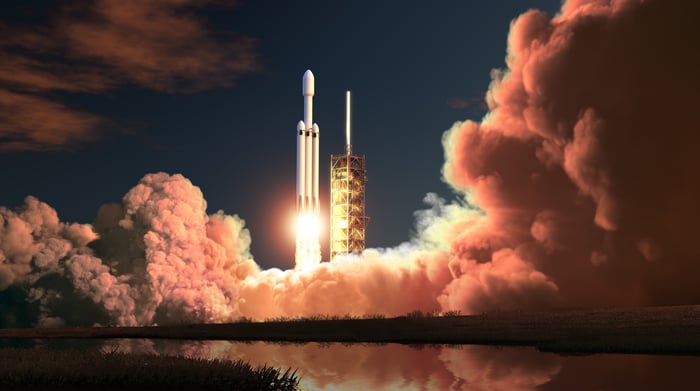
Image source: Getty Images.
But if SpaceX's reusable Starship comes online in its current form, it will only have a few possible landing sites due to its size. Starfall capsules could offer the flexibility to deliver payloads to far-flung locations where Starships can't land. The U.S. military could certainly use technology that could deploy a one-ton payload anywhere in the world in 80 minutes from a reusable launch vehicle, even if the initial cost is high.
Launch costs in general are expected to continue dropping sharply as SpaceX improves its technology and introduces the fully reusable Starship. So it's possible that Starfall could someday power consumer deliveries. But that won't happen in the next 80 days ... or even the next 80 weeks.
Ultimately, while Starfall could someday generate a valuable revenue stream for SpaceX, investors shouldn't try to factor it into their analysis just yet. Instead, we should at least wait for confirmed details before updating our SpaceX valuation.
Should you buy stock in Space Exploration Technologies right now?
Before you buy stock in Space Exploration Technologies, consider this:
The Motley Fool Stock Advisor analyst team just identified what they believe are the 10 best stocks for investors to buy now… and Space Exploration Technologies wasn’t one of them. The 10 stocks that made the cut could produce monster returns in the coming years.
Consider when Netflix made this list on December 17, 2004... if you invested $1,000 at the time of our recommendation, you’d have $398,052!* Or when Nvidia made this list on April 15, 2005... if you invested $1,000 at the time of our recommendation, you’d have $1,181,688!*
Now, it’s worth noting Stock Advisor’s total average return is 892% — a market-crushing outperformance compared to 205% for the S&P 500. Don't miss the latest top 10 list, available with Stock Advisor, and join an investing community built by individual investors for individual investors.
See the 10 stocks »
*Stock Advisor returns as of June 28, 2026.
John Bromels has no position in any of the stocks mentioned. The Motley Fool has no position in any of the stocks mentioned. The Motley Fool has a disclosure policy.
Recommended Articles


