




SpaceX Just Spent $60 Billion on Artificial Intelligence (AI). Could Elon Musk Be Building the Next Amazon?
Key Points
Most investors know SpaceX for its rocket-launching operations and its Starlink satellite businesses.
SpaceX is also building an artificial intelligence (AI) infrastructure business, leasing cloud computing capacity to hyperscalers.
SpaceX acquired both xAI and Cursor to speed up its ambitions in AI infrastructure.
- 10 stocks we like better than Space Exploration Technologies ›
In the early days of online shopping, Amazon (NASDAQ: AMZN) was a simple website that sold books. In the years that followed, the company expanded its marketplace into a more comprehensive e-commerce platform. That eventually helped pave the way for the launch of its cloud infrastructure platform, Amazon Web Services (AWS). This chain of events quietly turned Amazon into an essential digital infrastructure provider -- driving trillions of dollars in market value.
Elon Musk's Space Exploration Technologies (NASDAQ: SPCX) is following a similar path. While SpaceX began with rockets that made it cheaper to get payloads into orbit, the company now also offers global internet connectivity through its Starlink business and is building large artificial intelligence (AI) data centers.
Where to invest $1,000 right now? Our analyst team just revealed what they believe are the 10 best stocks to buy right now, when you join Stock Advisor. See the stocks »
SpaceX's long-term goal is to create a comprehensive suite of tools that power the entire AI economy. Recent steps, including its merger with xAI and its acquisition of Cursor AI, are speeding this process up.
Image source: The Motley Fool.
Rockets, internet, and AI infrastructure all under one roof
SpaceX oversees the complete sequence required to deliver all aspects of the AI infrastructure value chain. The company's rockets handle the launches that place equipment into orbit. Starlink's broadband satellites provide a global connectivity network that can link AI systems with end users. And on the ground, SpaceX is deploying large clusters of servers dedicated to training AI models.
This vertical integration extends to power and data flow, too. Terrestrial data centers draw electricity from the established grid and power plant infrastructure, and supplement that with on-site power generation where needed. The data center satellites it aims to deploy in orbit will operate using continuously available solar power.
Since SpaceX controls rockets, the connectivity layer, the power approach, and the accelerated computing hardware, it will be able to develop and deploy next-generation AI systems without depending on external suppliers for each step. This playbook mirrors the one used by Amazon, which built its own warehouses, logistics network, and cloud platform rather than relying on outside vendors for those key pieces of its operation.
SpaceX is bolstering its AI business through key combinations
Prior to its initial public offering, SpaceX acquired xAI to bring advanced model development inside the organization. In essence, that deal allows SpaceX's engineers to design AI systems while simultaneously building the physical infrastructure that will run them. The result is a closed-loop system between the software and the hardware that supports AI development.
The company's recent $60 billion acquisition of Cursor further supports this effort. Cursor provides tools that help developers create and refine the software needed for designing advanced computing systems.
The key takeaway here is that SpaceX is not stopping at reusable rockets or satellite broadband. CEO Musk is aggressively assembling a portfolio of end-to-end capabilities that AI hyperscalers will need in the future. Against this backdrop, SpaceX is positioning itself to be a core infrastructure provider in the same way that AWS became one of the key supporters of enterprises' digital transformations.
SpaceX's long-term ambitions go beyond Earth
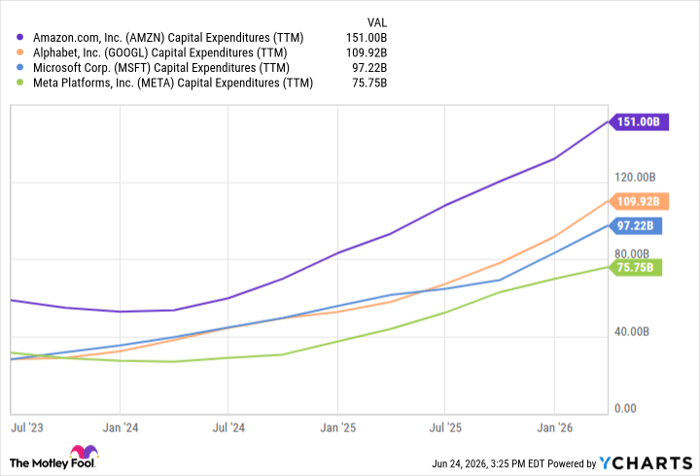
There are a host of constraints to building AI data centers on Earth. Such facilities consume massive amounts of electricity, straining local power grids and raising energy costs for everyone around them. They occupy large amounts of land, and also require extensive cooling systems that, in a majority of cases, suck up huge volumes of fresh water. All of those resources are becoming more expensive to secure, particularly given big tech's willingness to lay out hundreds of billions of dollars in capital expenditures to build out AI infrastructure.
AMZN Capital Expenditures (TTM) data by YCharts.
SpaceX is seeking to remove some of these bottlenecks by deploying a constellation of orbital AI servers. In certain orbits, intense solar power is available 24 hours a day to be converted into electricity. Moreover, these satellite-based computer servers can be cooled by using large radiator panels to emit the heat they generate as infrared radiation into the vacuum of space.
In theory, the payload capacity of SpaceX's Starship rocket will make it feasible to launch large-scale computing modules rather than individual parts -- allowing more efficient construction of these installations. The company can then use its Starlink infrastructure to maintain those data center satellites' connectivity to Earth. Such an orbital ecosystem would open a path for AI computing capacity to continue growing without facing the same resource constraints that hinder its ground-based expansion.
SpaceX combines a proven ability to maintain a rapid rocket launch cadence, a global satellite connectivity service, and a credible approach to building AI compute beyond Earth's limits. The company's ambitious long-term plan for infrastructure leadership echoes the narrative of Amazon's foray into cloud services, with clear implications for sustained growth and strategic importance in the AI economy if Musk and his companies can execute on his vision.
Should you buy stock in Space Exploration Technologies right now?
Before you buy stock in Space Exploration Technologies, consider this:
The Motley Fool Stock Advisor analyst team just identified what they believe are the 10 best stocks for investors to buy now… and Space Exploration Technologies wasn’t one of them. The 10 stocks that made the cut could produce monster returns in the coming years.
Consider when Netflix made this list on December 17, 2004... if you invested $1,000 at the time of our recommendation, you’d have $398,052!* Or when Nvidia made this list on April 15, 2005... if you invested $1,000 at the time of our recommendation, you’d have $1,181,688!*
Now, it’s worth noting Stock Advisor’s total average return is 892% — a market-crushing outperformance compared to 205% for the S&P 500. Don't miss the latest top 10 list, available with Stock Advisor, and join an investing community built by individual investors for individual investors.
See the 10 stocks »
*Stock Advisor returns as of June 28, 2026.
Adam Spatacco has positions in Alphabet, Amazon, Meta Platforms, and Microsoft. The Motley Fool has positions in and recommends Alphabet, Amazon, Meta Platforms, and Microsoft. The Motley Fool has a disclosure policy.
Recommended Articles


