




The Vanguard ETF Built for Investors Who Want Dividends That Actually Grow
Key Points
The Vanguard Dividend Appreciation ETF focuses on stocks with a long track record of dividend growth.
Because it doesn't focus on current yield, it has more tech stocks than most dividend ETFs.
It can be a great way to build a growing income stream and strong total returns simultaneously.
- 10 stocks we like better than Vanguard Dividend Appreciation ETF ›
There is no shortage of dividend-focused ETFs available to investors, but most people focus on high-yield versions or on a specific category of stocks, like large-cap dividend payers. And to be fair, these can be excellent investments, especially for older investors who rely on their portfolios for current income or plan to do so in the next few years.
On the other hand, too many people ignore dividend growth when choosing an ETF, but there are good reasons it could be a smarter way to go. For one thing, a growing income stream can help you keep up with inflation over time. Plus, stocks with a strong history of dividend growth tend to have excellent visibility into future cash flows.
Where to invest $1,000 right now? Our analyst team just revealed what they believe are the 10 best stocks to buy right now, when you join Stock Advisor. See the stocks »
One ETF in particular that could be worth a closer look is the Vanguard Dividend Appreciation ETF (NYSEMKT: VIG). As we'll see, this can produce not only a growing income stream, but potentially superior total returns compared to many other dividend-focused ETFs.

Image source: Getty Images.
What is the Vanguard Dividend Appreciation ETF?
The Vanguard Dividend Appreciation ETF is an index fund that focuses on large-cap companies with a strong track record of dividend growth. Specifically, it tracks the S&P U.S. Dividend Growers Index, which requires that stocks have increased dividends for at least 10 consecutive years.
Like most Vanguard ETFs, this one is cheap. It has a 0.04% expense ratio, which is among the lowest of any ETF on the market. This means that for every $1,000 invested, your annual investment costs will be just $0.40, which will be reflected in the fund's performance over time.
Perhaps the biggest difference between the Vanguard Dividend Appreciation ETF and other popular dividend ETFs is that it doesn't focus on current yield. This allows it to include high-growth stocks with low yields but a strong history of dividend increases. For example, tech heavyweight Broadcom (NASDAQ: AVGO) is the ETF's largest holding, and you'll also find Apple (NASDAQ: AAPL), Visa (NYSE: V), and Cisco Systems (NASDAQ: CSCO) among the top 10 -- stocks with low current yields that are often excluded from other dividend ETFs.
The portfolio has 331 dividend stocks altogether and is a weighted index, meaning certain stocks account for more of the fund's holdings than others. Over the past 10 years, the Vanguard Dividend Appreciation ETF has delivered 13.3% annualized total returns for investors -- significantly outperforming most "high dividend" ETFs over the same period, despite having a significantly lower dividend yield.
Growth and future income
With a dividend yield of about 1.5% as of this writing, it's easy to see why this ETF might get overlooked in favor of, say, the Vanguard High Dividend Yield ETF (NYSEMKT: VYM), which has a significantly higher yield. But the current yield isn't the point -- if the stocks in the ETF grow their dividends at an average rate of about 7% per year, your income will roughly double every decade. After 20 years, you'll be generating four times the income you started with. After 30 years, eight times the initial income.
It's also worth noting that most of the ETF's major holdings, including all four mentioned in the last section, have a record of even faster dividend growth. As you can see in the chart below, the ETF's dividend payments have roughly doubled in just the past eight years.
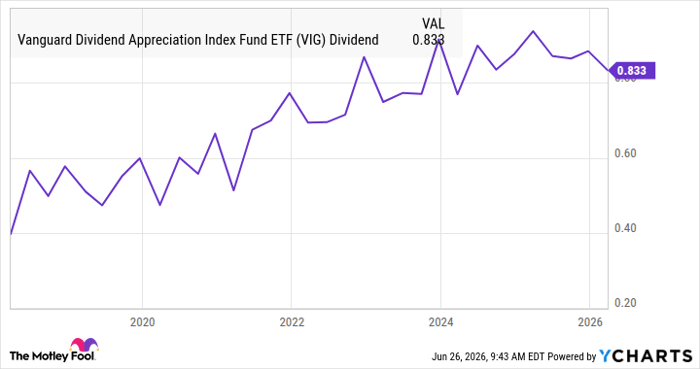
VIG Dividend data by YCharts.
The bottom line is that the Vanguard High Dividend Yield ETF allows you to set yourself up for an excellent future income stream when you need it, as well as for potentially market-beating total returns in the meantime. If you are still a decade or two from retirement, it could be worth a closer look.
Should you buy stock in Vanguard Dividend Appreciation ETF right now?
Before you buy stock in Vanguard Dividend Appreciation ETF, consider this:
The Motley Fool Stock Advisor analyst team just identified what they believe are the 10 best stocks for investors to buy now… and Vanguard Dividend Appreciation ETF wasn’t one of them. The 10 stocks that made the cut could produce monster returns in the coming years.
Consider when Netflix made this list on December 17, 2004... if you invested $1,000 at the time of our recommendation, you’d have $382,359!* Or when Nvidia made this list on April 15, 2005... if you invested $1,000 at the time of our recommendation, you’d have $1,201,390!*
Now, it’s worth noting Stock Advisor’s total average return is 883% — a market-crushing outperformance compared to 205% for the S&P 500. Don't miss the latest top 10 list, available with Stock Advisor, and join an investing community built by individual investors for individual investors.
See the 10 stocks »
*Stock Advisor returns as of June 27, 2026.
Matt Frankel, CFP® has no position in any of the stocks mentioned. The Motley Fool has positions in and recommends Apple, Broadcom, Cisco Systems, Vanguard Dividend Appreciation ETF, Vanguard High Dividend Yield ETF, and Visa. The Motley Fool has a disclosure policy.
Recommended Articles


