




Micron Just Delivered Great News for Intel, AMD, Arm, and Qualcomm Stock Investors
Key Points
Micron just delivered a blowout earnings report.
The memory shortage is having a significant impact across the tech sector.
Micron management discussed the emergence of edge AI, which could be a major tailwind for some chip stocks.
- 10 stocks we like better than Micron Technology ›
Micron (NASDAQ: MU) just faced the latest litmus test in the AI boom and passed with flying colors, with revenue jumping 346% and earnings per share growing by more than tenfold.
The third-quarter report makes clear that the memory shortage is only getting more severe as Micron's gross margin jumped to 85%, and it reported an operating margin of 80%, meaning it kept 80% of its revenue as before-tax profit.
Missed Nvidia in 2009? This Rare Signal Is Flashing Again. In 2009, a "Double Down" signal flashed for a little-known chipmaker called Nvidia. For the first time in years, that same "Total Conviction" signal is flashing for a company 1/100th the size of Nvidia. Continue »
For the rest of the tech industry, the implications of the memory shortage, which Micron said would continue through at least 2028, are mixed.
Apple stock fell 5% on Thursday after the company announced price hikes on some laptops and tablets to absorb higher costs for memory and storage, and the hyperscalers that make up Micron's data center customer base are also facing higher prices.
However, one comment from management in the earnings report shows that Micron sees benefits for its semiconductor peers outside of the memory market.
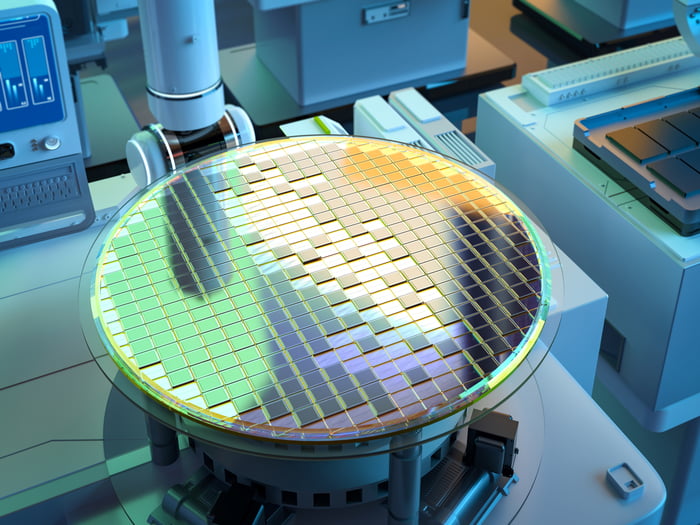
Image source: Getty Images.
Is a boom in edge AI coming?
The memory shortage isn't happening in a vacuum. It's part of the broader surge in demand for chips to power AI applications.
Micron argued that the AI boom would sweep into new industries, saying, "We are only in the early innings of the significant innovation productivity that can be unleashed in every part of the global economy over time."
Management also said, "Data center-driven growth will be increasingly complemented by AI-enabled features in smartphones, high-end PCs and new consumer devices, as well as in automotive, industrial applications, and robotics."
That has significant implications for chip companies that make a large percentage of their revenue from the smartphone and PC market, including Intel (NASDAQ: INTC), AMD (NASDAQ: AMD), Arm Holdings, (NASDAQ: ARM) and Qualcomm (NASDAQ: QCOM).
The device market has struggled in the AI era, in part because it's largely a mature market. Now, rising memory costs are making devices more expensive as well.
Thus far, the bulk of the deployment in AI has been in the data center, supporting cloud-based applications, including AI chatbots like OpenAI's ChatGPT and Anthropic's Claude, among others, but edge AI, or AI that takes place on devices, is coming.
On the earnings call, CEO Sanjay Mehrotra said, "Over time, we expect the value of on-device AI combined with pent-up unit replacement demand to drive memory demand growth in PCs and smartphones." He also said new agentic AI platforms like OpenClaw would increase the value of edge devices.
What it means for chip stocks like Intel, Arm, AMD, and Qualcomm
The global edge AI market is expected to grow from $30.9 billion this year to $225.5 billion in 2035, or a compound annual growth rate of 24.7%, according to Global Market Insights.
For the chip companies involved in the edge, the opportunity is huge, especially after years of lackluster growth in device sales. Arm, for example, has 99% market share of the smartphone CPU market, and if edge AI reaches a tipping point of adoption, the company's growth could significantly accelerate. The same could be said for Qualcomm, which makes most of its money from smartphones, and growth has stalled. If edge AI can drive demand for devices and raise prices, Qualcomm will benefit.
The same is true for Intel and AMD in PCs, another market that has struggled, but could get a boost from edge AI.
The trends Micron is describing will take years to play out, but investors shouldn't be fooled into thinking that the memory shortage is a short-term event. It has implications for the broader semiconductor industry and shows that there's still a long runway for the AI boom as the technology comes to smartphones and PCs, as well as robotics and autonomous vehicles.
Should you buy stock in Micron Technology right now?
Before you buy stock in Micron Technology, consider this:
The Motley Fool Stock Advisor analyst team just identified what they believe are the 10 best stocks for investors to buy now… and Micron Technology wasn’t one of them. The 10 stocks that made the cut could produce monster returns in the coming years.
Consider when Netflix made this list on December 17, 2004... if you invested $1,000 at the time of our recommendation, you’d have $382,359!* Or when Nvidia made this list on April 15, 2005... if you invested $1,000 at the time of our recommendation, you’d have $1,201,390!*
Now, it’s worth noting Stock Advisor’s total average return is 883% — a market-crushing outperformance compared to 205% for the S&P 500. Don't miss the latest top 10 list, available with Stock Advisor, and join an investing community built by individual investors for individual investors.
See the 10 stocks »
*Stock Advisor returns as of June 26, 2026.
Jeremy Bowman has positions in Advanced Micro Devices, Arm Holdings, and Micron Technology. The Motley Fool has positions in and recommends Advanced Micro Devices, Arm Holdings, Intel, Micron Technology, and Qualcomm. The Motley Fool has a disclosure policy.
Recommended Articles


