




Volkswagen Plans to Cut Up to 100,000 Jobs and Close 4 German Plants, European Auto Industry Faces Historic Restructuring
TradingKey - Volkswagen, Europe's largest automaker, is drawing up its most aggressive restructuring plan in nearly 90 years. According to multiple media reports, Volkswagen plans to lay off up to 100,000 employees over the next several years and halt production at four domestic factories in Germany to cope with the multiple pressures of a slow electric vehicle transition, high costs, and persistently weak demand in the European market. Meanwhile, the group plans to cut capital expenditure by about 15% over the next five years, reducing it to over 130 billion euros.
Furthermore, according to the restructuring plan, Volkswagen's core passenger car brand VW and its components manufacturing business will be spun off from the current group structure to operate as independent entities.
Regarding the factory closures, Volkswagen plans to close three of its plants in Hanover, Zwickau, and Emden, along with an Audi plant in Neckarsulm, over the medium term. These four factories will gradually phase out production once current vehicle models are discontinued.
Previously, due to cost cuts and transition needs, Volkswagen officially ceased complete vehicle production at its Transparent Factory in Dresden by the end of 2025. The iconic facility, known for its glass-walled design, once produced the Phaeton luxury sedan.
Capital markets' reaction to the news has been relatively muted. As of press time, Volkswagen's (VOW3) preferred shares have not experienced significant volatility.
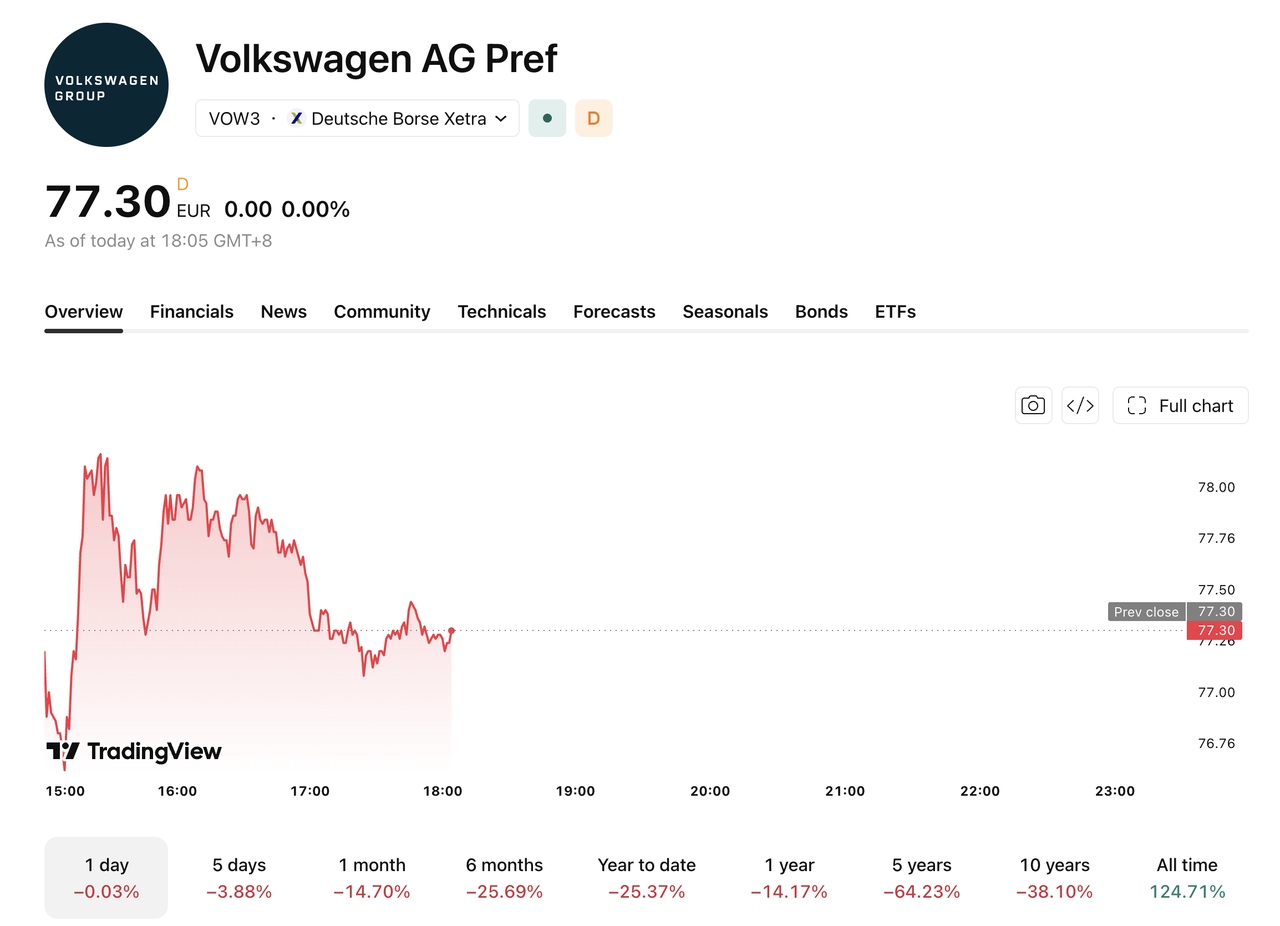
[Source: TradingView]
Volkswagen's Restructuring Dilemma: Plunging Profits, Union Standoff, and Overcapacity
Volkswagen's troubles did not develop overnight. In fiscal year 2025, Volkswagen Group's net profit fell sharply as sales in the European market continued to shrink, while the massive R&D investment required for its electrification transition simultaneously squeezed profit margins. Meanwhile, the offensive in the European market by rivals old and new, including Tesla (TSLA) and BYD, has intensified, continuously eroding Volkswagen's market share.
The deeper issue is overcapacity. According to Germany's Manager Magazin, the four domestic German plants slated for restructuring and closure in this round have a combined annual capacity of about 1.3 million vehicles, yet actual production stands at just 600,000 to 650,000 vehicles, leaving capacity utilization at these facilities below 50%. While closing these plants is expected to help Volkswagen cut up to 1 million units of global excess capacity, analysts believe this will still not be enough to fundamentally solve the problem without a thorough overhaul of its expensive domestic supply chain.
Volkswagen Group CEO Oliver Blume has repeatedly stressed that the company needs "decisive adjustments" to restore competitiveness. In a previous internal meeting, he stated: "Volkswagen must face reality. The European auto market is shrinking, yet our cost structure remains stuck in the past."
However, the plan has met with fierce opposition from IG Metall, Germany's largest trade union. The union has threatened to strike and accused management of "shifting the crisis onto the workers." The German state of Lower Saxony holds a 20% voting stake in Volkswagen and typically sides with the union, meaning the plan will face immense resistance at the supervisory board level.
Mercedes-Benz and BMW Collectively Downsize as European Auto Industry Faces a Harsh Winter
Volkswagen's predicament is merely a microcosm of the European automotive industry. Automakers such as BMW, Mercedes-Benz, and Stellantis are similarly experiencing the painful transition of slowing EV demand and intensifying cost pressures. Mercedes-Benz significantly tightened its budget in February this year after its profits halved, and initiated a new round of labor negotiations in June to deepen cost cuts; BMW was also forced in June, following a profit warning, to accelerate voluntary redundancy and natural attrition programs to reduce its workforce by 5%.
A senior fellow at the Brussels-based think tank Bruegel analyzed: "The European automotive industry is facing a double whammy of structural transition and external competition. Volkswagen's restructuring could trigger a ripple effect across the European automotive supply chain, including an existential crisis for parts suppliers."
Volkswagen's plan to cut 100,000 jobs is a landmark signal of the structural crisis facing the European auto industry. If implemented, its impact will extend far beyond its Wolfsburg headquarters, affecting manufacturing employment and the supply chain ecosystem across Germany and indeed Europe. In the short term, close attention should be paid to the outcome of the standoff between unions and management, with the German state government of Lower Saxony already stating it will closely monitor the negotiation progress; in the medium to long term, it will depend on whether Europe's automotive electrification transition can find a new path.
Recommended Articles


