




Battle of the Artificial Intelligence (AI) Computing Companies: Is AMD, Broadcom, Nvidia, or Marvell the Best Stock to Buy Now?
Key Points
Nvidia is still growing at a faster pace than fellow GPU maker AMD.
Broadcom and Marvell are seeing huge demand for their custom AI chips.
- 10 stocks we like better than Nvidia ›
There are four major competitors in the artificial intelligence (AI) chip game: Nvidia (NASDAQ: NVDA), AMD (NASDAQ: AMD), Broadcom (NASDAQ: AVGO), and Marvell (NASDAQ: MRVL). These four can be split up into two groups: designers of broad-purpose computing chips and designers of narrow-purpose custom AI chips. Nvidia and AMD both make GPUs, which fall into the broad-purpose category, while Broadcom and Marvell make application-specific integrated circuits (ASICs), which are narrow-purpose chips.
Each company is vying to gain as much space in data centers as possible, but which of them looks like the best buy right now?
Where to invest $1,000 right now? Our analyst team just revealed what they believe are the 10 best stocks to buy right now, when you join Stock Advisor. See the stocks »

Image source: Getty Images.
Nvidia's AI revenue dwarfs all
First, let's look at the market share of each company. Nvidia is easily the largest. In Q1, its data center division generated a jaw-dropping $75.2 billion, rising 92% year over year. This showcases Nvidia's dominance in the data center realm, and even though it's massive, it can still put up solid growth. Later this year, Nvidia's new Vera Rubin architecture will start shipping to customers, which should help sustain its elevated growth rates.
AMD directly competes with Nvidia in the GPU realm. However, its sales in the data center segment are nowhere near Nvidia's. In the first quarter, it saw data center revenues of $5.8 billion, up 57% year over year. While this is an improvement over previous quarters, it's less than a tenth of the volume of Nvidia's data center division, and it's growing at a slower pace. And much of its data center revenues come from its line of central processing units (CPUs).
Moving to Broadcom, in its fiscal Q2, which ended May 3, its AI semiconductor division generated $10.8 billion, up 143% year over year. Its growth in that business is still early in its ramp-up, and management believes the unit will generate over $100 billion in revenue in 2027. This expected rapid acceleration is due to several AI hyperscalers launching their custom AI chips, which can outperform GPUs on a cost basis as long as they are handling the specific types of workloads they are designed for.
Broadcom's major ASIC clients include Alphabet (NASDAQ: GOOG) (NASDAQ: GOOGL), Meta Platforms (NASDAQ: META), Anthropic, and OpenAI. That's a solid client list, and with that cohort spending big to try to capture market share in their own industries, the future looks bright for Broadcom.
Marvell's custom AI chip client list is headlined by Microsoft (NASDAQ: MSFT) and Amazon (NASDAQ: AMZN), and both of them are starting to ramp up production of their custom AI chips as well. Marvell's data center division is quite small compared to the other three, with only $1.8 billion in revenue in its fiscal 2027 Q1, growing at a 27% year-over-year pace. However, Marvell expects its annual revenues to double in its fiscal 2028, as there is a massive demand for custom AI chips.
Nvidia has way more data center revenue than all of the other three combined, and is still growing at a fast pace. Though the custom AI chip makers will likely grow faster than Nvidia in the near future, it's hard not to prefer it due to the dominance of its products.
Nvidia's valuation is cheap compared to its peers
Trading at just 23 times forward earnings, Nvidia is also far cheaper than either AMD or Marvell. It's also a better value than Broadcom, but not by nearly as much.
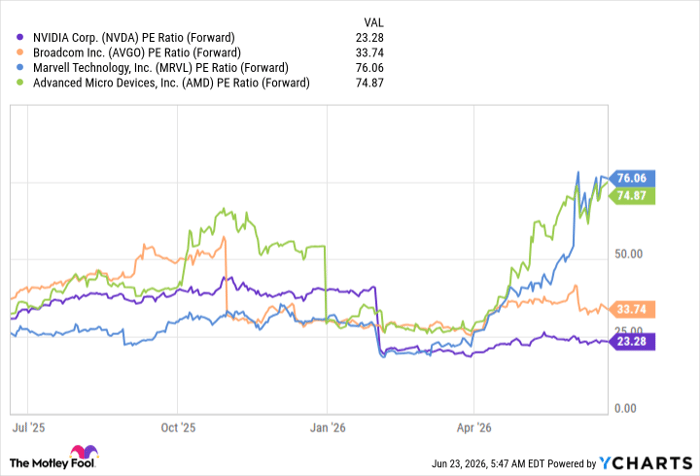
NVDA PE Ratio (Forward) data by YCharts.
With Nvidia's rapid growth and sustained dominance in AI computing chips, it's hard not to prefer it over the others. I still like Broadcom, too, but the stock's valuation just isn't as attractive as Nvidia's. Shares of AMD and Marvell already have a ton of expected future success priced into them, which may cap their upside.
If you're looking to add to an AI computing stock to your portfolio, I think Nvidia makes the most compelling argument by far. Demand for AI computing power will remain strong in the future, and Nvidia will likely lead the way in providing it.
Should you buy stock in Nvidia right now?
Before you buy stock in Nvidia, consider this:
The Motley Fool Stock Advisor analyst team just identified what they believe are the 10 best stocks for investors to buy now… and Nvidia wasn’t one of them. The 10 stocks that made the cut could produce monster returns in the coming years.
Consider when Netflix made this list on December 17, 2004... if you invested $1,000 at the time of our recommendation, you’d have $387,428!* Or when Nvidia made this list on April 15, 2005... if you invested $1,000 at the time of our recommendation, you’d have $1,221,398!*
Now, it’s worth noting Stock Advisor’s total average return is 895% — a market-crushing outperformance compared to 205% for the S&P 500. Don't miss the latest top 10 list, available with Stock Advisor, and join an investing community built by individual investors for individual investors.
See the 10 stocks »
*Stock Advisor returns as of June 25, 2026.
Keithen Drury has positions in Alphabet, Amazon, Broadcom, Meta Platforms, Microsoft, and Nvidia. The Motley Fool has positions in and recommends Advanced Micro Devices, Alphabet, Amazon, Broadcom, Marvell Technology, Meta Platforms, Microsoft, and Nvidia. The Motley Fool has a disclosure policy.
Recommended Articles


