




Micron Soars, Apple Sinks, and the Indexes Tread Water
Key Points
Micron surged 16% after a massive earnings beat, but Apple fell more than 6% after raising Mac and iPad prices due to soaring memory costs.
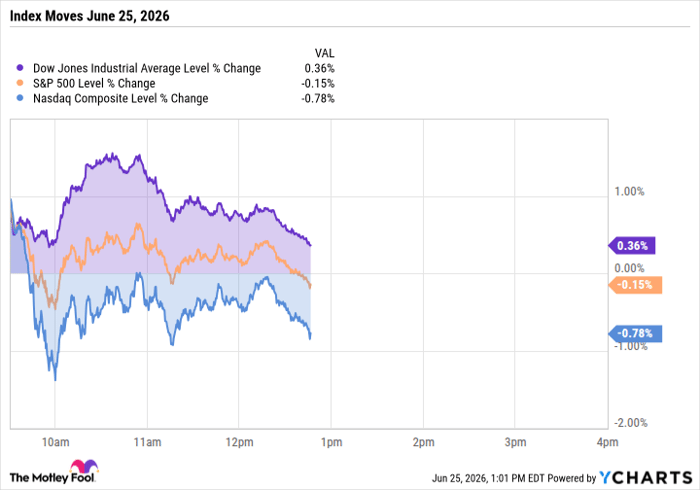
The S&P 500 was nearly flat while the Nasdaq Composite dropped 0.8%; the Dow rose 0.4%, led by Caterpillar's all-time high.
Friday's Russell index reconstitution will add SpaceX to the Russell 1000 and trigger an estimated $150 billion in fund rebalancing.
- 10 stocks we like better than Dow Jones Industrial Average ›
Micron Technology (NASDAQ: MU) had a very good day on Thursday. Apple (NASDAQ: AAPL) did not. Those two facts may sound unrelated, but one move inspired the other quite directly. And they pulled the major market indexes in opposite directions today.
Micron surged 16% on Thursday after reporting blowout earnings, but the memory chipmaker's gain came at a cost for many other tech stocks. Micron soared on rising memory prices due to limited supply and massive demand, forcing Apple to raise prices on its MacBooks and iPads. As a result of this push/pull dynamic, the stock market moved sideways despite dramatic action underneath the surface.
Missed Nvidia in 2009? This Rare Signal Is Flashing Again. In 2009, a "Double Down" signal flashed for a little-known chipmaker called Nvidia. For the first time in years, that same "Total Conviction" signal is flashing for a company 1/100th the size of Nvidia. Continue »
^DJI data by YCharts
The S&P 500 (SNPINDEX: ^GSPC) was down just 0.2% at 1 p.m. ET, while the Nasdaq Composite (NASDAQINDEX: ^IXIC) fell 0.8%. The Dow Jones Industrial Average (DJINDICES: ^DJI) rose 0.4%, buoyed by Caterpillar (NYSE: CAT) hitting an all-time high.
The memory tax
Micron's earnings weren't just good. They were borderline absurd. Q3 revenues more than quadrupled year over year while earnings skyrocketed from $1.91 to $25.11 per share. Micron's management followed up on this Street-stumping performance with strong guidance for the next quarter.

Image source: Getty Images.
This is what happens when AI data centers inhale every available memory chip. Industry leaders Micron, Samsung (OTC: SSNLF), and SK Hynix are prioritizing those orders, and everyone else gets to fight over scraps at premium prices.
Apple found out the hard way. On Thursday morning, the company announced price hikes across its Mac and iPad lineup. The Neo laptop, which launched at $599 specifically to compete with budget-priced Windows machines, now costs $699. That's a 17% price hike months after launch. The company's core customers may be fairly open to price boosts, but these significant changes will probably still undermine Apple's unit sales.
So Micron is up, Apple is down, and many other tech companies on the buying side of the memory pipeline followed suit. As of this writing, Micron has added $233 billion to its market cap overnight while Apple took a $212 billion cut. Many hyperscalers also pulled back in response to Micron's good news. When you add it up, the memory crunch created one big winner and a whole lot of losers on Thursday.
Looking ahead
The memory-chip drama is so powerful that I haven't even mentioned the consumer-side inflation report or the Strait of Hormuz yet. These items usually write their own headlines, but were downgraded to mere distractions today.
Oil prices ticked up by 2% as U.S. negotiations with Iran hit another snag. Iranian leaders don't like a new shipping route through the Strait of Hormuz, and Israel is still fighting in Lebanon.
Friday's main event is the reconstitution of several Russell indexes. Space Exploration Technologies (NASDAQ: SPCX) will join the Russell 1000. Micron and SanDisk (NASDAQ: SNDK) are being added to the Russell 1000 Growth index. Apple and Microsoft (NASDAQ: MSFT), meanwhile, will straddle both the value and growth indexes; make of that what you will. The index updates will drive at least $150 billion of automated trading as iShares Russell 1000 Growth (NYSEMKT: IWF) and other exchange-traded funds (ETFs) strive to keep up with the reshuffled stock lists.
One note unrelated to markets: a pair of major earthquakes struck Venezuela on Wednesday evening, killing more than 160 people with the death toll expected to climb into the thousands. That's not exactly index-moving news, but a reminder that some things matter more than stock indexes.
Should you buy stock in Dow Jones Industrial Average right now?
Before you buy stock in Dow Jones Industrial Average, consider this:
The Motley Fool Stock Advisor analyst team just identified what they believe are the 10 best stocks for investors to buy now… and Dow Jones Industrial Average wasn’t one of them. The 10 stocks that made the cut could produce monster returns in the coming years.
Consider when Netflix made this list on December 17, 2004... if you invested $1,000 at the time of our recommendation, you’d have $387,428!* Or when Nvidia made this list on April 15, 2005... if you invested $1,000 at the time of our recommendation, you’d have $1,221,398!*
Now, it’s worth noting Stock Advisor’s total average return is 895% — a market-crushing outperformance compared to 205% for the S&P 500. Don't miss the latest top 10 list, available with Stock Advisor, and join an investing community built by individual investors for individual investors.
See the 10 stocks »
*Stock Advisor returns as of June 25, 2026.
Anders Bylund has positions in Micron Technology. The Motley Fool has positions in and recommends Apple, Caterpillar, Micron Technology, and Microsoft. The Motley Fool has a disclosure policy.
Recommended Articles


