




The Newest Federal Reserve June Inflation Forecast Is a Good News-Bad News Scenario for Wall Street
Key Points
New Fed Chair Kevin Warsh has wasted little time changing the narrative at America's foremost financial institution.
The Iran-war-driven energy supply disruption has sent U.S. inflation to a three-year high.
Although the Cleveland Fed's proprietary inflation forecasting tool expects a modest drop in prices for June, one of the central bank's favorite inflationary indicators remains stubbornly high.
- 10 stocks we like better than S&P 500 Index ›
It's been a history-making year for Wall Street and the Federal Reserve. Earlier this month, the Dow Jones Industrial Average (DJINDICES: ^DJI), S&P 500 (SNPINDEX: ^GSPC), and Nasdaq Composite (NASDAQINDEX: ^IXIC) reached all-time highs.
Meanwhile, President Donald Trump's handpicked successor to Jerome Powell, Kevin Warsh, was officially sworn in as only the 17th chair in the Federal Reserve's history, since its inception in December 1913. Warsh has wasted little time changing the narrative at America's foremost financial institution, which holds major implications for Wall Street and investors.
Missed Nvidia in 2009? This Rare Signal Is Flashing Again. In 2009, a "Double Down" signal flashed for a little-known chipmaker called Nvidia. For the first time in years, that same "Total Conviction" signal is flashing for a company 1/100th the size of Nvidia. Continue »
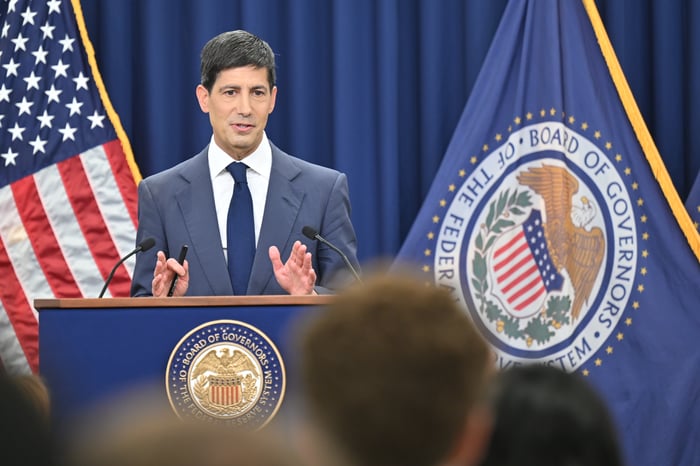
Fed Chair Kevin Warsh is ushering in a new era at the central bank. Image source: Official Federal Reserve Photo.
There's, arguably, no issue of greater importance at the moment than inflation. With trailing 12-month inflation vaulting to a three-year high in May, the newly updated June inflation forecast from the Federal Reserve offers a good news-bad news scenario for Wall Street.
The Iran war has sent prices soaring
Although President Trump's tariffs are a lingering concern in the goods sector, the bulk of America's inflationary pressure can currently be traced to the Iran war.
Shortly after President Trump gave the green light for the U.S. military to attack Iran, the latter closed the Strait of Hormuz to commercial vessels. This action-and-reaction halted the daily transport of approximately 20 million barrels of petroleum liquids, representing a fifth of the world's demand.
BREAKING: May CPI inflation rises to 4.2%, the highest level since April 2023.
-- The Kobeissi Letter (@KobeissiLetter) June 10, 2026
Core CPI inflation also rises to 2.9%, the highest since September 2025.
Inflation in the US is officially back above 4% and more than double the Fed's target.
Odds of Fed rate hikes are rising.
As you can imagine, removing 20% of the world's crude oil supply overnight had quite the impact on energy prices. Gas prices soared at the fastest pace in more than three decades, while diesel prices jumped by an even steeper percentage.
In three months, TTM inflation has increased from a modest 2.4% to the aforementioned three-year high of 4.2% in May. Consumers are feeling this pressure in their pocketbooks, and the central bank has taken notice.

Image source: Getty Images.
The latest June inflation forecast is a mixed bag
However, the Federal Reserve Bank of Cleveland's proprietary Inflation Nowcasting tool offers something of a silver lining for June. This inflation forecasting tool updates daily, Monday through Friday, following the release of new economic data.
According to the Cleveland Fed (as of June 18), TTM inflation for June is expected to modestly decline to 4.01%. Crude oil prices have tapered noticeably as peace talks between the U.S. and Iran have progressed. Since energy prices have been the primary driver of inflation, lower oil prices can provide some relief to consumers.
On the other hand, Core Personal Consumption Expenditures (PCE), a favorite inflationary measure of the central bank, isn't budging. The June Core PCE estimate of 3.3% remaining flat suggests inflationary pressures are filtering into other areas of the U.S. economy beyond energy and food. This implies that above-average inflation may last considerably longer than initially expected.
Very hawkish dot plot.
-- Nick Timiraos (@NickTimiraos) June 17, 2026
Nine out of 18 officials have at least one hike this year (and six of those 9 have *multiple hikes*).
Only one person has a cut this year, and one participant (presumably Warsh) didn't submit an SEP
The statement gets a complete writethru from top to... pic.twitter.com/KRwatpTFOP
Even if the president and his administration are successful in ending the Iran war in the near future, the foundation has been laid for the Federal Reserve to act. The quarterly filed dot plot (officially, Summary of Economic Projections) found that nine out of 18 anonymous Federal Open Market Committee members expect higher interest rates by the end of this year.
It could be extremely difficult for a historically pricey stock market to adapt to a rate-hiking environment. An expensive stock market already has little room for error. If Trump's actions in Iran force the central bank to raise interest rates, this margin for error may completely disappear.
Should you buy stock in S&P 500 Index right now?
Before you buy stock in S&P 500 Index, consider this:
The Motley Fool Stock Advisor analyst team just identified what they believe are the 10 best stocks for investors to buy now… and S&P 500 Index wasn’t one of them. The 10 stocks that made the cut could produce monster returns in the coming years.
Consider when Netflix made this list on December 17, 2004... if you invested $1,000 at the time of our recommendation, you’d have $392,713!* Or when Nvidia made this list on April 15, 2005... if you invested $1,000 at the time of our recommendation, you’d have $1,227,782!*
Now, it’s worth noting Stock Advisor’s total average return is 897% — a market-crushing outperformance compared to 208% for the S&P 500. Don't miss the latest top 10 list, available with Stock Advisor, and join an investing community built by individual investors for individual investors.
See the 10 stocks »
*Stock Advisor returns as of June 25, 2026.
Sean Williams has no position in any of the stocks mentioned. The Motley Fool has no position in any of the stocks mentioned. The Motley Fool has a disclosure policy.
Recommended Articles


