




This Artificial Intelligence (AI) Chip Stock Is Dominating the Inference Era. It Could Be the Biggest Winner of This Megatrend (Hint: It's Not AMD or Broadcom)
Key Points
Though CPUs and custom AI processors are considered ideal for running AI inference workloads, Nvidia continues to dominate this market.
It won't be surprising to see Nvidia remain the top player in AI inference thanks to its product development moves.
- 10 stocks we like better than Nvidia ›
Artificial intelligence (AI) is moving from the training phase to the production phase, as enterprises, users, and governments that have spent hundreds of billions of dollars on this technology are looking to unlock its productivity gains.
This process of deploying trained AI models into production, where they execute tasks in the real-world by ingesting fresh inputs, is known as inference. Deloitte estimates that the shift from training AI models to using them at scale in real-world applications will drive a change in AI computing. The consulting firm points out that AI inference workloads will account for two-thirds of the computing power in AI data centers this year.
Where to invest $1,000 right now? Our analyst team just revealed what they believe are the 10 best stocks to buy right now, when you join Stock Advisor. See the stocks »
For comparison, inference workloads accounted for one-third of computing power in 2023 and half of the computing power in AI data centers last year. Now, this shift from training to inference is good news for Advanced Micro Devices (NASDAQ: AMD) and Broadcom (NASDAQ: AVGO). These semiconductor companies design inference-focused chips, which explains why they have been growing at a solid pace.
But they may not be the biggest winners of the AI inference era. Let's see why.
Image source: The Motley Fool.
Broadcom and AMD are reaping the benefits of the growing AI inference demand
A big chunk of the massive investments in AI data centers has been directed toward purchasing Nvidia's (NASDAQ: NVDA) graphics processing units (GPUs). The massive parallel computational power of these chips has made them ideal for training AI models, a process that requires ingesting huge data sets and performing calculations on them simultaneously.
Inference, meanwhile, is a process requiring fewer calculations. The specific nature of AI inference tasks means that they don't need as much computing power as GPUs provide. Instead, inference can be carried out using central processing units (CPUs) and application-specific integrated circuits (ASICs). These chips can be programmed to perform specific tasks, which means hyperscalers and AI companies don't need to spend unnecessarily on the excess computing power provided by GPUs.
Broadcom and AMD are among the leading designers of ASICs and server CPUs. Counterpoint Research expects Broadcom to control 60% of the custom AI processor market in 2027. The company is already partnering with major hyperscalers and AI giants such as Google, Meta Platforms, and Anthropic. These partnerships, along with the rapid growth of the custom AI processor market, explain why Broadcom has been growing at a red-hot pace.
Broadcom's AI revenue in the second quarter of fiscal 2026 (which ended on May 3) increased by 143% year over year to $10.8 billion. Even better, Broadcom expects a 200% jump in AI revenue this quarter to $16 billion. More importantly, the company is forecasting $100 billion in AI revenue next year, which could supercharge its stock and send it soaring.
On the other hand, AMD's growth is accelerating due to inference-driven demand for its server CPUs. AMD CEO Lisa Su noted on the company's May earnings call:
Inferencing and Agentic AI are increasing the need for server CPU compute as these workloads require additional CPU processing for orchestration, data movement and parallel execution in addition to serving as the head nodes for GPUs and accelerators. As a result, we are seeing both stronger near-term demand and deeper engagement with customers on long-term capacity planning.
AMD notes that its Epyc server CPUs can run small to medium inference workloads. Not surprisingly, they are witnessing healthy customer adoption, with the company noting that its server CPU revenue will grow by 70% year over year in the second quarter. What's more, AMD now sees its server CPU addressable market growing to $120 billion by 2030, double the earlier forecast of $60 billion.
However, AMD and Broadcom are way behind their biggest rival in AI inference. Nvidia, whose GPUs have been instrumental in training some of the most popular large language models (LLMs), is the dominant player in this space.
Nvidia is the dominant AI inference chipmaker
While the shift from AI training to inference should ideally have dented Nvidia's growth by reducing demand for its GPUs, the opposite is happening. As reported by The Information, a tech-focused business publication, Nvidia now controls 74% of the market for AI inference chips. The report points out that Nvidia sold $41 billion worth of AI inference processors in the first quarter of 2026, significantly higher than $18 billion in the year-ago period.
Importantly, Nvidia's share of AI inference chips has grown by eight percentage points from the prior-year period, suggesting that it is tightening its grip over this space. What's worth noting is that Nvidia's AI inference chip revenue in Q1 is higher than Broadcom's Q1 AI revenue and AMD's data center revenue of $5.8 billion last quarter, combined.
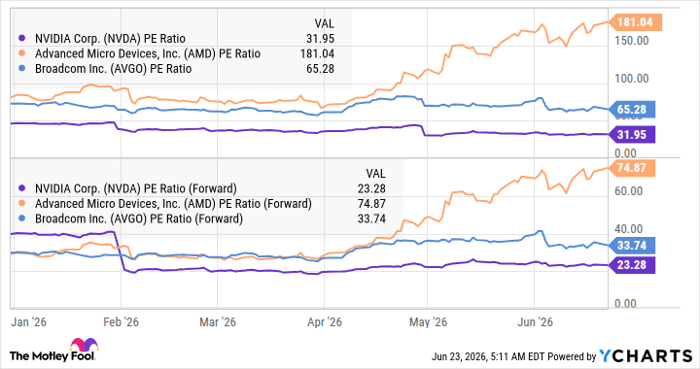
It won't be surprising to see Nvidia pulling ahead of AMD and Broadcom following its entry into the stand-alone server CPU market, where it is already poised to make a big dent this year. Also, Nvidia's latest generation Vera Rubin processors have been designed to substantially reduce inference costs. So, don't be surprised to see Nvidia dominating the AI inference market in the future, and that makes it a better buy than AMD and Broadcom, especially considering that it is the most attractively valued of the three.
Data by YCharts
So, Nvidia is likely to remain the top player in AI chips in the inference era, which is why investors should consider buying this AI stock while it trades at an attractive valuation.
Should you buy stock in Nvidia right now?
Before you buy stock in Nvidia, consider this:
The Motley Fool Stock Advisor analyst team just identified what they believe are the 10 best stocks for investors to buy now… and Nvidia wasn’t one of them. The 10 stocks that made the cut could produce monster returns in the coming years.
Consider when Netflix made this list on December 17, 2004... if you invested $1,000 at the time of our recommendation, you’d have $392,713!* Or when Nvidia made this list on April 15, 2005... if you invested $1,000 at the time of our recommendation, you’d have $1,227,782!*
Now, it’s worth noting Stock Advisor’s total average return is 897% — a market-crushing outperformance compared to 208% for the S&P 500. Don't miss the latest top 10 list, available with Stock Advisor, and join an investing community built by individual investors for individual investors.
See the 10 stocks »
*Stock Advisor returns as of June 24, 2026.
Harsh Chauhan has no position in any of the stocks mentioned. The Motley Fool has positions in and recommends Advanced Micro Devices, Broadcom, Meta Platforms, and Nvidia. The Motley Fool has a disclosure policy.
Recommended Articles


