




Former Fed Chair Jerome Powell Just Took a Jab at President Donald Trump, While Indirectly Leveling With Wall Street About Inflation
Key Points
Jerome Powell's final day as Fed chair was May 15, paving the way for Kevin Warsh to take the lead position (officially) on May 22.
The Federal Reserve's credibility is predicated on its independence from political persuasion.
Powell offered an indirect reality check on inflation that should hit home with Wall Street.
- 10 stocks we like better than S&P 500 Index ›
It's been quite the year for Wall Street and America's foremost financial institution, the Federal Reserve. Since the start of the year, the Dow Jones Industrial Average (DJINDICES: ^DJI), S&P 500 (SNPINDEX: ^GSPC), and Nasdaq Composite (NASDAQINDEX: ^IXIC) have all closed at record levels. As for the Fed, it's under new leadership.
The final day of Jerome Powell's second term as Fed chair was May 15. This paved the way for President Donald Trump's handpicked successor, Kevin Warsh, to take the baton (officially) on May 22. Warsh becomes the 17th head of the Fed since its creation in December 1913, and brings five years of experience (Feb. 24, 2006 – March 31, 2011) as a former member of the Board of Governors to the position.
Will AI create the world's first trillionaire? Our team just released a report on the one little-known company, called an "Indispensable Monopoly" providing the critical technology Nvidia and Intel both need. Continue »
But this was anything but a normal transition -- and Wall Street has taken notice.

Now-former Fed Chair Jerome Powell delivering remarks. Official Federal Reserve Photo.
Powell has chosen to serve out the remainder of his 14-year term on the Board of Governors (until January 2028), which is an uncharacteristic move for a former Fed chair. This means that while Powell is no longer leading the central bank, his speeches and votes on the Federal Open Market Committee (FOMC) will still have weight.
In his first comments since taking on his new role, the former Fed chair took a jab at President Trump, while also indirectly leveling with Wall Street about the challenges the FOMC faces.
The perception of credibility is paramount to the Fed's success
While accepting the John F. Kennedy Profile in Courage Award on May 31, now-Governor Powell delivered a roughly nine-minute acceptance speech that had a few tangents thrown in.
In particular, Powell homed in on the importance of the Federal Reserve's independence and the need to remain free of political persuasion. Said the former Fed chair:
We do not take into account the fortunes of any political party or politician in making those [monetary policy] decisions... Like many other institutions, the Fed has been undergoing a stress test. Congress wisely chose to insulate monetary policy decisions from political pressures.
While Jerome Powell never mentioned President Trump in his speech, the insinuation is crystal clear following a year of public disagreement between the two over the course of interest rates.
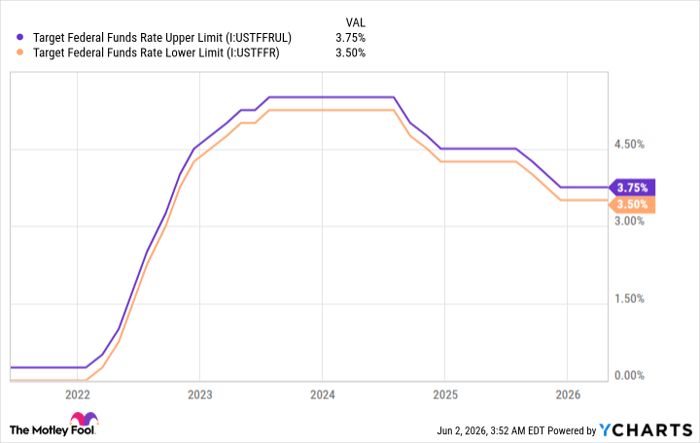
Target Federal Funds Rate Upper Limit data by YCharts.
Since the start of Trump's second, non-consecutive term on Jan. 20, 2025, he chastised Powell and other members of the FOMC for not aggressively slashing interest rates. Though the FOMC enacted six rate cuts from September 2024 through December 2025, the current federal funds target rate of 3.5% to 3.75% remains a far cry from the 1% or lower interest rate that Trump has repeatedly called for.
During his final year as Fed chair, Powell was adamant that he and the other members of the FOMC would rely on economic data to guide their monetary policy decisions.
Wall Street and investors have historically been forgiving of the FOMC when they've been tardy or outright wrong with their policy decisions. Since these decisions are made with backward-looking economic data, it's not uncommon for the nation's central bank to be behind the curve.
But the key point here is that the Fed maintains its credibility in investors' eyes when it sticks to its mission of maximum employment and price stability, and relies on economic data, not political opinions, to sway its decisions. The Fed is viewed as a foundational pillar for the stock market, so maintaining this credibility is of the utmost importance.

Former Fed Chair Jerome Powell speaking with President Trump. Image source: Official White House Photo by Daniel Torok.
The former Fed chair just gave investors an indirect reality check on inflation
In addition to Jerome Powell taking a jab at Donald Trump, he leveled with his audience and investors about the challenges the central bank faces:
Even in good times, central banks make monetary policy decisions under high uncertainty -- about the true state and path of the economy, and the timing and scope of the effects of our policies. At the Fed, we are, of course, human and thus imperfect. When we make mistakes, we acknowledge them and change course.
Not only do we see a bit of hubris in this statement by Powell, acknowledging that the FOMC's historically low federal funds target rate of 0% to 0.25% was, in hindsight, kept in place too long in 2021-2022, but we see the uncomfortable admission that even when things seem good, they're often uncertain from the standpoint of the FOMC's policymakers. And nothing is creating more uncertainty at the moment than inflation.
Yes, the Dow, S&P 500, and Nasdaq Composite have all hit record highs on the heels of the artificial intelligence revolution, and yes, corporate earnings have impressed. But there's also a high degree of uncertainty caused by the Iran war.
Trump's decision to attack Iran on Feb. 28 led the latter to close the Strait of Hormuz to virtually all commercial vessels. This has stymied the movement of 20 million barrels of petroleum liquids per day (about 20% of worldwide demand), representing the largest energy supply disruption in modern history.
FED HIKE ODDS JUMP
-- *Walter Bloomberg (@DeItaone) May 22, 2026
Markets now price a 43% chance of a Fed hike before 2027 -- the highest in months.
Odds have climbed in 2026 as the Fed stays on hold.https://t.co/sO21R9Zvxv
Next FOMC: June 30 (39 days). pic.twitter.com/ef91xFCZ2w
Unsurprisingly, energy prices have soared, with gas prices rising at the fastest clip in over 30 years. It's not uncommon for the adverse effects of energy supply shocks to lag for businesses by a few months. But once the effects of higher transportation and production costs are included in economic data, inflation often rises further.
In February, trailing 12-month (TTM) inflation was a modest 2.4% and moving closer to the Fed's long-term target of 2%. As of April, TTM inflation had surged to 3.8%. For May, the Cleveland Fed's Inflation Nowcasting tool estimates TTM inflation will jump another 38 basis points to 4.18%.
While new Fed Chair Kevin Warsh, Powell, and other members of the FOMC won't be hasty in adjusting monetary policy in light of this surge of inflation, the Iran war has undoubtedly created a level of uncertainty about inflation that can't be swept under the rug. The door is wide open for the central bank to shelve its easing bias or potentially even hike interest rates before the end of the year.
Adjusting to a more restrictive monetary stance could spell the end of Wall Street's historic rally.
Should you buy stock in S&P 500 Index right now?
Before you buy stock in S&P 500 Index, consider this:
The Motley Fool Stock Advisor analyst team just identified what they believe are the 10 best stocks for investors to buy now… and S&P 500 Index wasn’t one of them. The 10 stocks that made the cut could produce monster returns in the coming years.
Consider when Netflix made this list on December 17, 2004... if you invested $1,000 at the time of our recommendation, you’d have $443,191!* Or when Nvidia made this list on April 15, 2005... if you invested $1,000 at the time of our recommendation, you’d have $1,258,838!*
Now, it’s worth noting Stock Advisor’s total average return is 941% — a market-crushing outperformance compared to 211% for the S&P 500. Don't miss the latest top 10 list, available with Stock Advisor, and join an investing community built by individual investors for individual investors.
See the 10 stocks »
*Stock Advisor returns as of June 7, 2026.
Sean Williams has no position in any of the stocks mentioned. The Motley Fool has no position in any of the stocks mentioned. The Motley Fool has a disclosure policy.
Recommended Articles


