




Market Indexes Tumble at Midday as Treasury Yields Spike on Hot Employment Report
Key Points
May nonfarm payroll growth came in at 172,000, more than double what economists expected.
Traders are now fully pricing in a quarter-point Fed rate hike by the end of 2026.
SpaceX's $1.75 trillion IPO won't be eligible for S&P 500 inclusion until at least June 2027.
- 10 stocks we like better than NASDAQ Composite Index ›
Good news is bad news again, and Wall Street is having one of those days.
A blowout jobs report landed Friday morning, and stocks responded by doing the opposite of what you might expect. The Nasdaq Composite (NASDAQINDEX: ^IXIC) index dropped nearly 3% by 1:18 p.m. ET, the S&P 500 (SNPINDEX: ^GSPC) fell 1.8%, and even the stodgy Dow Jones Industrial Average (DJINDICES: ^DJI) slipped 0.8%.
Will AI create the world's first trillionaire? Our team just released a report on the one little-known company, called an "Indispensable Monopoly" providing the critical technology Nvidia and Intel both need. Continue »
The technology sector bore the brunt of the damage, dropping 4.3%, while defensive sectors including consumer staples, healthcare, and utilities posted gains. 172,000 new jobs is the kind of economic strength that makes investors nervous.
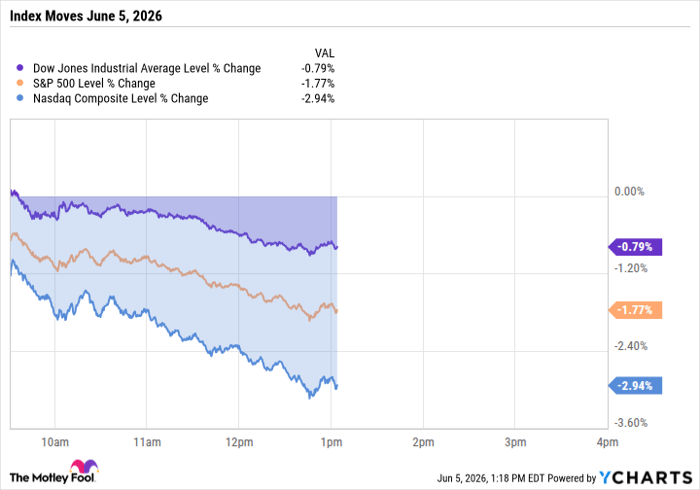
^DJI data by YCharts
Mo' jobs, mo' problems
Markets plunging on a stronger-than-expected jobs report may sound silly, but there's actually solid logic behind it.
May nonfarm payrolls rose by 172,000, more than double economists' expectations, while the unemployment rate held steady at 4.3%. That's great if you're looking for work, less great if you were hoping the Federal Reserve might hold off on raising interest rates. The data prompted traders to fully price in a quarter-point interest rate increase by the end of 2026.
Semiconductor stocks led the decline. Nvidia (NASDAQ: NVDA) dropped 5% and Broadcom (NASDAQ: AVGO) fell 5.5%, while Micron Technology (NASDAQ: MU) and AMD (NASDAQ: AMD) both lost more than 9%. These four companies alone erased over $500 billion in combined market capitalization by midday.
When money gets more expensive, high-growth tech valuations tend to compress. Today was a textbook example of that dynamic.
On the Dow, the usual heavyweights Goldman Sachs (NYSE: GS) burned 264 points and Caterpillar (NYSE: CAT) took away another 180 points. But 15 of the 30 Dow stocks are trading up today, led by defensive stalwarts. Coca-Cola (NYSE: KO) gained 3.8%, adding back 18 points, and Travelers (NYSE: TRV) boosted the Dow's total score by 54 points.

Image source: Getty Images.
Oil fell 3% despite ongoing uncertainty in the Strait of Hormuz situation. The crypto market experienced broad price drops, with Bitcoin (CRYPTO: BTC) sliding 4.9% and dropping below $61,000. Crypto investors were primed for volatility earlier this week, when Strategy (NASDAQ: MSTR) sold 32 Bitcoin to cover dividend payments. It was the company's first crypto sale since 2022, breaking from chairman Michael Saylor's long-standing "never sell Bitcoin" stance.
Elsewhere on the index front, SpaceX is preparing for its June 12 IPO at a $1.75 trillion valuation, but don't expect to see it in S&P 500 index funds anytime soon. SpaceX can't join until at least June 2027, and only if it turns a profit and boosts its public float. The Standard & Poor's selection panel is sticking to its stated requirements. The company lost nearly $5 billion last year, so it could take a while before SpaceX qualifies.
Playing defense into the weekend
The defensive rotation into healthcare, utilities, and consumer staples suggests institutional money is playing it safe heading into the weekend. That makes sense in light of the hiring surprise and its likely rate-boosting aftermath.
The companies leading today's decline remain among the most profitable in the market. Their fundamentals have not changed since yesterday. For retail investors, the takeaway is familiar: volatility is the cost of showing up on Wall Street.
Should you buy stock in NASDAQ Composite Index right now?
Before you buy stock in NASDAQ Composite Index, consider this:
The Motley Fool Stock Advisor analyst team just identified what they believe are the 10 best stocks for investors to buy now… and NASDAQ Composite Index wasn’t one of them. The 10 stocks that made the cut could produce monster returns in the coming years.
Consider when Netflix made this list on December 17, 2004... if you invested $1,000 at the time of our recommendation, you’d have $439,847!* Or when Nvidia made this list on April 15, 2005... if you invested $1,000 at the time of our recommendation, you’d have $1,342,065!*
Now, it’s worth noting Stock Advisor’s total average return is 968% — a market-crushing outperformance compared to 211% for the S&P 500. Don't miss the latest top 10 list, available with Stock Advisor, and join an investing community built by individual investors for individual investors.
See the 10 stocks »
*Stock Advisor returns as of June 5, 2026.
Anders Bylund has positions in Bitcoin, Micron Technology, and Nvidia. The Motley Fool has positions in and recommends Advanced Micro Devices, Bitcoin, Broadcom, Caterpillar, Goldman Sachs Group, Micron Technology, and Nvidia. The Motley Fool has a disclosure policy.
Recommended Articles


