




This Growth Stock Is Down Over 40% in 2026. Will Investors Regret Not Buying the Dip?
Key Points
Zscaler specializes in zero-trust cybersecurity, which is a preventative type of enterprise network protection.
The company recently lost two key executives, prompting management to issue very conservative guidance.
Zscaler's stock plummeted following the news, but its valuation now sits at an attractive level for investors.
- 10 stocks we like better than Zscaler ›
Zscaler (NASDAQ: ZS) is one of the world's leading cybersecurity companies. Its zero-trust architecture was designed to protect businesses from the most serious cyber threats, including those powered by advanced technologies like artificial intelligence (AI).
The company released its operating results for its fiscal 2026 third quarter (ended April 30) after the market closed on Tuesday, May 26, and despite a relatively strong report, its stock plummeted by 31% the next day. The company announced that two senior members of its sales department had left, so management subsequently issued very conservative revenue guidance for fiscal 2027.
Will AI create the world's first trillionaire? Our team just released a report on the one little-known company, called an "Indispensable Monopoly" providing the critical technology Nvidia and Intel both need. Continue »
Zscaler stock is now down 42% in 2026, but could this be a long-term buying opportunity for investors?

Image source: Getty Images.
Zero-trust security was built for the AI revolution
A zero-trust cybersecurity architecture treats every attempted connection to a corporate network as hostile, meaning that nobody receives automatic access. Zscaler's Zero Trust Exchange verifies each user not only by their login credentials, but also by analyzing the device they are using and their location. This increases the odds of stopping an imposter.
But the Zero Trust Exchange goes even further. It only connects employees to the specific applications they need to complete their jobs, so even if a malicious actor does bypass the identity security layer, they won't have unrestricted access to the entire corporate network. In essence, this minimizes the damage from a successful breach.
In 2024, Zscaler expanded its focus to include "branches," which can be anything from a warehouse to a factory to a retail store. This culminated in a product called Zero Trust Branch, which isolates those assets from the rest of the corporate network, so even if one of them is breached, the hacker can't compromise the rest of the organization.
Zscaler is now extending the Zero Trust Exchange to include AI agents, allowing enterprises to choose which specific applications or data files agents can access in order to complete tasks. This eliminates a hacker's ability to gain access to all of an organization's valuable assets by hijacking a single agent.
These new products tie Zscaler's "Zero Trust Everywhere" philosophy together. Hackers are increasingly using technologies like AI to launch sophisticated attacks at machine speed, meaning they can uncover vulnerabilities faster than ever before. As a result, a zero-trust architecture at the identity and application layers is no longer enough -- it has to be the standard across the entire organization.
Solid revenue growth, but weak forward guidance
Zscaler ended the fiscal 2026 third quarter with $3.5 billion in annual recurring revenue (ARR), which was a 25% increase from the year-ago period. That matched the 25% growth rate the company delivered in the second quarter three months earlier, suggesting there hasn't been a slowdown in momentum.
Nevertheless, Wall Street is nervous about the potential impact of Zscaler losing two senior sales employees during the quarter, particularly because the company offered very few details about their departures when probed by analysts. However, CFO Kevin Rubin did say the sales team could face disruptions in the near term as it adjusts to new leaders.
Some of that disruption was reflected in management's forward guidance, which suggests Zscaler's ARR growth could slow to just 16% in fiscal 2027. That is the key reason why its stock plummeted following the release of the third-quarter report. However, it's too early to know whether the conservative guidance will be accurate, and Zscaler does have a history of beating management's expectations.
After all, it appears that enterprises are buying into Zscaler's Zero Trust Everywhere philosophy at a blistering pace. At the end of the third quarter, the company had 700 customers in this category, which more than tripled from the year-ago period. I personally wouldn't bet against any company producing that kind of growth in its core product portfolio.
Zscaler stock is near the cheapest level in its history
Zscaler stock is trading at a price-to-sales (P/S) ratio of 6.6, which is close to the lowest level since its initial public offering (IPO) in 2018. Plus, it's significantly cheaper than competitors Palo Alto Networks and CrowdStrike:
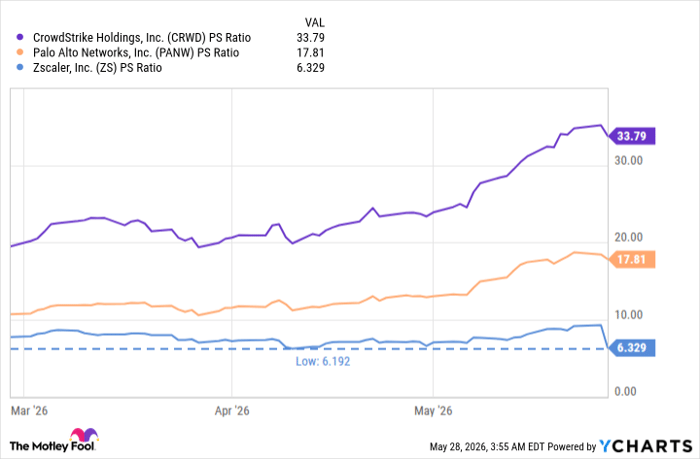
CRWD PS Ratio data by YCharts
From that perspective, Zscaler stock looks like a good value right now. I'm not suggesting it will achieve a similar P/S to CrowdStrike, because that company has a deeper product portfolio that targets a broader addressable market, so its long-term opportunity is larger. Besides, I happen to think a P/S ratio of over 30 is extremely expensive, particularly in a hyper-competitive industry like cybersecurity. However, even if Zscaler closes some of the valuation gap, its stock could deliver solid upside from here.
In summary, it wouldn't be wise to invest too aggressively in Zscaler stock until there is more clarity about its true growth trajectory next year, but I think demand will only increase for zero-trust architectures in the coming years, which should support strong long-term returns.
Should you buy stock in Zscaler right now?
Before you buy stock in Zscaler, consider this:
The Motley Fool Stock Advisor analyst team just identified what they believe are the 10 best stocks for investors to buy now… and Zscaler wasn’t one of them. The 10 stocks that made the cut could produce monster returns in the coming years.
Consider when Netflix made this list on December 17, 2004... if you invested $1,000 at the time of our recommendation, you’d have $463,900!* Or when Nvidia made this list on April 15, 2005... if you invested $1,000 at the time of our recommendation, you’d have $1,294,401!*
Now, it’s worth noting Stock Advisor’s total average return is 978% — a market-crushing outperformance compared to 211% for the S&P 500. Don't miss the latest top 10 list, available with Stock Advisor, and join an investing community built by individual investors for individual investors.
See the 10 stocks »
*Stock Advisor returns as of May 31, 2026.
Anthony Di Pizio has no position in any of the stocks mentioned. The Motley Fool has positions in and recommends CrowdStrike and Zscaler. The Motley Fool recommends Palo Alto Networks. The Motley Fool has a disclosure policy.
Recommended Articles


