




Can Sandisk Become a $1 Trillion Company in 5 Years?
Key Points
Sandisk is posting substantial sequential growth.
Sandisk is sold out of memory products through 2026, and tech giants are rushing to buy its 2027 production in advance.
A Melius Research report forecasts that memory demand will remain elevated for the rest of the decade.
- 10 stocks we like better than Sandisk ›
Sandisk (NASDAQ: SNDK) has been the top-performing S&P 500 stock over the past year, rising by about 4,200%. Its market cap has blasted past $240 billion, and based on its parabolic growth, a $1 trillion valuation may be realistic within the next five years.
Indeed, it may hit that milestone even earlier; fellow memory storage provider Micron (NASDAQ: MU) accomplished the feat recently, thanks to a surge of more than 800% over the past year. Sandisk has been growing faster than Micron in recent quarters, and both have long-term tailwinds.
Will AI create the world's first trillionaire? Our team just released a report on the one little-known company, called an "Indispensable Monopoly" providing the critical technology Nvidia and Intel both need. Continue »
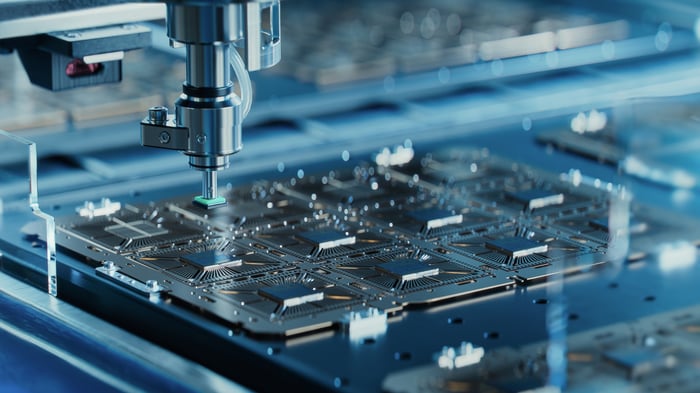
Image source: Getty Images.
Substantial sequential growth is fueled by compelling tailwinds
High sequential growth has been the main story that has helped Sandisk gain market cap so rapidly since it was spun back off from Western Digital in February 2025. In its fiscal 2026 third quarter (which ended April 3), Sandisk's revenue increased by 97% sequentially to $5.95 billion. Sandisk only brought in $1.7 billion in the prior-year period.
The NAND flash drive provider is riding the artificial intelligence (AI) wave. Grand View Research projects that the AI industry will grow at a compound annual rate of 30.6% through 2033. Sandisk has already been an outsized beneficiary of that trend, and its guidance implies high sequential growth will continue: The company is aiming for $8 billion at the midpoint for the fourth quarter of its fiscal 2026.
Maintaining that type of growth will be critical if the company is to reach a $1 trillion market cap within five years. Sandisk also boasts a surging net profit margin, which exceeded 60% in the most recent quarter. It was just 26.6% in the previous quarter, and in the one prior to that, it was just 4.9%.
Micron surprised many investors by reaching a $1 trillion market cap shortly after unlocking the perks of AI memory demand. Sandisk is achieving a similar degree of fundamental growth, but still is generating only about one-fourth of the revenue of Micron.
A multiyear chip shortage is upon us
One of the main concerns about investing in memory companies is that they operate in a cyclical industry. At intervals, demand grows for their products, resulting in a boom and a shortage, at which point the various players begin the multiyear process of building new production facilities to capitalize. In each previous cycle, supply has caught up to and exceeded waning demand, and those memory makers were left with inventory gluts that compelled them to cut prices and lower their margins.
The bust part of this boom-and-bust cycle seems far away, though, and elevated demand for memory chips may become the new normal. Nvidia CEO Jensen Huang anticipates more than $1 trillion in data center revenue for his company across 2026 and 2027. That means there will be plenty of demand for memory chips, which are critical hardware for AI infrastructure.
This also comes at a time when tech companies are ramping up their AI spending and seeing tangible results from those investments. As new innovations such as self-driving cars or agentic AI go mainstream, they will further boost demand for AI and memory chips, which will benefit Sandisk.
The company has already sold all the NAND flash drives it will be able to manufacture in 2026 and is generating strong demand for its 2027 production. Furthermore, in a recent report, Melius Research predicted that memory demand will remain strong through the end of the decade. Based on that outlook, Sandisk has a real shot at becoming a $1 trillion company within five years.
Should you buy stock in Sandisk right now?
Before you buy stock in Sandisk, consider this:
The Motley Fool Stock Advisor analyst team just identified what they believe are the 10 best stocks for investors to buy now… and Sandisk wasn’t one of them. The 10 stocks that made the cut could produce monster returns in the coming years.
Consider when Netflix made this list on December 17, 2004... if you invested $1,000 at the time of our recommendation, you’d have $463,900!* Or when Nvidia made this list on April 15, 2005... if you invested $1,000 at the time of our recommendation, you’d have $1,294,401!*
Now, it’s worth noting Stock Advisor’s total average return is 978% — a market-crushing outperformance compared to 211% for the S&P 500. Don't miss the latest top 10 list, available with Stock Advisor, and join an investing community built by individual investors for individual investors.
See the 10 stocks »
*Stock Advisor returns as of May 30, 2026.
Marc Guberti has no position in any of the stocks mentioned. The Motley Fool has positions in and recommends Micron Technology, Nvidia, and Western Digital. The Motley Fool has a disclosure policy.
Recommended Articles


