




New Fed Chair Kevin Warsh Has a $6.7 Trillion Conundrum -- and Wall Street Is Stuck in the Middle
Key Points
Jerome Powell's successor, Kevin Warsh, has officially taken over as Fed chair.
One question looms large for the new head of the Fed: How to tackle the central bank's bloated balance sheet?
Though Warsh would like to see the Fed "get out of the fiscal business," altering the Fed's balance sheet may not offer an amicable solution for Wall Street and investors.
- 10 stocks we like better than S&P 500 Index ›
It's been a year filled with history on Wall Street. We've watched the iconic Dow Jones Industrial Average (DJINDICES: ^DJI), broad-based S&P 500 (SNPINDEX: ^GSPC), and growth-driven Nasdaq Composite (NASDAQINDEX: ^IXIC) all hit record highs, and we're awaiting the largest initial public offering in history from SpaceX.
We've also witnessed an incredibly rare change in power at America's foremost financial institution, the Federal Reserve.
Will AI create the world's first trillionaire? Our team just released a report on the one little-known company, called an "Indispensable Monopoly" providing the critical technology Nvidia and Intel both need. Continue »
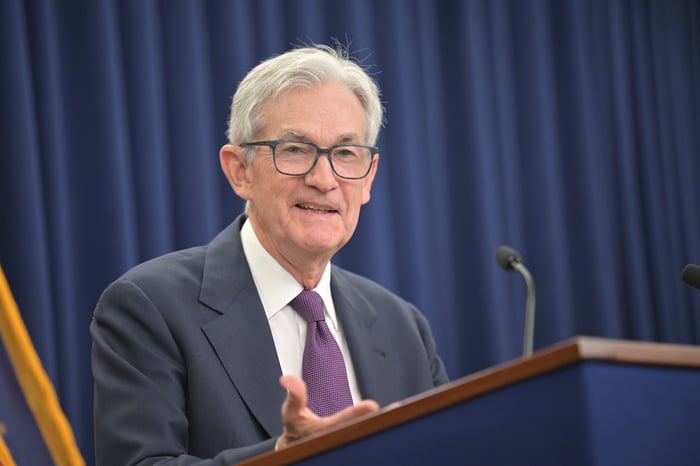
Jerome Powell's final day as Fed chair was May 15. Image source: Official Federal Reserve Photo.
Jerome Powell hands the baton to new Fed Chair Kevin Warsh
Friday, May 15, marked the final day of Jerome Powell's second term as Fed chief. Vocal disagreements about interest rates between President Donald Trump and Powell made it clear that he wouldn't be back for a third term.
Trump has repeatedly chastised Powell and the other members of the Federal Open Market Committee (FOMC) -- the 12-person body responsible for setting the nation's monetary policy -- for not aggressively cutting interest rates to 1% or below. Lower interest rates have the potential to accelerate economic growth, boost hiring, and foster a lending environment that spurs innovation.
Meanwhile, Powell regularly highlighted the price stickiness of the president's tariffs on the goods sector and, more recently, the inflationary effects of the Iran war, as reasons why interest rates weren't cut.
BREAKING: April PPI Inflation surges to 6%, well above expectations of 4.9% and the highest level since January 2023.
-- The Kobeissi Letter (@KobeissiLetter) May 13, 2026
Core PPI Inflation rose to 5.2%, above expectations of 4.3%.
Both CPI and PPI Inflation are now officially at 3+ year highs.
Odds of rate HIKES are rising.
Succeeding Powell and becoming only the 17th individual to hold the position of Fed chair is Trump's nominee, Kevin Warsh.
Warsh previously served on the Board of Governors of the Federal Reserve and was a voting member of the FOMC from Feb. 24, 2006, to March 31, 2011. He was one of the instrumental figures who helped steer the American economy through the financial crisis in 2008-2009.
But just because the new head of the Fed brings experience to the position, it doesn't mean his job will be easy. Powell's successor is facing a $6.7 trillion conundrum right out of the gate, and Wall Street is stuck in the middle.
Kevin Warsh's $6.7 trillion question may not have a pleasant answer for Wall Street
As is the case with the ascension of virtually every new Fed chair, there are more questions than answers for Wall Street and investors.
For example, Warsh's FOMC voting record shows his monetary policy stance primarily leaned hawkish from 2006 to 2011. In simpler terms, Warsh often cautioned against lowering the federal funds target rate, even as the unemployment rate soared during the financial crisis. His track record suggests he favors higher interest rates to curb inflationary pressures, which threatens to put him at odds with President Trump.
Kevin Warsh Nomination: one reason why market players are interpreting it as a hawkish pick- I agree-is because of his views on the need for a radical balance sheet reduction.
-- Joseph Brusuelas (@joebrusuelas) January 30, 2026
The $31 trillion-dollar American economy demands liquidity & financing needs that are larger than what... pic.twitter.com/zYunGAItV8
But there's an even bigger question that looms large for the new Fed chair: What to do about the central bank's $6.7 trillion balance sheet?
The Fed's new leader has been a vocal critic of the ballooning of its balance sheet since the financial crisis. Between August 2008 and March 2022, the central bank's balance sheet grew roughly tenfold to almost $9 trillion. Following a period of quantitative tightening, the Fed's total assets sit at approximately $6.7 trillion, comprised mainly of long-term U.S. Treasury bonds and mortgage-backed securities.
Kevin Warsh's "pitch" is relatively straightforward: dispose of (most of) these assets and allow America's leading financial institution to rightly be a market observer rather than an active participant. During his testimony before the Senate Banking Committee, Warsh even commented that the "Fed needs to get out of the fiscal business."
However, paring down a $6.7 trillion balance sheet from America's financial bedrock isn't as easy as it sounds, and may come with potentially dire consequences for Wall Street.

Image source: Getty Images.
Deleveraging the Fed's balance sheet could be disastrous for an expensive stock market
The key dynamic for investors to consider is that bond prices and yields move in opposite directions.
If Warsh is successful in lobbying for a significant reduction in the balance sheet, it would mean the eventual sale of trillions of dollars in long-term Treasury bonds. Doing so would depress long-term Treasury bond prices, increase yields, and send borrowing rates (including mortgage rates) higher.
Typically, an increase in lending rates wouldn't be a make-or-break scenario for the stock market -- but this isn't your typical stock market.
According to the S&P 500's Shiller Price-to-Earnings (P/E) Ratio, the stock market began 2026 at its second-priciest valuation in history, and the artificial intelligence (AI) revolution has only made it more expensive. The Shiller P/E Ratio of 42.18 on May 14 is within eyeshot of the all-time high of 44.19, set months before the bursting of the dot-com bubble in December 1999.
Shiller PE is now less than 5% away from surpassing the level reached during the Dot Com Bubble which would give the stock market its most expensive valuation in history 🚨🚨🚨 pic.twitter.com/Qd8rvlVvUn
-- Barchart (@Barchart) May 14, 2026
Investors began the year expecting several interest rate cuts in 2026-2027. With those cuts effectively off the table due to elevated inflation, and Warsh's balance sheet reduction proposal threatening to raise lending rates, it's a worst-case scenario for a historically pricey stock market.
At the same time, the Fed choosing to do nothing with its bloated balance sheet can be just as damaging. If Warsh isn't successful in convincing his peers to pare down the Fed's trillions in total assets, the ongoing artificial depression of long-term interest rates could fuel rampant risk-taking and inefficient capital allocation, leading to another dot-com bubble-bursting event (only this time led by AI).
Jerome Powell's successor has quite the $6.7 trillion conundrum on his hands, and there may not be an amicable solution for Wall Street and investors.
Should you buy stock in S&P 500 Index right now?
Before you buy stock in S&P 500 Index, consider this:
The Motley Fool Stock Advisor analyst team just identified what they believe are the 10 best stocks for investors to buy now… and S&P 500 Index wasn’t one of them. The 10 stocks that made the cut could produce monster returns in the coming years.
Consider when Netflix made this list on December 17, 2004... if you invested $1,000 at the time of our recommendation, you’d have $469,293!* Or when Nvidia made this list on April 15, 2005... if you invested $1,000 at the time of our recommendation, you’d have $1,381,332!*
Now, it’s worth noting Stock Advisor’s total average return is 993% — a market-crushing outperformance compared to 207% for the S&P 500. Don't miss the latest top 10 list, available with Stock Advisor, and join an investing community built by individual investors for individual investors.
See the 10 stocks »
*Stock Advisor returns as of May 17, 2026.
Sean Williams has no position in any of the stocks mentioned. The Motley Fool has no position in any of the stocks mentioned. The Motley Fool has a disclosure policy.
Recommended Articles


