




Better Buy: Taiwan Semiconductor vs. Micron Stock
Key Points
Taiwan Semiconductor offers leading technology.
Micron operates in a commodity market.
- 10 stocks we like better than Micron Technology ›
In the chip manufacturing world, there are two primary types of chips made: memory and logic chips. Each serves a different purpose in a computer, and each is important.
In the logic chip world, there is no bigger manufacturer than Taiwan Semiconductor (NYSE: TSM). In the memory world, it's a bit more spread out, and Micron (NASDAQ: MU) is among the largest producers. However, many investors are intrigued by the investment opportunities offered by these chipmakers.
Will AI create the world's first trillionaire? Our team just released a report on the one little-known company, called an "Indispensable Monopoly" providing the critical technology Nvidia and Intel both need. Continue »
The biggest draw is that they are a somewhat neutral investment. Both companies do business with nearly every chip designer, and as long as artificial intelligence (AI) demand continues to grow, these two should thrive.
But which is the better buy right now? Let's take a look.
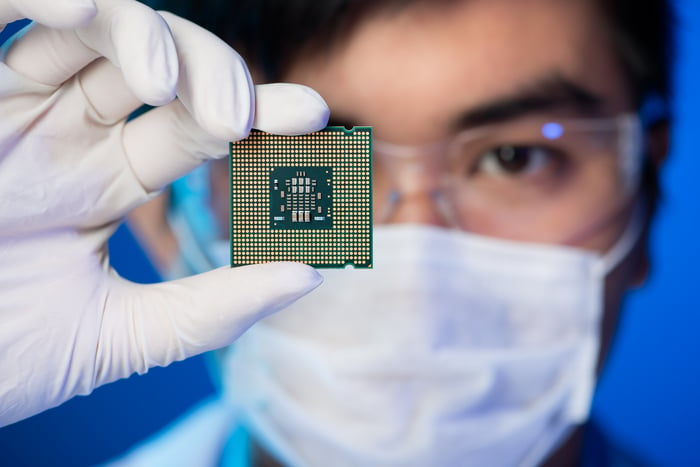
Image source: Getty Images.
The logic chip market is more stable than the memory chip market
The chip industry is notoriously cyclical. There is a recurring boom-and-bust cycle that happens along a random time frame in the chip world. It's impossible to predict the start and finish of these cycles, which makes investing in them a bit difficult, but not impossible.
Furthermore, the level of cyclicity each company displays varies by product. Between manufacturers, there are quite a few differences in logic chips. This variety makes them a bit less susceptible to market cycles because it differentiates one product from another.
In the memory chip space, there is hardly anything to separate one provider from another, so chip prices are more commodity-like and heavily affected by supply-and-demand economics.
Currently, demand for memory chips is at an all-time high, while supply is lagging. During Micron's last quarterly conference call, management noted that they would only be able to meet half to two-thirds of medium-term demand. That sentiment is echoed across the memory chip industry, where supply hasn't kept pace with demand. Furthermore, the market for memory chips is expanding each year, so demand isn't slowing down, either.
This boom creates a huge tailwind for Micron, which is boosting its revenue. However, once capacity has been built out, memory prices may return to normal levels, making a company like Taiwan Semiconductor a far more stable investment. Most investors (including myself) prefer stability, so I'm giving this category win to Taiwan Semiconductor.
Winner: Taiwan Semiconductor
The memory chip shortage is delivering unreal growth to Micron
Micron's latest quarterly results have been jaw-dropping, thanks to booming memory chip prices. In Q2 of fiscal year (FY) 2026 (ending Feb. 26), its revenue totaled $23.9 billion. For comparison, it was a mere $8.05 billion last year. Next quarter, it expects $33.5 billion in revenue.
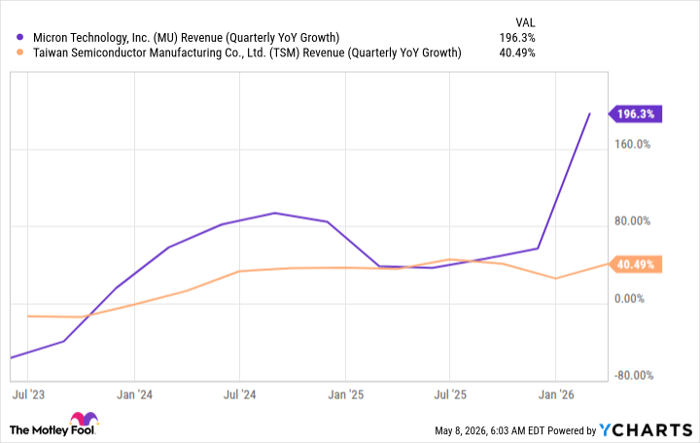
MU Revenue (Quarterly YoY Growth) data by YCharts
Don't be surprised to see the growth rate stay sustained for a long time frame, as the memory shortage is real and could persist for several years.
At a 40% revenue growth rate, Taiwan Semiconductor is posting excellent results. However, it's tough to compete with a company whose product is seeing insatiable demand with soaring prices.
Winner: Micron
Valuing these two is tricky
Because Micron is a more cyclical business, it normally trades at a pretty hefty discount. This discount springs from its unpredictability, and most investors don't want to invest in cyclical businesses.
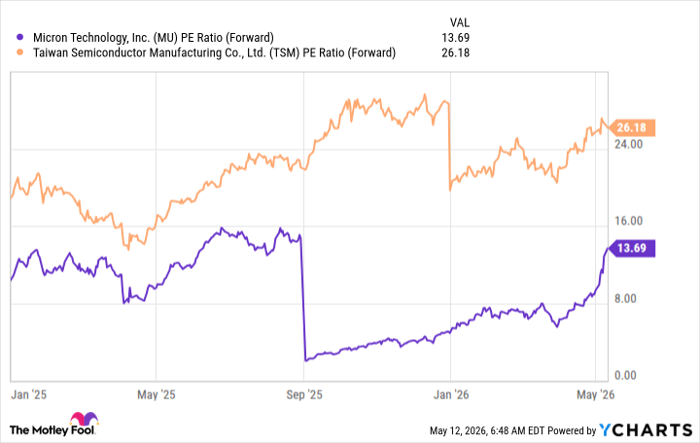
MU PE Ratio (Forward) data by YCharts
As a result, Micron looks dirt cheap at 14 times forward earnings, while Taiwan Semiconductor is pretty expensive at 26 times forward earnings. The question is, is Micron's price worth it versus Taiwan Semiconductor's premium?
I think that is a question each investor must decide for themselves. If you want a set-it-and-forget-it stock, Taiwan Semiconductor is a better bet. If you want a stock that can deliver maximum upside, but you must watch industry trends to see if chip demand is falling, then Micron is a better pick.
Winner: Tie
Although these two both make chips, they are vastly different investments. One isn't categorically better than the other. Investors must choose which one is right for them, or they can invest in both.
Should you buy stock in Micron Technology right now?
Before you buy stock in Micron Technology, consider this:
The Motley Fool Stock Advisor analyst team just identified what they believe are the 10 best stocks for investors to buy now… and Micron Technology wasn’t one of them. The 10 stocks that made the cut could produce monster returns in the coming years.
Consider when Netflix made this list on December 17, 2004... if you invested $1,000 at the time of our recommendation, you’d have $472,744!* Or when Nvidia made this list on April 15, 2005... if you invested $1,000 at the time of our recommendation, you’d have $1,353,500!*
Now, it’s worth noting Stock Advisor’s total average return is 991% — a market-crushing outperformance compared to 207% for the S&P 500. Don't miss the latest top 10 list, available with Stock Advisor, and join an investing community built by individual investors for individual investors.
See the 10 stocks »
*Stock Advisor returns as of May 13, 2026.
Keithen Drury has positions in Taiwan Semiconductor Manufacturing. The Motley Fool has positions in and recommends Micron Technology and Taiwan Semiconductor Manufacturing. The Motley Fool has a disclosure policy.
Recommended Articles


