




Century Aluminum Is Building a $4 Billion Smelter. Is CENX Stock a Buy Right Now?
Key Points
The new smelter would double the U.S. aluminum capacity in the U.S.
Century's stock is up more than 22% so far this month.
Its new smelter is looking to benefit from lower-cost energy sources.
- 10 stocks we like better than Century Aluminum ›
Century Aluminum (NASDAQ: CENX) has seen its shares rise more than 22% over the past month. The company is making a significant transition, evolving from a high-volatility commodity play into a dominant leader of U.S. primary aluminum production.
The Chicago-based company operates primary aluminum smelting facilities in Oklahoma, Kentucky, South Carolina, and Iceland, and is the majority owner and managing partner of the Jamalco alumina refinery in Jamaica. Its smelters produce bauxite, alumina, and primary aluminum.
Will AI create the world's first trillionaire? Our team just released a report on the one little-known company, called an "Indispensable Monopoly" providing the critical technology Nvidia and Intel both need. Continue »
Here are three reasons why investors are looking closely at this materials stock:
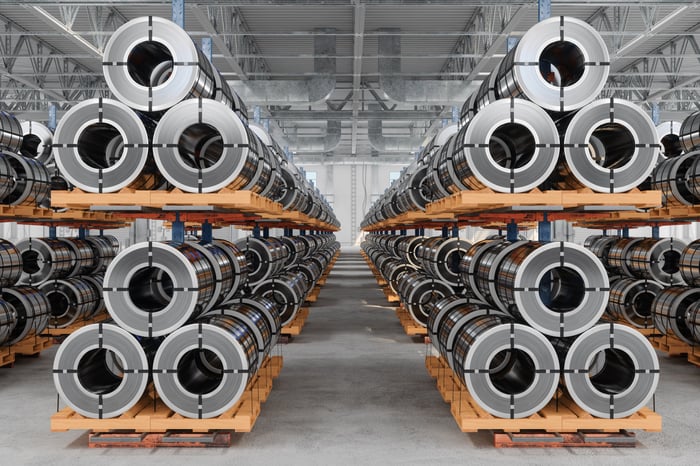
Image source: Getty Images.
It is significantly scaling up its operations
In February, the company announced that it is partnering with Emirates Global Aluminium to build the first new aluminum smelter in the U.S. in 46 years, in Oklahoma.
Once the new Oklahoma smelter is complete, it is expected to produce 750,000 tons annually, effectively doubling current U.S. capacity. The project positions Century as a critical infrastructure play for the U.S. government, which views primary aluminum as a critical metal for defense and aerospace security.
The joint agreement came on top of two other moves to increase aluminum operations. On April 23, Century said it had moved up the restart of the second potline at its Norðurál smelter in Grundartangi, Iceland, and it is close to completing the final stages of its Mount Holly smelter expansion in South Carolina. The Mount Holly project alone is expected to increase total U.S. primary aluminum production by 10%, the company said.
Tightened demand is driving price spikes
The global aluminum market has tightened significantly in early 2026, creating a perfect storm for producers with domestic capacity. Aluminum supplies have fallen due to permanent capacity constraints, reduced Chinese flexibility, lower North American demand, higher energy costs, trade barriers, and geopolitical risks. These factors together have made the market structurally tighter, so even small disruptions can have outsize effects on prices and availability.
As of April 28, global aluminum prices hit approximately $3,578 per metric ton, up roughly 46% from the previous year. Analysts have raised their first-half 2026 price forecasts due to low global inventories and high demand for grid expansion and electric vehicles.
The company has also benefited from reinforced Section 232 aluminum tariffs, which protect domestic producers from lower-priced imports. This policy support, combined with high regional premiums, is expected to drive the company's first-quarter adjusted earnings before interest, taxes, depreciation, and amortization (EBITDA) to between $215 million and $235 million, up from $128.2 million in the fourth quarter, driven by improved metal pricing and regional premiums, partially offset by temporary higher energy costs.
In 2025, the company reported sales of $2.53 billion, up 13.9%, and adjusted earnings per share (EPS) of $2.46, up 242%, led mainly by higher aluminum prices.
The company will cash in on green-energy savings
The reason no smelters have been built in the U.S. over the past 50 years is that powering them is expensive, and the electrolysis process that extracts aluminum from alumina relies on a steady, cheap, reliable source of electricity.
In 2024, the company secured a Department of Energy award of up to $500 million to build a first-of-its-kind green aluminum smelter, specifically designed to use low-carbon energy, making its product attractive to the electric vehicle (EV) and aerospace sectors, which have strict Scope 3 emission targets. The smelter in Oklahoma, once complete, will benefit from nearby natural gas sources as well as hydropower and wind farms that produce a surplus of relatively cheap electricity.
The Oklahoma smelter will be the first in the U.S. to use EGA's EX smelting technology, which lowers the energy intensity per ton of aluminum produced compared to the 1970s-era technology used in most other U.S. plants. The lower costs of this smelter could significantly improve Century's margins.
For all these reasons above, investors should take a closer look at Century Aluminum now.
Should you buy stock in Century Aluminum right now?
Before you buy stock in Century Aluminum, consider this:
The Motley Fool Stock Advisor analyst team just identified what they believe are the 10 best stocks for investors to buy now… and Century Aluminum wasn’t one of them. The 10 stocks that made the cut could produce monster returns in the coming years.
Consider when Netflix made this list on December 17, 2004... if you invested $1,000 at the time of our recommendation, you’d have $504,832!* Or when Nvidia made this list on April 15, 2005... if you invested $1,000 at the time of our recommendation, you’d have $1,223,471!*
Now, it’s worth noting Stock Advisor’s total average return is 971% — a market-crushing outperformance compared to 202% for the S&P 500. Don't miss the latest top 10 list, available with Stock Advisor, and join an investing community built by individual investors for individual investors.
See the 10 stocks »
*Stock Advisor returns as of May 1, 2026.
James Halley has no position in any of the stocks mentioned. The Motley Fool has no position in any of the stocks mentioned. The Motley Fool has a disclosure policy.
Recommended Articles


