




Could IonQ Stock Turn $10,000 Into $100,000 This Decade?
Key Points
IonQ's revenue grew by 202% to $130 million in 2025, and management expects another surge to between $225 million and $245 million in 2026.
However, it's still losing money and trades at an expensive valuation, making it a risky investment.
- 10 stocks we like better than IonQ ›
IonQ (NYSE: IONQ) hit a major milestone in 2025, when it became the first pure-play quantum computing company to surpass $100 million in annual GAAP revenue. It reported $130 million in revenue for the year, a 202% year-over-year increase. That was largely thanks to its 80% year-over-year organic revenue growth.
Since quantum computing is in the early stages, investors are hoping for explosive growth. IonQ is leading the pack among the pure-play options so far, so could a 10x return this decade be on the table?
Will AI create the world's first trillionaire? Our team just released a report on the one little-known company, called an "Indispensable Monopoly" providing the critical technology Nvidia and Intel both need. Continue »
Image source: The Motley Fool.
The bull case is compelling
The case for IonQ as an investment starts with its trapped-ion technology, which has achieved a world-record 99.99% two-qubit gate fidelity. Gate fidelity measures the accuracy of quantum operations.
When it comes to quantum systems, seemingly minuscule differences in gate fidelity can make a massive difference. IonQ says that 99.99% fidelity means customers can run applications with a 10 billion-fold performance increase compared to gate fidelity of 99.9%, the previous gold standard, on the same-sized device.
IonQ's technical advantage has helped it attract a diverse and growing customer base. In 2025, commercial clients accounted for over 60% of sales, and international clients accounted for over 30%. The quantum computing company has also landed quite a few federal and defense contracts, including four Air Force Research Laboratory contracts, each worth about $100 million, from 2022 to 2025.
Management expects revenue to continue ramping up, guiding for $225 million to $245 million in 2026. On the technical side, IonQ recently released a roadmap with an objective of 2 million physical qubits and 80,000 logical qubits by 2030. That's a lofty goal -- it's planning to launch systems with 100 to 256 physical qubits this year -- but if achieved, it could lead to significant advancements in commercial uses for quantum computing, such as drug discovery and machine learning.
IonQ is still an expensive and high-risk stock
Even with its revenue growth, IonQ trades at about 96 times trailing sales at the time of this writing (April 27). That's less than its closest competitors in the quantum computing space. D-Wave Quantum, Rigetti Computing, and Quantum Computing all cost even more. IonQ is arguably the most reasonably priced of the group.
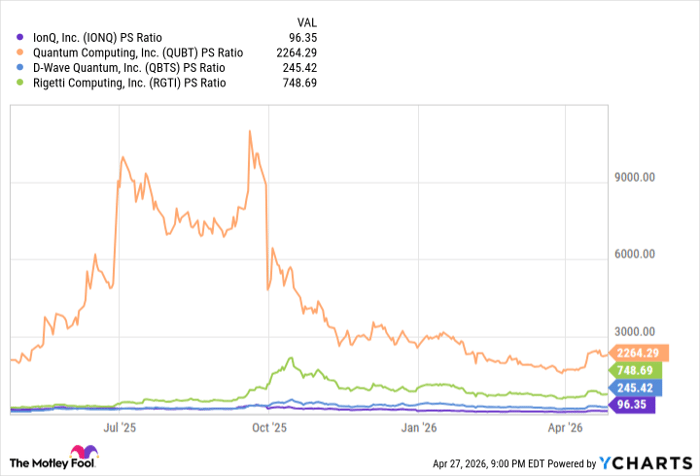
IONQ PS Ratio data by YCharts
But quantum computing stocks trade at much higher valuations than most stocks. The tech-heavy Nasdaq-100 index, in comparison, trades at about 6.5 times sales. Pure-play quantum computing companies are also unprofitable. In IonQ's case, it reported a net loss of $510.4 million in 2025.
Could IonQ deliver 10x returns by 2030?
IonQ sits at a market cap of about $16 billion. Turning $10,000 into $100,000 would mean reaching a market cap of about $160 billion. It would also almost certainly require at least 10x revenue growth, and probably much more, as I doubt IonQ will trade at such a sky-high valuation for the rest of the decade.
This kind of growth is within the realm of possibility. McKinsey projects that quantum computing revenue will grow from $4 billion in 2024 to as much as $72 billion by 2035, a trajectory that would give IonQ the opportunity to multiply its revenue.
I think it's more likely that IonQ doesn't achieve 10x returns by 2030, although it could fall short of that mark and still be extremely successful. It has significant growth potential if everything goes right. Just be careful how much you invest, given the substantial risk.
Should you buy stock in IonQ right now?
Before you buy stock in IonQ, consider this:
The Motley Fool Stock Advisor analyst team just identified what they believe are the 10 best stocks for investors to buy now… and IonQ wasn’t one of them. The 10 stocks that made the cut could produce monster returns in the coming years.
Consider when Netflix made this list on December 17, 2004... if you invested $1,000 at the time of our recommendation, you’d have $492,752!* Or when Nvidia made this list on April 15, 2005... if you invested $1,000 at the time of our recommendation, you’d have $1,327,935!*
Now, it’s worth noting Stock Advisor’s total average return is 991% — a market-crushing outperformance compared to 201% for the S&P 500. Don't miss the latest top 10 list, available with Stock Advisor, and join an investing community built by individual investors for individual investors.
See the 10 stocks »
*Stock Advisor returns as of April 28, 2026.
Lyle Daly has no position in any of the stocks mentioned. The Motley Fool has positions in and recommends IonQ. The Motley Fool has a disclosure policy.
Recommended Articles


