




3 Green Energy Stocks for Investors Playing the Long Game in 2026
Key Points
Hydrogen fuel cells haven’t caught on nearly as well as once expected. Bloom Energy’s tweak is changing that.
Cameco may not be a conventional green energy name, but it still solves a serious, pressing problem in a way that’s environmentally friendly.
Like Cameco, GE Vernova isn’t a company people think of when they think of renewables. Just take a closer look at its product lineup and how it works.
- 10 stocks we like better than Bloom Energy ›
There's no denying the green energy mania that enthralled investors in the industry's not-so-recent past has since cooled. Nuclear power seems to be all the rage now, and fossil fuels aren't fading away nearly as quickly as previously anticipated.
If you think renewables stocks don't offer investors enough upside to bother with them, however, think again. The United States' Energy Information Administration reports that a little over half of the nation's installed power capacity in 2025 was solar, with wind accounting for another 14%. Natural gas and coal still collectively produce the majority of the country's electricity, but coal's share is shrinking fast, while renewables' share has doubled over the past 15 years.
Will AI create the world's first trillionaire? Our team just released a report on the one little-known company, called an "Indispensable Monopoly" providing the critical technology Nvidia and Intel both need. Continue »
And yet, renewable energy still only produced less than 20% of the United States' total power in 2025. Similar proportions and trends apply outside of the U.S. as well. This is why -- and how -- Mordor Intelligence expects the worldwide renewable energy market to grow at an average annual pace of nearly 14% through 2031, although it's likely to continue expanding at a comparable rate for far longer.
With that as the backdrop, here's a rundown of three fantastic green energy stocks that long-term investors can buy right now with plans of holding onto them forever.
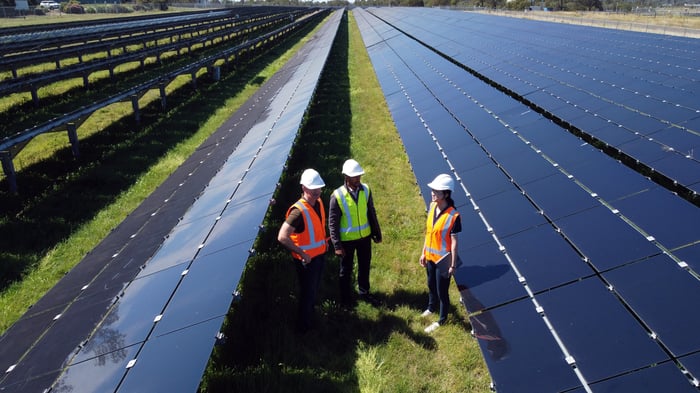
Image source: Getty Images.
Bloom Energy
In light of the sheer number of years hydrogen fuel cell outfit Plug Power failed to deliver as expected, it would be easy to doubt that seemingly similar Bloom Energy (NYSE: BE) will fare any better.
There's a little tweak with its electricity-generating technology, however, that makes a big difference. That's the flexibility and durability of its fuel cells themselves. They're solid oxide fuel cells, with a ceramic electrolyte rather than a more commonly used polymer membrane. This not only allows its equipment to operate at higher temperatures but also allows it to use natural gas, biogas, or hydrogen as its fuel source.
Natural gas, of course, is already readily available, although hydrogen and biogas aren't exactly outside of the mainstream anymore, particularly given that Bloom also supplies the electrolyzing equipment that lets its customers produce their own hydrogen.
And the marketplace is clearly responding. Driven by a customer base that includes Honda, AT&T, and Oracle, just to name a few, last year's revenue grew 37% to just over $2 billion, pushing the company to a much firmer operating profit of nearly $73 million and $114 million in operational cash flow.
This is still just the beginning. The company's backlog of business now stands at roughly $20 billion. Given the amount of future business that's already lined up, the analyst community is calling for top-line growth of nearly 60% this year and more than 60% next year.
Cameco
Nuclear power was one of the energy sources many green energy proponents hoped to continue moving away from when more renewables like wind and solar became viable. The fact is, however, nuclear has since proven itself to be safe and environmentally friendly. It is part of the green energy movement, and a part of it that the International Atomic Energy Agency expects to nearly double its total power output by 2050.
This, of course, means the nuclear power industry will need a lot more nuclear fuel ... uranium, to be specific.
Enter Cameco (NYSE: CCJ).
It's not just one of the world's uranium miners and enrichers. It's one of the biggest and best among a small number of names in the business. It produced 21 million pounds of uranium last year, driving nearly $3.5 billion in revenue versus 2024's comparison of a little less than $3.2 billion. The company's also sitting on more than 400 million pounds of the stuff, plus more than 400 million pounds' worth of proven and probable reserves, in addition to more than 150 million pounds of inferred resources. It's also apt to find more as that uranium is dug up.
And this underscores what makes this ticker such a compelling investment prospect. See, Cameco is integrated from end to end, starting with a massive source of supply and ending with the ability to refine and convert this material into a final product needed by nuclear power plants. It even holds a sizable stake in Westinghouse, providing it with exposure to the nuclear power facility construction and service market.
Connect the dots. If the nuclear power industry is going to grow, it's not going to grow without Cameco's involvement.
GE Vernova
Finally, add GE Vernova (NYSE: GEV) to your list of long-term green energy stocks to buy this year.
Like Cameco, some people might debate whether or not this is actually a green energy name. It makes wind turbines, but they only make up less than 20% of its total business. The company's big breadwinner is natural gas power turbines, but natural gas is still technically a fossil fuel.
Gas is a largely misunderstood fossil fuel; however, it burns very cleanly, producing far fewer emissions than most other hydrocarbons. In fact, given the chemicals required and created by the manufacture and eventual disposal of solar panels and lithium batteries, there's an argument to be made that natural gas is certainly no worse for the environment than more conventional green energy solutions.
And gas turbines offer another upside that's proving to be a stumbling block for wind and solar power. That's the fact that turbines can be powered up or powered down as needed, while solar and wind remain subject to the weather and the time of day.
For what it's worth, GE Vernova makes power turbines that can run on biogas and other man-made gases, including those produced by industrial processes like coking and refining.
The market's figuring all of this out, too. This company's top line improved by 16% last quarter, growing to just over $9.3 billion -- a pace it expects to maintain for the rest of the year. That's only a drop in the bucket, though. As of the end of March, its order backlog stands at $163 billion. The company's chief challenge right now is simply figuring out how to add more production capacity.
Should you buy stock in Bloom Energy right now?
Before you buy stock in Bloom Energy, consider this:
The Motley Fool Stock Advisor analyst team just identified what they believe are the 10 best stocks for investors to buy now… and Bloom Energy wasn’t one of them. The 10 stocks that made the cut could produce monster returns in the coming years.
Consider when Netflix made this list on December 17, 2004... if you invested $1,000 at the time of our recommendation, you’d have $498,522!* Or when Nvidia made this list on April 15, 2005... if you invested $1,000 at the time of our recommendation, you’d have $1,276,807!*
Now, it’s worth noting Stock Advisor’s total average return is 983% — a market-crushing outperformance compared to 200% for the S&P 500. Don't miss the latest top 10 list, available with Stock Advisor, and join an investing community built by individual investors for individual investors.
See the 10 stocks »
*Stock Advisor returns as of April 28, 2026.
James Brumley has positions in AT&T. The Motley Fool has positions in and recommends Bloom Energy, Cameco, GE Vernova, and Oracle. The Motley Fool has a disclosure policy.
Recommended Articles


