




2 Energy Dividend Stocks Paying You to Wait While Oil Prices Stay Elevated
Key Points
The closure of the Strait of Hormuz has caused oil and gas prices to spike.
Enterprise Products Partners is a major American energy midstream company with a yield of almost 6%.
Enbridge owns pipelines that span the U.S. and Canada with green energy facilities in North American and Europe. It pays a 5.25% yield.
- 10 stocks we like better than Enterprise Products Partners ›
For most of the past year, oil prices hovered between $50 and $70 per barrel, and prices at the pump were generally stable and affordable. But that all changed in late February when the current war between the United States, Israel, and Iran broke out.
Oil was at $60 per barrel at the end of February, but the Strait of Hormuz closure and the chaos of the conflict pushed it to $109 per barrel in early April. Prices have since come down but remain elevated at around the $85-$95 range.
Will AI create the world's first trillionaire? Our team just released a report on the one little-known company, called an "Indispensable Monopoly" providing the critical technology Nvidia and Intel both need. Continue »
Peace negotiations are ongoing, but despite an extended ceasefire, the throttling of Persian Gulf shipping is likely to keep oil prices elevated for a while. Especially considering that Iran lost track of some of the sea mines it placed in the strait when it was initially closed.
It's an unfortunate reality of our global energy market. But it could be very fortunate for you if you give these two high-yield energy dividend stocks a look.
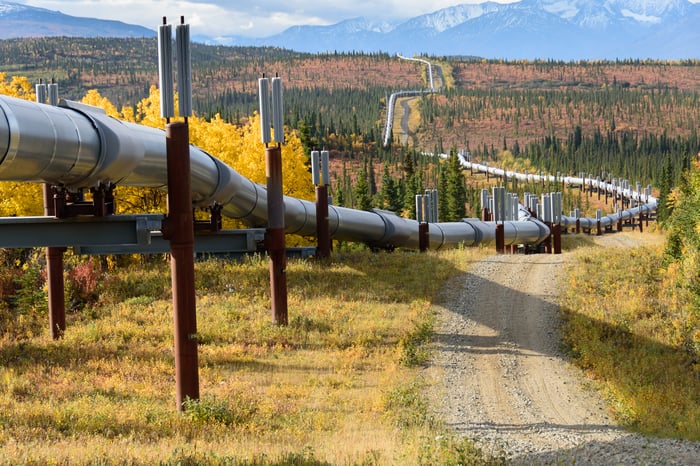
Image source: Getty Images.
1. Energy Products Partners: Its distribution yields 5.75%
Up first is Enterprise Products Partners (NYSE: EPD), which doesn't technically pay a dividend. It's a master limited partnership and pays a distribution instead. It works very similarly to a dividend, though. And right now, Enterprise Products Partners' distribution yields 5.75%.
Enterprise owns and runs a vast network of oil and gas pipelines, refineries, and storage facilities across the United States, with a presence in most of America's major oil fields. As a midstream company, it doesn't extract oil or gas from the ground. It just moves it to where it can be refined and shipped for use. You can think of Enterprise and companies like it as the providers of the energy equivalent of the interstate highway system. And Enterprise saw record volumes in its processing plants and pipelines last year.
Enterprise has a net profit margin of 11.17% and has remained consistently around that figure for several years. It also has a stable debt-to-equity ratio of 1.14. As for its distribution, that's the main way Enterprise returns value to shareholders. It has raised its annual dividend for 29 years in a row, and with a relatively high, but healthy, forward payout ratio of 69.24%, it should be able to continue its growth streak for the foreseeable future.
At a nearly 6% yield, it's worth your consideration to collect some fat profits while you sit back and wait for energy markets to return to normal.
2. Enbridge: Bridging the gap with a 5.25% yield
Canada's Enbridge (NYSE: ENB) is a midstream company like Enterprise Products Partners -- it simply operates on a larger scale. Its pipelines and refineries tie together the enormous energy markets of Canada and the United States. Unlike Enterprise, however, Enbridge has also entered the renewable energy space, owning several solar plants and battery storage facilities across the United States, wind farms in the U.S., Canada, and Western Europe, and even a geothermal plant in Oregon.
Also, unlike Enterprise, Enbridge is a normal dividend-paying company, so you don't need to worry about any potential differences between company dividends and partnership distributions.
The company finished 2025 at the top end of management's guidance and has reaffirmed its 2026 guidance, which is set to see it continue its 8% EBITDA compound annual growth rate (CAGR) since 2023 and its 3% distributable cash flow (DCF) per share CAGR of 3% over the same time frame.
Enbridge has a comparable net profit margin to Enterprise at 11.95% and a higher debt-to-equity ratio of 1.61. However, Enterprise saw a 6.4% revenue decline in 2025, while Enbridge managed 21.92% revenue increase.
These companies are very similar, and that continues in their dividends. Enbridge has grown its dividend for 30 years in a row, and it yields 5.25% at current prices. However, Enbridge's payout ratio is a much less healthy 117% at the moment. Its payout ratio has been much higher in the past (it was at 268% in 2022). On a GAAP basis, the figure is admittedly high, but Enbridge targets paying out 60%–70% of its distributable cash flow (a non-GAAP figure) to shareholders, specifically to attract income-focused investors. The non-GAAP measure suggests the payout is safe, and Enbridge has a 31-year streak of dividend increases.
Both of these stocks offer a solid way to profit as we wait and see what energy markets do as the situation in the Persian Gulf continues.
Should you buy stock in Enterprise Products Partners right now?
Before you buy stock in Enterprise Products Partners, consider this:
The Motley Fool Stock Advisor analyst team just identified what they believe are the 10 best stocks for investors to buy now… and Enterprise Products Partners wasn’t one of them. The 10 stocks that made the cut could produce monster returns in the coming years.
Consider when Netflix made this list on December 17, 2004... if you invested $1,000 at the time of our recommendation, you’d have $498,522!* Or when Nvidia made this list on April 15, 2005... if you invested $1,000 at the time of our recommendation, you’d have $1,276,807!*
Now, it’s worth noting Stock Advisor’s total average return is 983% — a market-crushing outperformance compared to 200% for the S&P 500. Don't miss the latest top 10 list, available with Stock Advisor, and join an investing community built by individual investors for individual investors.
See the 10 stocks »
*Stock Advisor returns as of April 28, 2026.
James Hires has no position in any of the stocks mentioned. The Motley Fool has positions in and recommends Enbridge. The Motley Fool recommends Enterprise Products Partners. The Motley Fool has a disclosure policy.
Recommended Articles


