




SSO vs. SPYM: Which Is the Best Way to Buy the S&P 500?
Key Points
The State Street SPDR Portfolio S&P 500 ETF has delivered an annualized return of 14.2% for the past 10 years.
With the power of leverage, the SSO Ultra S&P 500 ETF has achieved higher gains of 21.2% annually in that time.
However, leveraged ETFs tend to involve risks and volatility that aren’t appropriate for most long-term investors.
- 10 stocks we like better than State Street SPDR Portfolio S&P 500 ETF ›
A common bit of advice for beginning investors is to "just buy an S&P 500 index fund." But there's more than one way to do this. A variety of S&P 500 ETFs make it possible to buy all the stocks of the 500 largest publicly traded U.S. companies, often at low fees. If you want to get more aggressive with your investing, you could choose a leveraged S&P 500 ETF that lets you buy stocks with borrowed money.
Let's look at two popular funds that let you buy the S&P 500. The State Street SPDR Portfolio S&P 500 ETF (NYSEMKT: SPYM) is a straightforward low-cost index fund that tracks the S&P 500 -- whatever return the index delivers, this fund will pass on to you with minimal expenses. But if you are open to a higher level of risk and volatility, the SSO Ultra S&P 500 ETF (NYSEMKT: SSO) is another choice -- this is a leveraged ETF designed to double the daily performance of the S&P 500.
Will AI create the world's first trillionaire? Our team just released a report on the one little-known company, called an "Indispensable Monopoly" providing the critical technology Nvidia and Intel both need. Continue »
Over the past 10 years, SSO has delivered average annual returns (by net asset value) of 21.2%, while the non-leveraged SPYM has generated 14.2% per year. But choosing the best ETF isn't just about past performance. Here's a quick breakdown for how investors can choose between SSO vs. SPYM.

Image source: Getty Images.
SPYM: a simple, low-cost way to buy the S&P 500
If you want an easy, low-fee S&P 500 index fund, the State Street SPDR Portfolio S&P 500 ETF is one of the best. This fund charges an expense ratio of 0.02%, which is one of the lowest in the investment industry.
As for what's in the fund, the holdings aren't complicated. This ETF gives you the entire S&P 500 index, representing 80% of the U.S. stock market. The top 10 holdings are nine major tech names like Nvidia, Apple and Microsoft, plus Berkshire Hathaway Class B shares.
Some investment commentators have warned recently that the S&P 500 is not as diversified as it used to be, because so much of the index is weighted toward tech stocks. But based on recent trends, investment dollars seem to be rotating out of tech and toward the hundreds of other stocks in the S&P 500.
That's one reason why SPYM has outperformed the tech-heavy Nasdaq-100 index year to date. Even if tech stocks continue to struggle, SPYM could still be a good buy.
SSO: a leveraged ETF for amplified S&P 500 returns
The S&P 500 index tends to deliver an average annual return of 10% per year over the long run. But some investors want their money to grow faster. By using borrowed money (leverage) to buy stocks, investors can amplify their returns when share prices go up -- but leverage also makes declines bigger.
The State Street SPDR Portfolio S&P 500 ETF lets you use the power of leverage to generate 2 times the daily performance of the S&P 500. So if the S&P 500 goes up 1% tomorrow, your shares in SSO would go up 2%. But leverage also magnifies the downside risk: If the S&P 500 drops 2% in a day, your shares would go down twice as fast, or 4% in one day.
SSO has a solid long-term track record of outperforming the S&P 500. If you believe that the stock market will always deliver 10% per year on average, and you can stomach the short-term fluctuations of watching your balance sometimes get smaller because of leverage, this could be a good way to buy the S&P 500.
Why choose SPYM instead of SSO
However, there are two big reasons why SSO might not be appropriate for most investors. The first is fees. This ETF charges a net expense ratio of 0.87%. That's on the higher end of the range of ETF fees, because the SSO fund managers use complex methods to make trades based on leverage and derivatives. Just buying a simple low-cost index fund like SPYM is a better move if you're concerned about fees.
The other reason not to use a leveraged ETF to buy the S&P 500 is that the long-term gains aren't as impressive. SSO has generated average annual returns of 14.5% since the fund's inception in June 2006. That's better than SPYM's long-term average returns of 10.7% per year since November 2005, but it's not twice as good. Doubling the daily performance of the S&P 500 is not the same thing as doubling the long-term performance. Sometimes with leverage, losses are magnified more than gains.
For example, in the past five years, SSO has gained more than 105%, which is more than the gains for SPYM (65.3%) but not twice as much.
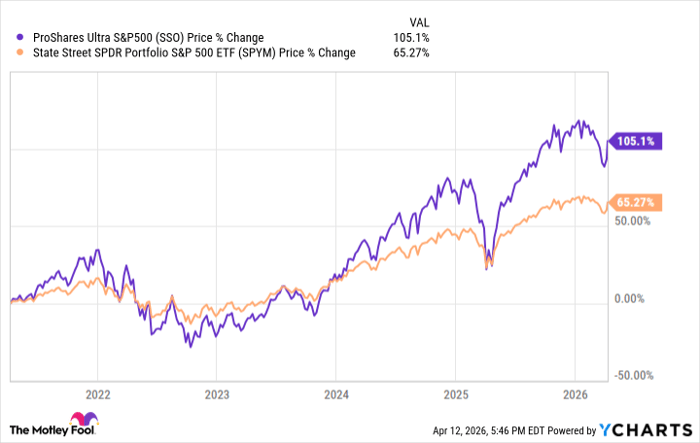
SSO data by YCharts
And year to date, SPYM is down 0.32%, while SSO has declined by 2.49%. Getting 2 times the daily return of the S&P 500 doesn't guarantee that you'll get 2 times the long-term return -- you might be risking too much for not enough long-term gain.
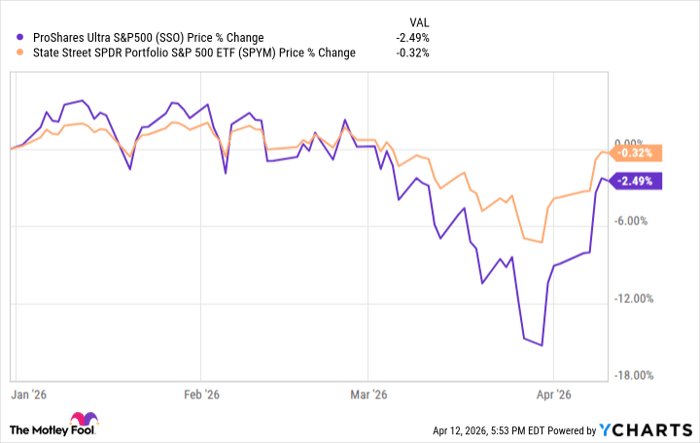
SSO data by YCharts
Day traders who are trying to make short-term moves based on what they think will happen next in the stock market might want a leveraged ETF like SSO. But most long-term investors who are saving for retirement should keep things simple and choose SPYM.
Should you buy stock in State Street SPDR Portfolio S&P 500 ETF right now?
Before you buy stock in State Street SPDR Portfolio S&P 500 ETF, consider this:
The Motley Fool Stock Advisor analyst team just identified what they believe are the 10 best stocks for investors to buy now… and State Street SPDR Portfolio S&P 500 ETF wasn’t one of them. The 10 stocks that made the cut could produce monster returns in the coming years.
Consider when Netflix made this list on December 17, 2004... if you invested $1,000 at the time of our recommendation, you’d have $580,872!* Or when Nvidia made this list on April 15, 2005... if you invested $1,000 at the time of our recommendation, you’d have $1,219,180!*
Now, it’s worth noting Stock Advisor’s total average return is 1,017% — a market-crushing outperformance compared to 197% for the S&P 500. Don't miss the latest top 10 list, available with Stock Advisor, and join an investing community built by individual investors for individual investors.
See the 10 stocks »
*Stock Advisor returns as of April 16, 2026.
Ben Gran has no position in any of the stocks mentioned. The Motley Fool has positions in and recommends Apple, Berkshire Hathaway, Microsoft, and Nvidia and is short shares of Apple. The Motley Fool has a disclosure policy.
Recommended Articles


