




What Happens If Tesla's Robotaxi Service Flops?
Key Points
One of Tesla's core ambitions with artificial intelligence (AI) is building a network of driverless taxis.
The company expects its Robotaxi service to rival legacy ride-hailing platforms.
Tesla's current valuation reflects enormous optimism for the Robotaxi service, despite its limited progress so far.
- These 10 stocks could mint the next wave of millionaires ›
For years, Tesla (NASDAQ: TSLA) has been touting its now-nascent Robotaxi service as more than a ride-hailing app. It's being marketed as a self-sustaining network of autonomous vehicles that the company asserts will generate billions of dollars of high-margin revenue. Yet the gap between vision and execution in full-self-driving technology is vast.
If the Robotaxi service underdelivers, it would not necessarily signal the end of Tesla. Rather, a flop like this would expose the fragility of the company's valuation, which is already pricing in future game-changing successes from artificial intelligence (AI).
Will AI create the world's first trillionaire? Our team just released a report on the one little-known company, called an "Indispensable Monopoly" providing the critical technology Nvidia and Intel both need. Continue »
The gap between narrative-driven hype and real-world autonomy
Building fully autonomous systems is not simply a function of software toggles. This type of technology is an engineering breakthrough layered with puzzles. Even the most advanced driver-assistance systems falter when they encounter edge cases from time to time.
If Tesla's full self-driving systems struggle in more sophisticated environments -- construction zones, erratic pedestrians, or sensor-confusing weather -- public confidence in their safety will erode. Riders will not trust a robotic system that lacks the reliability and reflexes of a human driver who can improvise in real time.
Unlike aircraft or elevators, which earn trust through visible safety redundancies, driverless taxis' decision-making abilities are hidden within a massive but intangible code base. All it will take to stall the adoption curve of this technology are a few videos of confused autonomous vehicles blocking traffic or behaving in an apparently erratic way. The risk is that Tesla could wind up operating its Robotaxi service at a more limited scale than it hopes -- burning cash on an underutilized fleet rather than printing cash with a heavily utilized one.
Image source: Getty Images.
Factoring in the competition
The biggest hurdles that the Robotaxi will face along its path toward widespread adoption won't come from lengthy regulatory approval processes. Instead, they'll involve everyday human behaviors and the existence of rival options.
Many city-dwellers are already accustomed to using low-cost e-bikes or rental scooters to get around in lieu of cars, and at least a few metropolises have robust subway systems and other mass transit options. Meanwhile, established ride-hailing platforms or specialized autonomous fleets that are already operating across select cities can cherry-pick profitable markets -- navigating around Tesla's all-or-nothing approach.
In the long run, adoption of autonomous driving services may not stall because the technology is impossible to develop to a level of safety that people feel comfortable with, but more so because it targets a problem that people don't feel the need to pay a premium for a solution to. In theory, this could keep the Robotaxi's per-mile costs elevated.
The risk is of a valuation decline, but not a full collapse
Even if its Robotaxi service flops, relatively speaking, Tesla will survive. The company's electric-vehicle business, energy-storage unit, and manufacturing scale remain formidable. The real risk revolves around its stock price, which already reflects the future value of a successful Robotaxi business.
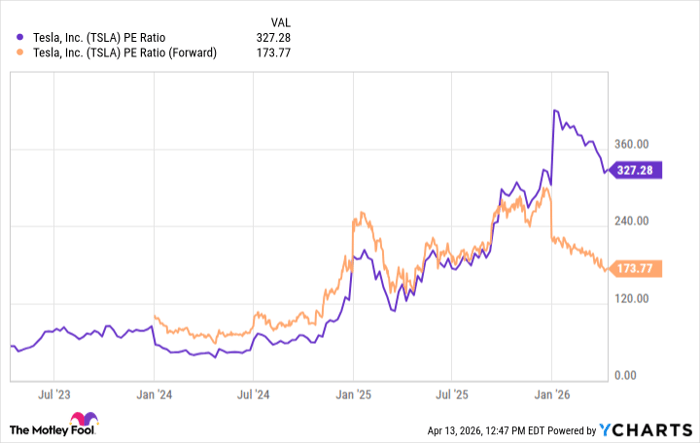
TSLA PE Ratio data by YCharts; PE = price-to-earnings ratio.
A visible shortfall in the return on Tesla's investments in this AI-driven technology would likely trigger a harsh rerating of the stock, with lower valuation multiples and slower stock price appreciation as investors pressure management to prove the company's value through today's products over tomorrow's promises.
A future without a widely-used and profitable Robotaxi service would likely see the company relying on cheaper vehicle models, expanding its energy offerings, and repositioning autonomy as a feature rather than a network monopoly. While such a misfire would not kill Tesla, it would force the market to reckon with reality. Narrative-driven hype has inflated the company's valuation over the last several years. Now, execution must sustain it.
Don’t miss this second chance at a potentially lucrative opportunity
Ever feel like you missed the boat in buying the most successful stocks? Then you’ll want to hear this.
On rare occasions, our expert team of analysts issues a “Double Down” stock recommendation for companies that they think are about to pop. If you’re worried you’ve already missed your chance to invest, now is the best time to buy before it’s too late. And the numbers speak for themselves:
- Nvidia: if you invested $1,000 when we doubled down in 2009, you’d have $515,842!*
- Apple: if you invested $1,000 when we doubled down in 2008, you’d have $50,733!*
- Netflix: if you invested $1,000 when we doubled down in 2004, you’d have $580,872!*
Right now, we’re issuing “Double Down” alerts for three incredible companies, available when you join Stock Advisor, and there may not be another chance like this anytime soon.
See the 3 stocks »
*Stock Advisor returns as of April 16, 2026.
Adam Spatacco has positions in Tesla. The Motley Fool has positions in and recommends Tesla. The Motley Fool has a disclosure policy.
Recommended Articles


