




If You Only Buy 1 AI Stock This Year, Wall Street Says Make It This One
Key Points
Alphabet has a track record of investing for growth.
The tech giant's capital investments are masking its underlying cash flow.
- 10 stocks we like better than Alphabet ›
Wall Street is almost unanimous: Of the 67 analysts covering Alphabet (NASDAQ: GOOG) (NASDAQ: GOOGL), 60 have buy or outperform ratings on the stock, seven have hold ratings, and none have sell ratings, according to S&P Global Market Intelligence. The Google owner is definitely a favorite among analysts. Here's why.
The bond markets love Alphabet, too
It's not just equity market analysts who love Alphabet; the bond markets favor the stock as well. It's no secret that the market is questioning the mammoth capital expenditures planned by artificial intelligence (AI) hyperscalers to build out their data center infrastructure. Indeed, shares of Oracle and Microsoft have slumped steeply over the last six months (by 52% and 27%, respectively) as investors fret over their exposure to OpenAI. Moreover, in the case of Oracle, the debt markets are pricing in fears of possible liquidity problems.
Will AI create the world's first trillionaire? Our team just released a report on the one little-known company, called an "Indispensable Monopoly" providing the critical technology Nvidia and Intel both need. Continue »
That said, the debt markets have little concern about Alphabet's ability to fund its investments.

Image source: Getty Images.
Alphabet is already a winner in cloud computing
The main reason the market doesn't doubt Alphabet's ability to fund its AI plans and still grow its profits is its dominant position in internet search and other Google services. The earnings and cash flow from search enabled Alphabet to build a leading cloud computing business, Google Cloud, which is rapidly becoming a significant source of income for the company.
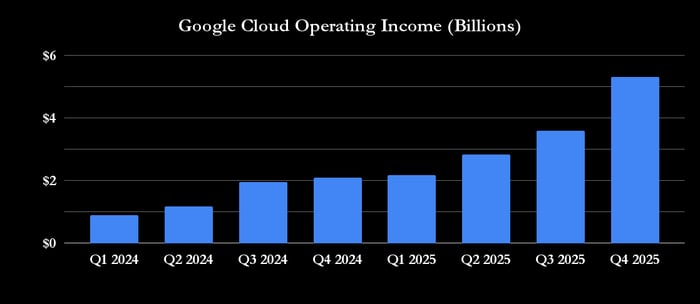
Data source: Alphabet presentations. Chart by author.
The principle of investing heavily now to generate future income also applies to Alphabet's AI investments. According to Alphabet's statements and analysts' estimates, the company is significantly ramping up its capital expenditures. As a rough rule of thumb, a company's depreciation can be approximated by its maintenance capital spending (the amount needed to maintain the assets required to maintain current earnings). As you can see below, the gap between Alphabet's capital spending and its depreciation and amortization is exploding, reflecting its AI investments.
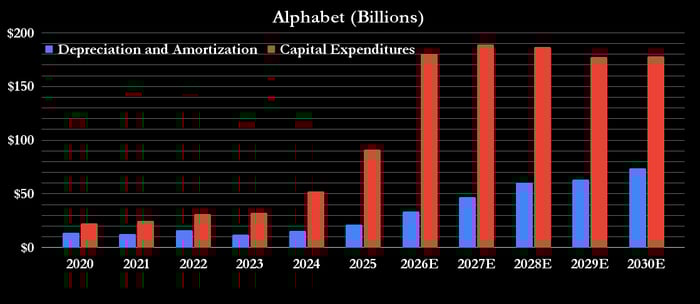
Data source: S&P Global Market Intelligence. Chart by author.
Alphabet is attractively valued
Moreover, Alphabet remains attractively valued. The average 12-month price target on the stock is about $376, and the following table outlines the company's estimated enterprise value (market cap plus net debt, or EV) relative to estimated free cash flow (FCF) based on analyst estimates.
By way of example, I've calculated the EV-to-FCF ratio using FCF, assuming capital expenditures equal depreciation and amortization.
| Metric |
2025 |
2026 (Estimated) |
2027 (Estimated) |
2028 (Estimated) |
2029 (Estimated) |
2030 (Estimated) |
|---|---|---|---|---|---|---|
|
Free cash flow |
$73.3 billion |
$22.2 billion |
$49.4 billion |
$94.8 billion |
$151.7 billion |
$192.7 billion |
|
EV-to-FCF ratio |
51.2 |
170 |
75.7 |
39.5 |
23.9 |
18.2 |
|
Free cash flow* |
$143.6 billion |
$164.5 billion |
$187.4 billion |
$220.6 billion |
$264.7 billion |
$301.9 billion |
|
EV-to-FCF ratio* |
26.1 |
22.9 |
20 |
17 |
13.7 |
11.6 |
Data source: S&P Global Market Intelligence, author's analysis. *Based on equating capital spending with depreciation and amortization estimates.
This analysis is not perfect. After all, Alphabet is a growth business and needs growth capex, too. In addition, Alphabet is spending more on shorter-cycle technologies such as servers and graphics processing units. However, the EV/FCF metric does indicate the underlying cash flow the company is generating, and as capital spending starts to decline in 2028 (see the second chart above), Alphabet's stock will look like a great value.
Should you buy stock in Alphabet right now?
Before you buy stock in Alphabet, consider this:
The Motley Fool Stock Advisor analyst team just identified what they believe are the 10 best stocks for investors to buy now… and Alphabet wasn’t one of them. The 10 stocks that made the cut could produce monster returns in the coming years.
Consider when Netflix made this list on December 17, 2004... if you invested $1,000 at the time of our recommendation, you’d have $573,160!* Or when Nvidia made this list on April 15, 2005... if you invested $1,000 at the time of our recommendation, you’d have $1,204,712!*
Now, it’s worth noting Stock Advisor’s total average return is 1,002% — a market-crushing outperformance compared to 195% for the S&P 500. Don't miss the latest top 10 list, available with Stock Advisor, and join an investing community built by individual investors for individual investors.
See the 10 stocks »
*Stock Advisor returns as of April 16, 2026.
Lee Samaha has no position in any of the stocks mentioned. The Motley Fool has positions in and recommends Alphabet, Microsoft, and Oracle. The Motley Fool has a disclosure policy.
Recommended Articles


