




Risk-Off Sentiment Dissipates, Asia-Pacific Stocks Rally, Nikkei 225 Closes at New Record High
TradingKey - On April 16, the Nikkei 225 index not only recouped all losses from the U.S.-Iran conflict but also set a new record high at the close, rising 2.64% to 59,667.89, extending its recent strong upward trend with a year-to-date gain of 18.23%, making it one of the standout performers among major global stock indices.
Driven by a temporary easing of external risks and capital inflows, the Japanese stock market continues to attract incremental funding.
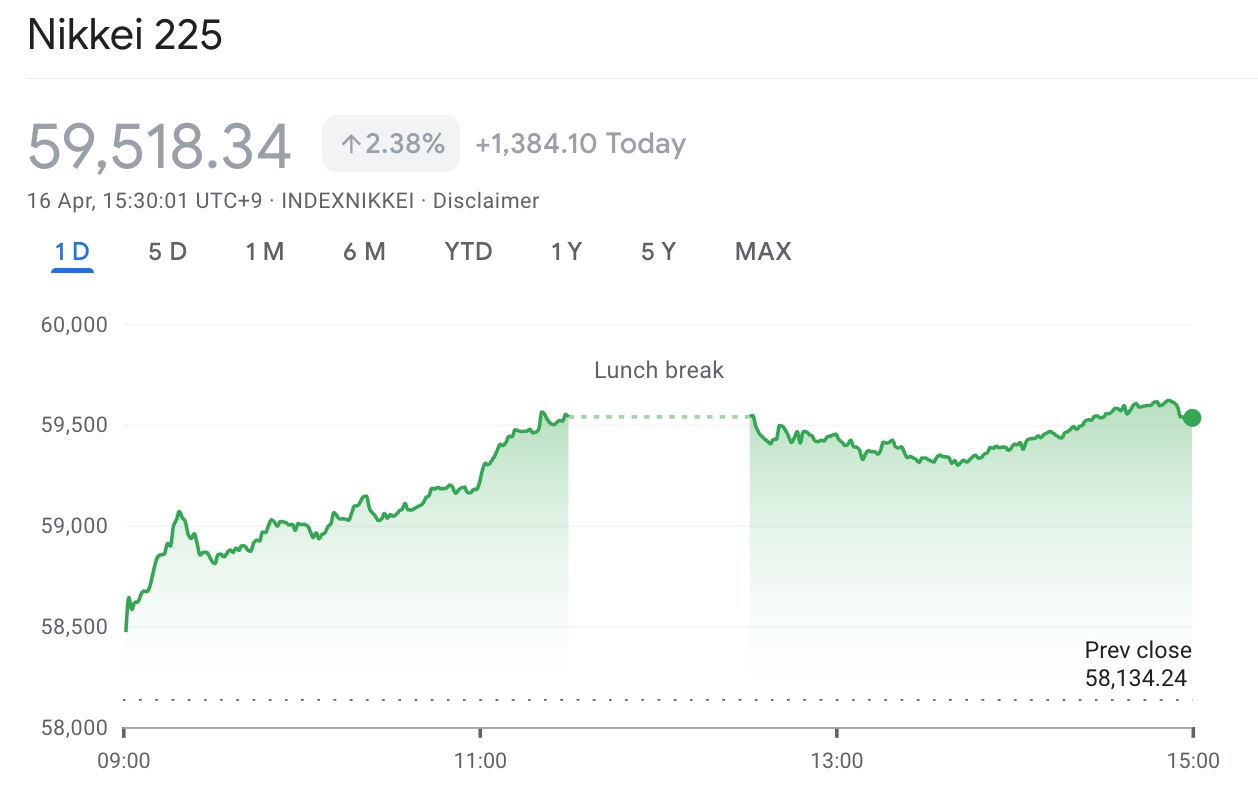
[Nikkei 225 Hits Record High, Source: Google Finance]
From a market perspective, this rally is clearly driven by heavyweight stocks, with electronics, semiconductors, and export-oriented leaders leading the advance. Against the backdrop of Japan's moderate economic recovery and improved corporate earnings expectations, combined with the relative weakness of the yen, the profit margins of export enterprises have been further expanded, serving as the core driver pushing the index to record highs.
On the macro level, tensions in the Middle East have cooled recently, and market concerns over an escalation of the U.S.-Iran conflict have eased at the margin, leading to a marked recovery in risk appetite. The geopolitical premium that previously weighed on global markets has rapidly receded, and the Japanese market, as a key destination for foreign capital allocation, has directly benefited from this sentiment recovery.
Simultaneously, global liquidity expectations have shown signs of marginal improvement. Although uncertainty persists regarding the policy paths of major central banks, market fears of further monetary tightening have eased, providing periodic support for high-valuation growth assets.
Structurally, the current rally in Japanese equities is driven not only by external liquidity but also by internal factors such as improved corporate governance and increased capital efficiency. In recent years, the optimization of share buyback and dividend policies, along with regulatory efforts to reform capital markets, has continuously enhanced the appeal of the Japanese market.
However, caution is warranted as valuation levels have reached relatively high points following the rapid ascent, and short-term volatility risks have accumulated. Should external disruptions occur, such as renewed geopolitical tensions or a reversal in global liquidity expectations, the market may face periodic correction pressure.
Overall, the Nikkei 225 index reaching a new all-time high reflects the reallocation of global funds into high-quality markets during a phase of recovering risk appetite. Driven by the resonance of internal and external factors, the medium-term trend for Japanese stocks remains resilient, though attention should be paid to the risk of heightened volatility following short-term sentiment overheating.
Recommended Articles


