




Could Buying BYD Stock Today Set You Up for Life?
Key Points
BYD looks undervalued relative to its growth potential.
It could be revalued as a growth stock once its near-term headwinds dissipate.
- 10 stocks we like better than BYD Company ›
BYD (OTC: BYDDY), China's largest automaker, has grown like a weed over the past five years. From 2020 to 2025, its annual vehicle sales surged from 427,302 units to 4.6 million units, its revenue jumped from 157 billion yuan to 804 billion yuan ($118 billion), and its net income soared from 4 billion yuan to 33 billion yuan ($5 billion). Most of that growth spurt occurred after it stopped producing gas-powered cars in 2022 and sold more hybrid and electric vehicles. It even surpassed Tesla (NASDAQ: TSLA) as the world's largest EV maker in 2024.
Yet with a market cap of 917 billion yuan ($134 billion), BYD still trades at less than one times this year's sales. Tesla, with a market cap of $1.3 trillion, trades at 13 times this year's sales. So could an investment in BYD today set you up for life?
Will AI create the world's first trillionaire? Our team just released a report on the one little-known company, called an "Indispensable Monopoly" providing the critical technology Nvidia and Intel both need. Continue »
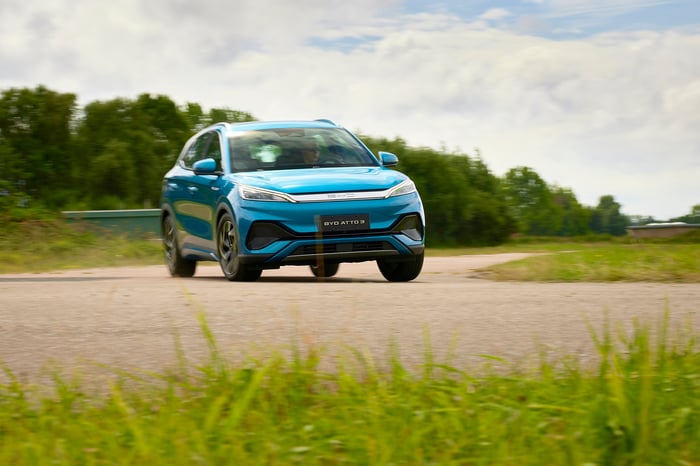
Image source: BYD.
How fast is BYD growing?
BYD, which was originally a battery maker before evolving into a diversified automaker, differentiates itself from other EV makers with its own lithium-iron phosphate (LFP) batteries, which are safer, cheaper, and more power-efficient than conventional lithium-ion batteries. It further expanded its first-party supply chain by manufacturing motors, chips, and power electronics, and unified its production lines with its e-Platform 3.0 architecture for multiple vehicles. That vertical integration reduced its expenses as it ramped up its production.
From 2025 to 2028, analysts expect BYD's revenue and net income to grow at 13% and 24% CAGRs, respectively. That growth will be driven by rising overseas shipments in Southeast Asia, Europe, and Latin America; the expansion of its fast-charging network in China, the rollout of new AI features in its mid-range vehicles, and increased production capacity.
To grow its profits, BYD will prioritize its higher-margin premium EVs and plug-in hybrid EVs, produce more cost-efficient first-party components, and leverage its scale to reduce costs. Those stable profits could make it a better investment than smaller Chinese EV makers like Nio, which are still years away from generating stable annual profits.
Could an investment in BYD set you up for life?
The trade war, tariffs, geopolitical conflicts, and the cooling EV market are all squeezing BYD's valuations. But if those headwinds dissipate, it could be revalued as a growth stock again.
If BYD matches analysts' estimates, grows its revenue at a 10% CAGR from 2028 to 2036, and trades at a more generous ten times sales by the final year, its stock could rise nearly 28 times over the next decade. Therefore, it could certainly be a life-changing investment -- but investors should brace for significant near-term volatility in this choppy market.
Should you buy stock in BYD Company right now?
Before you buy stock in BYD Company, consider this:
The Motley Fool Stock Advisor analyst team just identified what they believe are the 10 best stocks for investors to buy now… and BYD Company wasn’t one of them. The 10 stocks that made the cut could produce monster returns in the coming years.
Consider when Netflix made this list on December 17, 2004... if you invested $1,000 at the time of our recommendation, you’d have $556,335!* Or when Nvidia made this list on April 15, 2005... if you invested $1,000 at the time of our recommendation, you’d have $1,160,572!*
Now, it’s worth noting Stock Advisor’s total average return is 975% — a market-crushing outperformance compared to 193% for the S&P 500. Don't miss the latest top 10 list, available with Stock Advisor, and join an investing community built by individual investors for individual investors.
See the 10 stocks »
*Stock Advisor returns as of April 14, 2026.
Leo Sun has no position in any of the stocks mentioned. The Motley Fool has positions in and recommends Tesla. The Motley Fool recommends BYD Company. The Motley Fool has a disclosure policy.
Recommended Articles


