




This Insurance Stock Has Quietly Crushed the S&P 500 Over 10 Years
Key Points
Progressive's combined ratio is exceeding management's target, resulting in high profitability.
Progressive stock looks fairly valued.
It's incorporating technology into its systems in the age of AI.
- 10 stocks we like better than Progressive ›
Investors don't normally look to insurance stocks to beat the market. Sure, there are some tech-focused insurance stocks with high-growth potential, but the old insurance giants don't typically appear on the radar of growth investors.
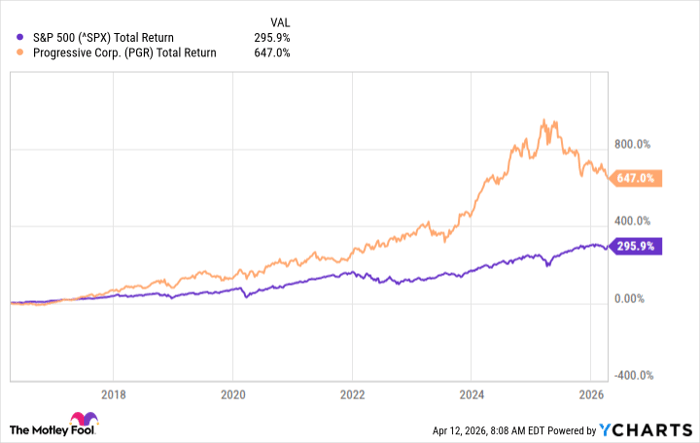
But these value stocks do offer the stability and strength to outlast riskier stocks and beat the market over the long term. A great example of this is Progressive (NYSE: PGR), which has seriously outperformed the S&P 500 over the last decade.
Will AI create the world's first trillionaire? Our team just released a report on the one little-known company, called an "Indispensable Monopoly" providing the critical technology Nvidia and Intel both need. Continue »

Image source: Getty Images.
Boring insurance, exciting gains for Progressive
Let's back up a minute and take a look at what Progressive does. It's one of the largest insurance companies in the U.S. and has been in operation since 1937, giving it almost a century of data to help it price its policies more accurately. It offers a broad range of policy types covering property and casualty insurance, auto insurance, life insurance, and more.
Its strength lies in its underwriting, which matches rates to risk and drives profitability. Management has a stated goal of keeping the combined ratio below 96%, and it came in below 90% in 2025. Along with a 7% return on investments, profits soared last year; earnings per share rose from $14.40 to $19.23. The company had a stellar 2025, with 3.7 million new policies in force and $9 billion in additional written premiums compared to the previous year.
Management has a tight focus on balancing capital needs with the uncertainty inherent in the insurance business. It has a flexible business structure, including a variable dividend that fluctuates with earnings. It paid out $13.50 per share in January, since profits were so high in 2025.
Insurance is a cyclical business, which means there are inevitable downtimes. But large companies have robust underwriting and investing systems that almost guarantee profits over time, and insurance stocks are long-term bets.
Progressive's path to beating the market
Progressive stock has trounced the S&P 500 over the past 10 years, dividends included.
Data by YCharts.
On a price-to-earnings basis, Progressive looks quite cheap with a P/E ratio of 10. However, its price-to-book ratio is 3.7, which is fairly expensive for a financial company. The market is heaping on a healthy premium for the company's fine performance, and between the two metrics, it looks fairly valued.
There are some risks as regulations continually change in the insurance industry, and the space moves into artificial intelligence (AI) and machine learning systems. But Progressive is using its decades of data to price policies accordingly. Any company that still exists that's as old as Progressive has successfully tackled new technology in the past.
Progressive has developed a recipe for strong performance that has led to market-beating performance over time, and there's good reason to believe it can keep it up.
Should you buy stock in Progressive right now?
Before you buy stock in Progressive, consider this:
The Motley Fool Stock Advisor analyst team just identified what they believe are the 10 best stocks for investors to buy now… and Progressive wasn’t one of them. The 10 stocks that made the cut could produce monster returns in the coming years.
Consider when Netflix made this list on December 17, 2004... if you invested $1,000 at the time of our recommendation, you’d have $556,335!* Or when Nvidia made this list on April 15, 2005... if you invested $1,000 at the time of our recommendation, you’d have $1,160,572!*
Now, it’s worth noting Stock Advisor’s total average return is 975% — a market-crushing outperformance compared to 193% for the S&P 500. Don't miss the latest top 10 list, available with Stock Advisor, and join an investing community built by individual investors for individual investors.
See the 10 stocks »
*Stock Advisor returns as of April 14, 2026.
Jennifer Saibil has no position in any of the stocks mentioned. The Motley Fool has positions in and recommends Progressive. The Motley Fool has a disclosure policy.
Recommended Articles


