




This Artificial Intelligence (AI) Stock Just Hit an All-Time Low, But Wall Street Says It's Time to Buy
Key Points
Cybersecurity stocks are getting crushed on fears that new artificial intelligence (AI) tools like Anthropic's Claude Mythos could eat their lunch.
However, these tools probably aren't specialized enough to deliver the wall-to-wall protection enterprises have come to expect from traditional vendors.
Shares of cybersecurity powerhouse SentinelOne just hit a record low, and Wall Street analysts think its time to buy.
- 10 stocks we like better than SentinelOne ›
Cybersecurity stocks are currently under pressure over fears that new artificial intelligence (AI) products like Anthropic's Claude Mythos could outperform even the best security software on the market. However, this is mostly speculation so far because these tools are largely unproven in real-world settings, and I'm not convinced they will be the perfect one-size-fits-all solution for every enterprise.
As a result, there might be value in traditional vendors right now. SentinelOne (NYSE: S) developed an enterprise-grade cybersecurity platform called Singularity, which already uses AI to deliver highly automated protection. Its stock is down 18% in 2026, and it closed at an all-time low on Friday, April 10.
Will AI create the world's first trillionaire? Our team just released a report on the one little-known company, called an "Indispensable Monopoly" providing the critical technology Nvidia and Intel both need. Continue »
But the majority of the analysts tracked by The Wall Street Journal think now might be a great time to buy, and in fact, none of them recommend selling. Their consensus price target also points to significant upside from the current level, so if the recent concerns about emerging AI tools prove to be overblown, investors could reap a very strong return.

Image source: Getty Images.
Enterprises need wall-to-wall cybersecurity
Anthropic is still testing Claude Mythos, but it has reportedly shown an incredible ability to identify bugs and vulnerabilities in existing networks practically instantly. However, this is only a small part of protecting modern enterprises in the digital age, because they also need proactive tools that are on guard against incoming threats at all hours of the day.
SentinelOne's Singularity platform protects cloud networks, operating systems, employee identities, and endpoints (computers and devices) around the clock, and it uses AI to identify and respond to threats at machine speed. Therefore, it's a truly holistic solution.
Plus, thanks to a series of freshly released features, Singularity can also protect enterprises when they deploy AI agents into their operations. These agents often require access to the business's sensitive data, which creates an entirely new attack surface for hackers to exploit. SentinelOne's new Prompt AI Agent Security tool monitors, controls, and enforces rules on every agent in real time, which ensures they operate with strict guardrails.
Another new feature is Purple AI Investigate Now, which is an upgrade to SentinelOne's flagship Purple AI virtual assistant. It now allows human managers to initiate an agent-led investigation into a cyber incident with a single click, so they no longer have to manually gather evidence, analyze threat data, or reconstruct timelines. In other words, this upgrade can save human teams countless hours.
To summarize, modern enterprise cybersecurity tools require a lot more depth and sophistication than the average AI start-up is capable of providing right now.
Demand remains strong
SentinelOne is trying to strike a balance between growth and profitability, so it's currently relying more on organic demand for its cybersecurity products than aggressive investments in customer acquisition.
The company's revenue grew by 22% year over year during 2025, and topped $1 billion for the first time. Operating expenses grew at a much slower rate of 13%, reflecting management's effort to control spending. As a result, SentinelOne narrowed its operating loss slightly, to $321 million.
However, after excluding one-off and non-cash expenses like stock-based compensation, SentinelOne actually delivered an adjusted (non-GAAP) profit of $68 million, which was up by a whopping 351% year over year.
SentinelOne is forecasting slightly slower revenue growth of 20% during 2026, suggesting management's focus will probably remain on improving the bottom line. By generating consistent profits, the company will have the flexibility to invest more heavily in customer acquisition in the future, which could eventually fuel a reacceleration in top-line growth. Plus, a healthy bottom line will create a sustainable business that thrives over the long term.
SentinelOne stock is the cheapest it has ever been
The Wall Street Journal tracks 40 analysts who cover SentinelOne stock, and 22 have given it a buy rating. Three others are in the overweight (bullish) camp, while the remaining 15 recommend holding. None recommend selling.
The analysts have an average price target of $18.64, suggesting the stock could climb by 56% over the next 12 months or so. However, the Street-high target of $26 implies an even greater potential upside of 117%.
I think both targets are achievable, partly because of SentinelOne's valuation. Its price-to-sales (P/S) ratio is just 3.9, which is the lowest it has been since the company went public in 2021. Further, that makes it far cheaper than its main competitors in the AI-powered cybersecurity space, including CrowdStrike, Palo Alto Networks, and Zscaler.
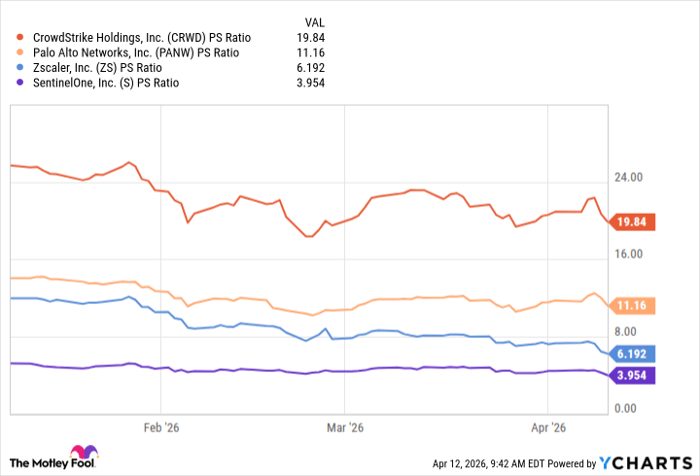
CRWD PS Ratio data by YCharts
If SentinelOne stock rose by 56% to $18.64, its P/S ratio would be 6.1, so it would still be cheaper than CrowdStrike, Palo Alto Networks, and Zscaler.
Looking at the bigger picture, I personally don't think stand-alone AI start-ups pose a threat to companies like SentinelOne -- at least not right now. When it comes to Claude Mythos, specifically, a report by tech publisher Tom's Hardware suggests claims regarding the model's capabilities might be more marketing hype than substance, because they rely on very limited testing and reviews.
This wouldn't be the first time an AI company got ahead of itself. OpenAI's GPT-5 models were supposed to offer a massive leap in performance over the previous GPT-4.5 models, but upon their release, the improvements were widely regarded as incremental at best.
Cyber threats are only growing more dangerous, so enterprises need protection they can count on. As things stand, they can only get it through traditional vendors like SentinelOne, so the recent industrywide sell-off looks like a buying opportunity for investors.
Should you buy stock in SentinelOne right now?
Before you buy stock in SentinelOne, consider this:
The Motley Fool Stock Advisor analyst team just identified what they believe are the 10 best stocks for investors to buy now… and SentinelOne wasn’t one of them. The 10 stocks that made the cut could produce monster returns in the coming years.
Consider when Netflix made this list on December 17, 2004... if you invested $1,000 at the time of our recommendation, you’d have $555,526!* Or when Nvidia made this list on April 15, 2005... if you invested $1,000 at the time of our recommendation, you’d have $1,156,403!*
Now, it’s worth noting Stock Advisor’s total average return is 968% — a market-crushing outperformance compared to 191% for the S&P 500. Don't miss the latest top 10 list, available with Stock Advisor, and join an investing community built by individual investors for individual investors.
See the 10 stocks »
*Stock Advisor returns as of April 13, 2026.
Anthony Di Pizio has no position in any of the stocks mentioned. The Motley Fool has positions in and recommends CrowdStrike, SentinelOne, and Zscaler. The Motley Fool recommends Palo Alto Networks. The Motley Fool has a disclosure policy.
Recommended Articles


