




Have President Donald Trump's Actions in Iran Done Irreparable Damage to the Stock Market? One Data Point Tells the Tale.
Key Points
Historically, the Dow Jones Industrial Average, S&P 500, and Nasdaq Composite have excelled under President Trump.
However, the inflationary effects of the Iran war will be virtually impossible for Wall Street to sweep under the rug.
The Federal Reserve may have no choice but to alter its monetary policy stance, which could prove devastating to Wall Street.
- 10 stocks we like better than S&P 500 Index ›
For most of President Donald Trump's tenure in the White House, the stock market has excelled. The widely followed Dow Jones Industrial Average (DJINDICES: ^DJI), benchmark S&P 500 (SNPINDEX: ^GSPC), and technology-dominated Nasdaq Composite (NASDAQINDEX: ^IXIC) surged 57%, 70%, and 142%, respectively, during his first term, and were all up by double digits through year one of his second, non-consecutive term.
But pullbacks, stock market corrections, bear markets, and crashes are par for the course when putting your money to work in the world's greatest wealth creator.
Will AI create the world's first trillionaire? Our team just released a report on the one little-known company, called an "Indispensable Monopoly" providing the critical technology Nvidia and Intel both need. Continue »

President Trump delivering remarks. Image source: Official White House Photo.
While the stock market has had its share of scares under President Trump (e.g., the five-week COVID-19 crash in February-March 2020 and the one-week tariff tantrum of April 2025), arguably the biggest challenge is yet to come.
Although a two-week ceasefire between the U.S. and Iran sent the Dow, S&P 500, and Nasdaq Composite soaring on Wednesday, April 8, the unfortunate reality for investors is that the damage done to Wall Street from the Iran war may be irreparable.
This may be an insurmountable headwind for a historically pricey stock market
Though the toll on human life is incalculable during war, military conflicts often have far-reaching effects that extend beyond the battlefield. The most notable impact of the Iran war, which began on Feb. 28 at Trump's command, has been observed in the energy arena.
Shortly after the U.S. and Israel commenced attacks on Iran, the latter closed the Strait of Hormuz to most oil exports. Although this closure remains somewhat fluid, as of this writing on April 8, what can be said with certainty is that, for over a month, we've witnessed the largest energy supply disruption in modern history.
In the wake of this virtual closure, crude oil prices have soared. This has led to higher prices at the pump for consumers, as well as steeper transportation and production costs for businesses.
Monthly #PCE inflation data will be released tomorrow. Our #inflation nowcasting model (updated daily!) predicts year-over-year PCE #inflation of 2.67% for February. Check it out: https://t.co/qXCmAZQfCn pic.twitter.com/7pEsoozbHq
-- Cleveland Fed (@ClevelandFed) April 8, 2026
Based on the Federal Reserve Bank of Cleveland's Inflation Nowcasting projections from April 8, the trailing 12-month U.S. inflation rate is estimated to climb from a reported 2.4% in February to 3.56% in April.
While the Trump administration's negotiated ceasefire with Iran sparked a significant sell-off in crude oil prices last week, energy prices often rocket to the upside during crude oil shocks and fall like a feather once they pass. This is to say that even if this ceasefire holds and military conflict between the U.S. and Iran is over, the pain consumers have felt fueling their vehicles, and the higher expenses businesses are paying to transport and produce goods, aren't going away anytime soon.
In short, inflationary pressures are likely to be sticky for some time -- and that's a huge problem for a historically pricey stock market.
Image source: Getty Images.
Sticky inflation can be the stock market's undoing
Although "value" is a subjective term, the stock market entered 2026 as its second-priciest valuation in over 155 years, according to the S&P 500's Shiller Price-to-Earnings Ratio. The only time the stock market was pricier was in the months leading up to the dot-com bubble bursting, which wiped 49% and 78% off the S&P 500 and Nasdaq Composite, respectively.
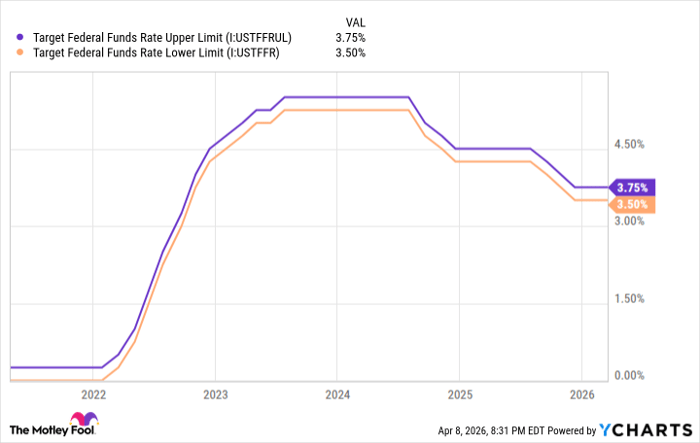
One of the primary reasons the stock market has been able to maintain a premium valuation is the expectation of additional interest rate cuts by the Federal Reserve in 2026. The Federal Open Market Committee (FOMC) -- the 12-person body, including Fed Chair Jerome Powell, that oversees the nation's monetary policy -- lowered the federal funds target rate six times since September 2024.
But these rate cuts were made with the assumption that the U.S. inflation rate was heading back to the Fed's long-term target of 2%. Based on the Cleveland Fed's inflation projections, the trailing 12-month inflation rate is set to jump by more than one percentage point in two months, and would be closer to 4% than 3%.
Target Federal Funds Rate Upper Limit data by YCharts.
There's absolutely no incentive for the FOMC to cut interest rates in 2026. In fact, it could be argued that there's a stronger case for raising interest rates than cutting them at this point.
Even if the FOMC doesn't go so far as to raise the federal funds target rate, simply taking rate cuts off the table could be enough to devastate a historically expensive stock market that's been counting on lower lending rates to fuel artificial intelligence (AI), space, and quantum computing investments.
Regardless of when the Iran war ends and/or the Strait of Hormuz is unconditionally reopened, President Trump's actions will have a lasting (and likely negative) impact on U.S. inflation and the stock market.
Should you buy stock in S&P 500 Index right now?
Before you buy stock in S&P 500 Index, consider this:
The Motley Fool Stock Advisor analyst team just identified what they believe are the 10 best stocks for investors to buy now… and S&P 500 Index wasn’t one of them. The 10 stocks that made the cut could produce monster returns in the coming years.
Consider when Netflix made this list on December 17, 2004... if you invested $1,000 at the time of our recommendation, you’d have $555,526!* Or when Nvidia made this list on April 15, 2005... if you invested $1,000 at the time of our recommendation, you’d have $1,156,403!*
Now, it’s worth noting Stock Advisor’s total average return is 968% — a market-crushing outperformance compared to 191% for the S&P 500. Don't miss the latest top 10 list, available with Stock Advisor, and join an investing community built by individual investors for individual investors.
See the 10 stocks »
*Stock Advisor returns as of April 12, 2026.
Sean Williams has no position in any of the stocks mentioned. The Motley Fool has no position in any of the stocks mentioned. The Motley Fool has a disclosure policy.
Recommended Articles


