




Another Day of Iran-Led Volatility: Why the Case for Staying Invested Remains Intact
Key Points
Market volatility is driven by geopolitical risks, especially around the Strait of Hormuz.
Staying invested is generally preferable to trying to time the market.
Adjusting portfolios to reflect current risks and opportunities is recommended.
- 10 stocks we like better than Chevron ›
The markets are volatile right now, and for good reason; the threat to the global economy from a prolonged closure of the Strait of Hormuz is significant. It's not just a question of crude oil and liquefied natural gas (LNG); significant quantities of refined petroleum products, fertilizers, and other commodities also flow through the Strait.
The conflict in Iran has an uncertain resolution, and that's feeding through into the markets, trying to price in the most likely outcome. Still, in all this uncertainty, the case for remaining fully invested remains.
Will AI create the world's first trillionaire? Our team just released a report on the one little-known company, called an "Indispensable Monopoly" providing the critical technology Nvidia and Intel both need. Continue »
Rational actors
It's impossible to tell when energy flows through the strait will return to normal. It's not just a question of whether Iran agrees to reopen the strait; there's also the question of the type of reopening and the conditions on which it will be reopened. There's clear daylight between the U.S. and Iran on that subject, but the uncertainty doesn't just end there.
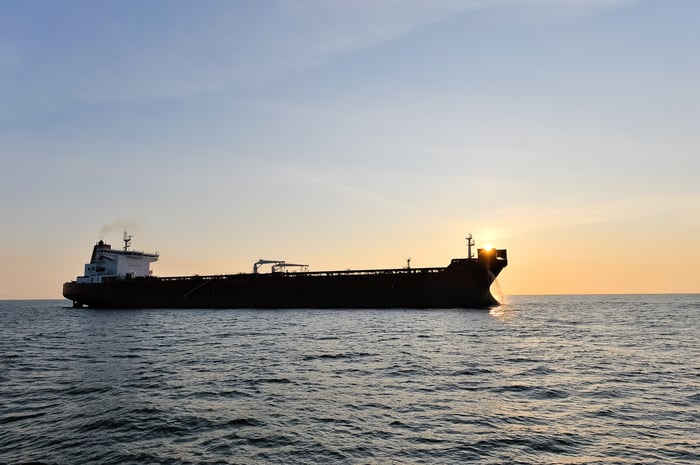
Image source: Getty Images.
There are also issues around insurance companies' willingness to insure shipping companies and cargo owners, and it's not yet clear what the damage to energy infrastructure in the region will be when the dust settles or the risk perception energy customers will be left with after the conflict is over.
However, what we do know is that it's in almost everyone's rational interest to reopen the strait to energy flow in some form or other. Europe and particularly Asia need physical supply; the countries of the Arabian peninsula need to export energy, fertilizer, and refined products; the U.S., Europe, Asia, and most of the world need lower energy prices; myriad developing countries need fertilizer; and Iran ships energy through the strait, as well as plans to generate revenue from controlling traffic through the strait.
Stay invested, but adjust portfolios accordingly
All of this is not to argue that there isn't a real possibility of lasting consequences from the conflict, because there is. While the magnitude is unknown, it's clear that the ripple effects are likely to impact crude oil, LNG, refining crack spreads, fertilizer prices, shipping rates, and even industries such as mining that use sulfuric acid from the gulf for leaching.
As such, it makes sense to increase the allocation of a portfolio to stocks that benefit from a prolonged closure of the strait and/or the consequences discussed. A stock like Chevron (NYSE: CVX) would suit the purpose. In addition, if you are concerned about growing geopolitical tensions worldwide and the trend toward global central banks holding reserves in gold rather than U.S. Treasuries or other U.S. assets, then increasing an allocation to gold makes sense, too.
The cost of missing out
While it's highly tempting to try to time the market, the market has a way of disciplining even the most discerning investors. Simply put, and as recently seen, when the market goes up, it can do so in a violent manner that leaves underinvested investors behind.
According to Hartford Funds, 48% of the best days for the market between 1996 and 2025 occurred during a bear market, and 28% of them occurred in the first two months of a bull market. In other words, if you wait for a bull market, you will capture only 24% of the best "up" days.
Moreover, a $10,000 investment in 1996 would have grown to more than $192,000 by 2025, but if you had missed the 10 best days, that figure would be only about $85,500. Missing the best 20 days reduces it further to approximately $49,500.
Simply put, trying to time the market can be costly for investors.

Image source: Getty Images.
Staying invested
To be clear, staying invested doesn't mean blindly maintaining the same portfolio through thick and thin; it means trying to keep money in the market by adjusting to circumstances and mitigating risk. There's a heightened sense of risk in the market now, but there are also rational realities in place that, hopefully, will guide events, and investors can adjust their portfolios to control for risk.
Should you buy stock in Chevron right now?
Before you buy stock in Chevron, consider this:
The Motley Fool Stock Advisor analyst team just identified what they believe are the 10 best stocks for investors to buy now… and Chevron wasn’t one of them. The 10 stocks that made the cut could produce monster returns in the coming years.
Consider when Netflix made this list on December 17, 2004... if you invested $1,000 at the time of our recommendation, you’d have $555,526!* Or when Nvidia made this list on April 15, 2005... if you invested $1,000 at the time of our recommendation, you’d have $1,156,403!*
Now, it’s worth noting Stock Advisor’s total average return is 968% — a market-crushing outperformance compared to 191% for the S&P 500. Don't miss the latest top 10 list, available with Stock Advisor, and join an investing community built by individual investors for individual investors.
See the 10 stocks »
*Stock Advisor returns as of April 11, 2026.
Lee Samaha has no position in any of the stocks mentioned. The Motley Fool has positions in and recommends Chevron. The Motley Fool has a disclosure policy.
Recommended Articles


