




Intel vs. Advanced Micro Devices: Shifting Trends in Revenue
Key Points
Intel currently generates a higher volume of total sales, but Advanced Micro Devices displays a stronger upward trajectory in its top-line performance.
Over the past eight quarters, Intel has experienced somewhat choppy and slower rate of growth, whereas Advanced Micro Devices has demonstrated a consistent pattern of strong quarterly increases.
Investors should monitor whether the ongoing revenue gap between the two companies continues to narrow or if the trend eventually begins to stabilize.
- 10 stocks we like better than Intel ›
The bigger company by revenue doesn’t always point you to the best stock to buy. The comparison between Intel (NASDAQ:INTC) and Advanced Micro Devices (NASDAQ:AMD) is a good example of why.
Intel has controlled the lion’s share of the central processing unit (CPU) market for decades, particularly in the desktop market. But the chart below shows AMD growing its quarterly revenue significantly faster. This reflects AMD’s gaining share against Intel across consumer and server segments in the last several years.
Intel: Navigating a Stagnant Revenue Trend
Intel primarily earns revenue by designing, manufacturing, and selling CPUs, system-on-chip packages, and workload-optimized compute solutions to original equipment manufacturers, government entities, and global cloud service providers.
While it reported a net income margin of about -2% for the quarter ended Dec. 27, 2025, there have been positive developments this year. It moved to regain ownership of its Ireland manufacturing facility from a joint venture partner — a signal that Intel’s financial position is strengthening. It also announced a deeper partnership with Alphabet’s Google to advance AI infrastructure using its Xeon and custom infrastructure chips.
Advanced Micro Devices: Sustaining Upward Revenue Momentum
AMD generates revenue by providing a wide array of CPUs, graphics processing units (GPUs), and semi-custom products to original design manufacturers, public cloud service providers, and independent distributors.
Along with posting a net income margin of approximately 16% for the quarter ended Dec. 27, 2025, it recently executed several infrastructure agreements to deploy hardware architectures. It introduced new desktop processors for consumer and business users.
Why Revenue Matters for Retail Investors
Revenue is a fundamental metric that shows how much money a business brings in from its operations before costs or taxes. AMD’s revenue is steadily growing, while Intel’s has flattened.
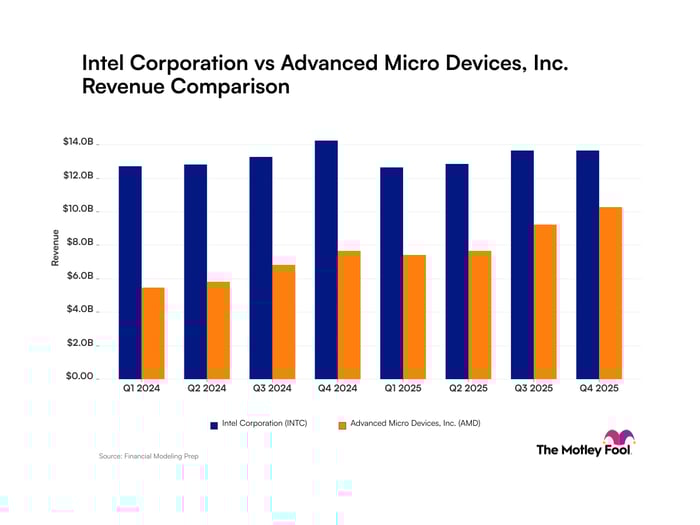
Quarterly Revenue for Intel and Advanced Micro Devices
| Quarter (Period End) | Intel Revenue | Advanced Micro Devices Revenue |
|---|---|---|
| Q1 2024 (March 2024) | $12.7 billion | $5.5 billion |
| Q2 2024 (June 2024) | $12.8 billion | $5.8 billion |
| Q3 2024 (Sept. 2024) | $13.3 billion | $6.8 billion |
| Q4 2024 (Dec. 2024) | $14.3 billion | $7.7 billion |
| Q1 2025 (March 2025) | $12.7 billion | $7.4 billion |
| Q2 2025 (June 2025) | $12.9 billion | $7.7 billion |
| Q3 2025 (Sept. 2025) | $13.7 billion | $9.2 billion |
| Q4 2025 (Dec. 2025) | $13.7 billion | $10.3 billion |
Data source: Company filings. Data as of April 8, 2026.
Foolish Take
The revenue performance of these two chip companies tells investors the story. AMD has delivered a better cost-performance balance for customers with its CPUs. This is driving much stronger growth as it gains share against Intel.
While Intel is still kicking and supplying chips for AI workloads, AMD still appears to have better prospects. This is evident with deals it has secured with OpenAI and other top AI companies to supply its MI450 graphics processing units (GPUs) when it launches later this year.
A part of AMD’s faster rate of revenue growth reflects the demand for its data center GPUs — a segment of the chip market that Intel has failed to gain meaningful traction in.
Investors will want to watch how new deals impact these companies’ growth. For Intel, it secured financial backing from the U.S. government last year, so it’s certainly not going anywhere. It continues to see demand for chips across data centers, networking, and consumer devices.
For AMD, the upcoming launch of its MI450 data center chip will be a major catalyst, potentially accelerating revenue growth. The demand for its data center GPUs could catapult AMD ahead of Intel in revenue by 2027, according to the consensus analyst estimate.
Should you buy stock in Intel right now?
Before you buy stock in Intel, consider this:
The Motley Fool Stock Advisor analyst team just identified what they believe are the 10 best stocks for investors to buy now… and Intel wasn’t one of them. The 10 stocks that made the cut could produce monster returns in the coming years.
Consider when Netflix made this list on December 17, 2004... if you invested $1,000 at the time of our recommendation, you’d have $550,348!* Or when Nvidia made this list on April 15, 2005... if you invested $1,000 at the time of our recommendation, you’d have $1,127,467!*
Now, it’s worth noting Stock Advisor’s total average return is 959% — a market-crushing outperformance compared to 191% for the S&P 500. Don't miss the latest top 10 list, available with Stock Advisor, and join an investing community built by individual investors for individual investors.
See the 10 stocks »
*Stock Advisor returns as of April 10, 2026.
John Ballard has no position in any of the stocks mentioned. The Motley Fool has positions in and recommends Advanced Micro Devices, Alphabet, and Intel. The Motley Fool has a disclosure policy.
Recommended Articles


