




I'm Calling It: Alphabet Stock Is a Buy Before June 2026
Key Points
Alphabet invested $900 million in SpaceX in 2015, acquiring a 7% stake in the space exploration business.
SpaceX could be valued at $2 trillion-plus following the IPO, meaning Alphabet's stake in the company could be worth over $100 billion.
Alphabet's valuation profile suggests investors are discounting the company's gains from artificial intelligence (AI) and next-generation services.
- 10 stocks we like better than Alphabet ›
When it comes to the SpaceX initial public offering (IPO), most investors are asking the wrong question. They want to know how they can participate in the offering, expected to occur in June.
The smarter questions are:
Will AI create the world's first trillionaire? Our team just released a report on the one little-known company, called an "Indispensable Monopoly" providing the critical technology Nvidia and Intel both need. Continue »
- Who already owns a piece of SpaceX?
- Of those companies, which ones trade at a reasonable valuation?
- Will a successful SpaceX IPO impact the financial profile of its owners?
Alphabet (NASDAQ: GOOGL) (NASDAQ: GOOG) has connections to all three questions. That means this artificial intelligence (AI) stock could benefit from this IPO in ways the market is currently overlooking.
Image source: Getty Images.
The hidden windfall on Alphabet's balance sheet
In 2015, Alphabet invested $900 million and acquired roughly 7% of SpaceX when it was valued at $12 billion.
At the time, Google's SpaceX investment was treated as a moonshot -- a speculative infrastructure bet on the potential of broadband satellites and global connectivity. Over the years, Alphabet pretty much stopped talking about its relationship with SpaceX. Instead, the investment sat quietly on the company's balance sheet -- classified under non-marketable equity securities and occasionally making a cameo in footnotes.
Where things get interesting is that SpaceX's valuation didn't stop at $12 billion. Earlier this year, SpaceX merged with xAI in a deal estimated at $1.25 trillion. With the company's IPO window approaching, reports are swirling that Elon Musk's space exploration empire could end up exceeding a valuation of $2 trillion.
Assuming Alphabet's stake was not diluted during subsequent capital raises, the company's SpaceX position could be worth over $100 billion following the IPO.
Why the SpaceX IPO could change everything for Alphabet
In accounting, there is a meaningful difference between an unrealized gain and a real one. Right now, Alphabet's SpaceX position is required to be periodically measured against private-market transactions -- secondary share sales, tender offerings, and merger valuations. On the income statement, these flow through earnings as unrealized gains and are usually glossed over.
Until now, institutional investors were likely underweight Alphabet because it's difficult to model opaque private holdings. But when SpaceX lists on a public exchange, this dynamic immediately reverses because Alphabet's equity becomes liquid.
Suddenly, the company's SpaceX position appears on the balance sheet at a verifiable market price. This valuation rerating moment is the real catalyst for Alphabet. In other words, Alphabet doesn't even need to sell a single share of SpaceX for the IPO to matter. The more important factor is the perception of what Alphabet's worth becomes, given its liquid SpaceX holding.
Alphabet's valuation profile only gets stronger with SpaceX
Google Search remains one of the most dominant distribution networks in digital advertising, Google Cloud is compounding at a double-digit pace, and Gemini is emerging as a genuine AI model contender with an underlying hardware advantage through custom Tensor Processing Units (TPUs). Waymo, which is largely overshadowed on Wall Street by Tesla's Robotaxi, is quietly becoming a more mature autonomous vehicle platform.
Data by YCharts.
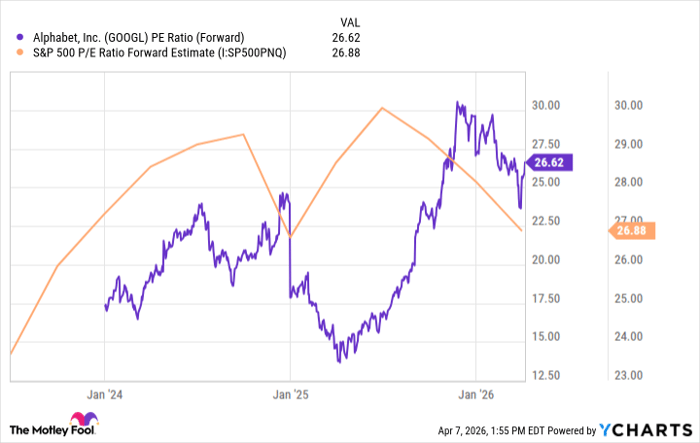
Nevertheless, Alphabet stock trades at roughly 26 times forward earnings -- in line with the S&P 500 average. This parity suggests an investor today is buying the world's most dominant search engine and a hyperscale cloud platform at a price that discounts a frontier AI lab and a $100 billion SpaceX gain.
The market is not being irrational with Alphabet. Investors simply haven't done the full accounting yet. This will swiftly change once SpaceX rings the bell this summer.
Should you buy stock in Alphabet right now?
Before you buy stock in Alphabet, consider this:
The Motley Fool Stock Advisor analyst team just identified what they believe are the 10 best stocks for investors to buy now… and Alphabet wasn’t one of them. The 10 stocks that made the cut could produce monster returns in the coming years.
Consider when Netflix made this list on December 17, 2004... if you invested $1,000 at the time of our recommendation, you’d have $550,348!* Or when Nvidia made this list on April 15, 2005... if you invested $1,000 at the time of our recommendation, you’d have $1,127,467!*
Now, it’s worth noting Stock Advisor’s total average return is 959% — a market-crushing outperformance compared to 191% for the S&P 500. Don't miss the latest top 10 list, available with Stock Advisor, and join an investing community built by individual investors for individual investors.
See the 10 stocks »
*Stock Advisor returns as of April 10, 2026.
Adam Spatacco has positions in Alphabet and Tesla. The Motley Fool has positions in and recommends Alphabet and Tesla. The Motley Fool has a disclosure policy.
Recommended Articles


