




3 Key Takeaways from the S&P 500's Worst-Performing Quarter Since 2022
Key Points
The high concentration of tech stocks weighed the S&P 500 down in the first quarter.
Nevertheless, around 57% of S&P 500 stocks outperformed the index in the first quarter.
Shares in the energy sector soared as investors looked to profit from increased oil prices.
- 10 stocks we like better than S&P 500 Index ›
After finishing 2025 with a gain of 16.4%, the S&P 500 (SNPINDEX: ^GSPC) did not see its best performance in the first three months of 2026. The index declined by 4.6% -- its worst quarterly period since the third quarter of 2022.
As the stock market's most-followed index, the S&P 500 is always under a microscope. And although it didn't have as rough a quarter as some Nasdaq indexes like the Nasdaq Composite and Nasdaq-100, any time you have your worst performance in a few years, it's worth taking a deeper look at what caused it and what takeaways investors should draw.
Will AI create the world's first trillionaire? Our team just released a report on the one little-known company, called an "Indispensable Monopoly" providing the critical technology Nvidia and Intel both need. Continue »

Image source: Getty Images.
1. The tech concentration is showing its weakness
The S&P 500 is weighted by market capitalization, so larger companies account for more of the index than smaller ones. This has led to the index becoming tech-heavy, as big-name tech companies have seen their market caps soar in the past few years.
As of the end of February, the information technology (tech) sector accounts for 32.4% of the S&P 500. Nine of its top 10 holdings (including both Alphabet classes) are tech companies, and the "Magnificent Seven" stocks -- Nvidia, Apple, Microsoft, Amazon, Alphabet, Meta Platforms, and Tesla -- account for over 32%. (Note: This percentage is close to the tech sector because companies like Amazon, Alphabet, Meta, and Tesla are technically in nontech sectors.)
The high concentration of tech stocks has worked well for the S&P 500 in the past, but what makes you smile can also make you cry. From 2023 through 2025, the S&P 500 tech sector grew by over 161%, helping propel the S&P 500's 78% gains during that span. However, the sector's 9.3% decline in the first quarter has a lot to do with the S&P 500's 4.6% drop.
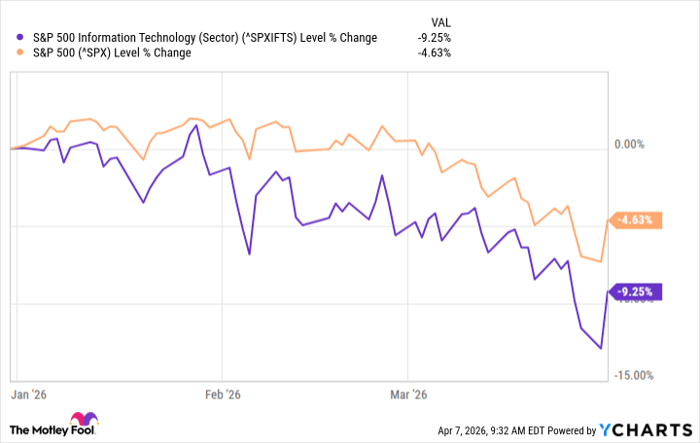
^SPXIFTS data by YCharts
The large influence big tech has on the S&P 500 is why it's important to track just how much of your portfolio is allocated to the same companies. Investing in an S&P 500 ETF and a tech-focused ETF could lead to significant overlap and too much exposure to too few companies.
2. Many S&P 500 companies had a great first quarter
If you only look at the S&P 500's performance, you'd think the index as a whole is struggling. However, that's far from the truth. Underneath the surface (and in the shadows of the tech struggles), there are plenty of companies having a good year through the first quarter.
Sixty-three stocks (12.6% of the index) finished the first quarter up over 20%; 128 stocks (25.6% of the index) finished up over 10%; and 285 stocks (57% of the index) outperformed the S&P 500.
The broad gains are why the equal-weight S&P 500 outperformed the standard S&P 500. It finished the quarter only up around 0.19%, but any gains are better than losses. Investing in an equal-weight S&P 500 ETF is a good way to hedge against the high concentration of the standard S&P 500.
3. Energy was by far the best-performing sector
The S&P 500 groups companies into 11 major sectors, ranging from tech to financials, healthcare, and energy, among others. The tech sector has been the best-performing sector over the past decade, but the energy sector was the best-performing sector of the first quarter -- and it wasn't even close.
S&P 500 energy stocks finished the first quarter up over 37%, far ahead of the second- and third-best performing sectors, materials (up 9.3%) and utilities (up 7.5%).
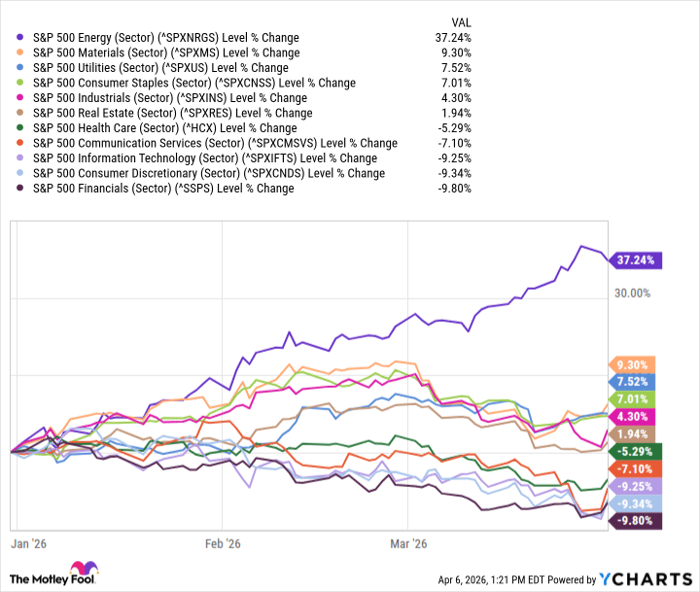
^SPXNRGS data by YCharts
Energy companies have benefited from the conflict in the Middle East, which has sent oil prices skyrocketing. This has typically led investors to pour more money into energy stocks, anticipating that higher prices will translate into better margins and higher profits for these companies (even if not sustained over the long term).
Should you buy stock in S&P 500 Index right now?
Before you buy stock in S&P 500 Index, consider this:
The Motley Fool Stock Advisor analyst team just identified what they believe are the 10 best stocks for investors to buy now… and S&P 500 Index wasn’t one of them. The 10 stocks that made the cut could produce monster returns in the coming years.
Consider when Netflix made this list on December 17, 2004... if you invested $1,000 at the time of our recommendation, you’d have $550,348!* Or when Nvidia made this list on April 15, 2005... if you invested $1,000 at the time of our recommendation, you’d have $1,127,467!*
Now, it’s worth noting Stock Advisor’s total average return is 959% — a market-crushing outperformance compared to 191% for the S&P 500. Don't miss the latest top 10 list, available with Stock Advisor, and join an investing community built by individual investors for individual investors.
See the 10 stocks »
*Stock Advisor returns as of April 10, 2026.
Stefon Walters has positions in Apple and Microsoft. The Motley Fool has positions in and recommends Alphabet, Amazon, Apple, Meta Platforms, Microsoft, Nvidia, and Tesla and is short shares of Apple. The Motley Fool has a disclosure policy.
Recommended Articles


