




Alphabet's Google Has Given Birth to 3 Millionaire-Maker Stocks Hiding in Plain Sight. All of Them Are Trading at Incredible Valuations Right Now.
Key Points
Alphabet's recently announced memory compression technology has spooked investors in Micron, Sandisk, and Seagate, but they are missing the bigger picture.
In fact, lower memory prices and more cost-efficient, capable AI models could increase adoption of this technology, potentially driving stronger memory demand.
The recent stock price weakness in the three memory-makers -- Sandisk, Seagate, and Micron Technology -- makes them no-brainer buys right now.
- 10 stocks we like better than Micron Technology ›
Alphabet's (NASDAQ: GOOG) (NASDAQ: GOOGL) Google sent waves through the artificial intelligence (AI) hardware market last month when it detailed its TurboQuant technology in a blog. In simple terms, TurboQuant is a compression method that reduces the size of large language models (LLMs) with no loss of accuracy.
It achieves this by shrinking the size of memory needed for training LLMs. Google specifically pointed out that TurboQuant is aimed at reducing memory costs, which have been ballooning in recent quarters due to the shortage of memory chips. Unsurprisingly, shares of memory manufacturers such as Micron Technology (NASDAQ: MU), Sandisk (NASDAQ: SNDK), and Seagate Technology (NASDAQ: STX) fell sharply after Google's research was published.
Will AI create the world's first trillionaire? Our team just released a report on the one little-known company, called an "Indispensable Monopoly" providing the critical technology Nvidia and Intel both need. Continue »
Investors feared that the stunning revenue and earnings growth these companies have been clocking, driven by a favorable demand-supply memory environment that is pushing up prices, could dry up due to Google's algorithm. However, a closer look at the bigger picture suggests that Google may have supercharged the prospects of the three stocks mentioned above.
Let's examine the reasons why these three artificial intelligence (AI) stocks could win big from TurboQuant and potentially play a key role in helping them become ideal buys for investors looking to construct million-dollar portfolios.

Image source: The Motley Fool.
TurboQuant is going to increase -- not decrease -- memory demand
It remains to be seen how TurboQuant is implemented in the real world and whether it can indeed reduce memory overhead in AI data centers. But even if the technology proves successful in practice and enjoys widespread adoption (assuming Google decides to make it broadly available), it will increase memory demand.
I say this because the size of LLMs has increased exponentially in recent years. For instance, the largest LLM in 2019 had just 0.09 billion parameters, a number that shot up to 540 billion in 2022. Parameters refer to the numerical values that an LLM learns to process inputs and generate responses. So, in theory, an LLM with more parameters may have the capability to better understand inputs and generate more accurate responses.
Unsurprisingly, the latest LLMs are being trained with more than 1 trillion parameters, with some popular models exceeding half a trillion. Removing a bottleneck, such as huge memory requirements, can help AI companies train bigger, more capable models. Also, Gartner recently remarked that performing inference applications on an LLM with 1 trillion parameters could cost 90% less in 2030 than last year, driven by lower chip costs, higher chip utilization rates, and the use of more cost-effective chips.
As a result, AI usage should ideally continue to increase over the long run, driven by the availability of more cost-efficient hardware. So, TurboQuant shouldn't be a hindrance for Micron, Sandisk, and Seagate, as the availability of cheaper memory chips is likely to boost their demand for training bigger AI models with higher accuracy and better quality. This is precisely why it makes sense to buy these three memory stocks, as the potential success of TurboQuant should ensure secular demand for their offerings in the long run.
The memory supercycle can send these stocks higher
Micron, Sandisk, and Seagate operate in three distinct areas of the memory market. While Micron makes compute-centric dynamic random-access memory (DRAM) and storage-oriented NAND flash storage products, Sandisk is a pure-play NAND flash company. Seagate, meanwhile, makes high-capacity hard-disk drives (HDDs).
Their products are used in data centers, smartphones, personal computers (PCs), and other applications where data storage and compute are a necessity. AI has been a major catalyst for these companies, driving up demand for DRAM, NAND flash, and HDD storage in data centers. In fact, data center-driven memory demand has been so solid that these companies are finding it difficult to produce enough chips.
Industry watchers estimate that the memory shortage could last until 2030. That won't be surprising, as according to Seagate, AI-fueled applications generate a whopping 394 zettabytes (ZB) of data in 2028 as compared to 72 ZB in 2020, a compound annual growth rate of almost 24%. However, advancements such as TurboQuant could spur greater growth in data generation.
Given that the data generated will have to be processed, the addressable markets of Micron, Sandisk, and Seagate should continue to improve. Importantly, all three companies have experienced healthy revenue growth in recent years, driven by AI.
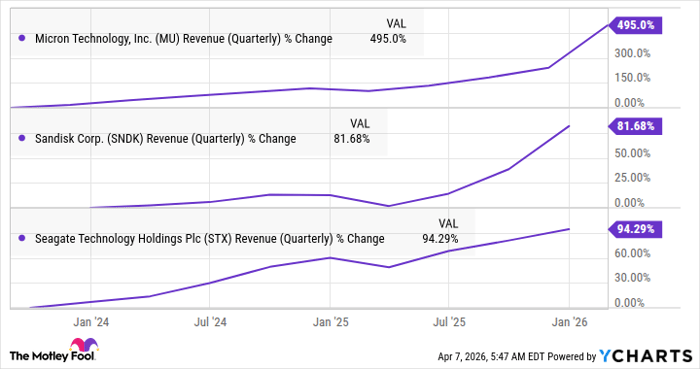
MU Revenue (Quarterly) data by YCharts.
Even better, analysts estimate that their outstanding earnings growth is poised to continue.
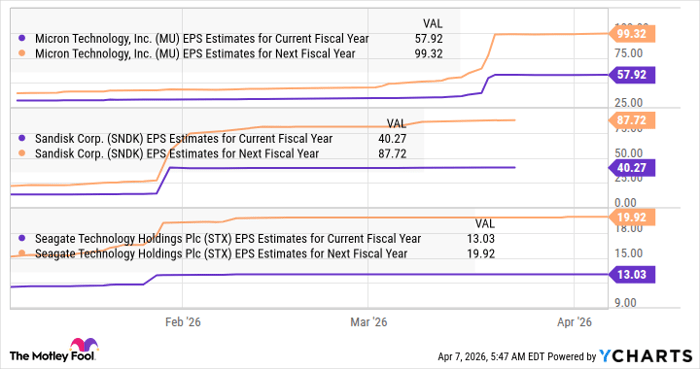
MU EPS Estimates for Current Fiscal Year data by YCharts. EPS = earnings per share.
Don't be surprised if these companies sustain their healthy growth rates in the long run as memory demand continues to increase. That's why it would be a good idea to buy these chip stocks while they are trading at extremely attractive valuations.
Seagate is the most expensive of the three stocks, trading at 24 times forward earnings. That's slightly higher than the tech-focused Nasdaq-100 index's forward earnings multiple of 23. However, Seagate deserves to trade at a significant premium, as its earnings are estimated to jump by 61% and 53% in the current and next fiscal years, respectively.
Micron stock, meanwhile, has a forward earnings multiple of just 6.3. Sandisk is also quite cheap, with a forward price-to-earnings ratio of 14. The outstanding earnings growth potential of these companies suggests that their valuations are well below the ideal levels they should be trading at.
That's why these companies are likely to see a big jump in their stock prices in the long run and are deserving of a place in potential million-dollar portfolios, especially given their outstanding growth prospects driven by heavy investments in AI data centers and technological advancements that could democratize AI.
Should you buy stock in Micron Technology right now?
Before you buy stock in Micron Technology, consider this:
The Motley Fool Stock Advisor analyst team just identified what they believe are the 10 best stocks for investors to buy now… and Micron Technology wasn’t one of them. The 10 stocks that made the cut could produce monster returns in the coming years.
Consider when Netflix made this list on December 17, 2004... if you invested $1,000 at the time of our recommendation, you’d have $550,348!* Or when Nvidia made this list on April 15, 2005... if you invested $1,000 at the time of our recommendation, you’d have $1,127,467!*
Now, it’s worth noting Stock Advisor’s total average return is 959% — a market-crushing outperformance compared to 191% for the S&P 500. Don't miss the latest top 10 list, available with Stock Advisor, and join an investing community built by individual investors for individual investors.
See the 10 stocks »
*Stock Advisor returns as of April 10, 2026.
Harsh Chauhan has no position in any of the stocks mentioned. The Motley Fool has positions in and recommends Alphabet and Micron Technology. The Motley Fool recommends Gartner. The Motley Fool has a disclosure policy.
Recommended Articles


