




Citigroup Inc Stock (C) Moved Down by 3.14% on Mar 9: What Investors Need To Know
Citigroup Inc (C) moved down by 3.14%. The Banking & Investment Services sector is down by 2.17%. The company underperformed the industry. Top 3 stocks by turnover in the sector: Goldman Sachs Group Inc (GS) down 1.69%; JPMorgan Chase & Co (JPM) down 2.43%; SoFi Technologies Inc (SOFI) down 3.89%.
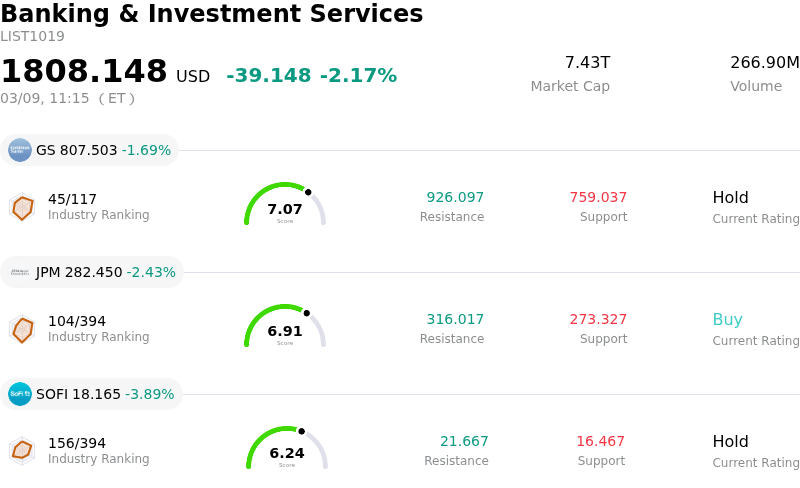
What is driving Citigroup Inc (C)’s stock price down today?
Citigroup's stock experienced a notable downward movement today, largely driven by a combination of broader macroeconomic headwinds, sector-specific anxieties, and some company-specific concerns. The overall market sentiment was risk-off, influenced by recently released economic data, including a weak jobs report that suggested a potential weakening of the economy. This, coupled with increasing oil prices and persistent inflation jitters stemming from escalating geopolitical tensions, contributed to a cautious investment environment. The CBOE Volatility Index also saw an increase, typically impacting financial stocks.
The financial sector, in general, faced heightened scrutiny and investor anxiety regarding the health of the private credit market. Troubling events in this space, such as a major asset manager capping withdrawals from one of its private credit funds and liquidity failures at other firms, sent shockwaves through the non-bank lending sector. This led to a broader reassessment of credit risk, particularly in private-credit and leveraged-loan markets, and growing concerns about increasing problem loans. The narrative of "sticky inflation" also suggests limited room for interest rate cuts, which can impact financial institutions. Geopolitical risks, especially in the Middle East, were identified as a top short-to-medium-term risk for banks, further exacerbating risk-off flows out of financials.
From a company-specific standpoint, Citigroup reported quarterly revenues that fell short of analyst expectations, indicating potential financial underperformance. The company continues to grapple with challenges related to adhering to regulatory consent orders from 2020 concerning risk management, compliance, and data quality, which highlights ongoing operational vulnerabilities and potential reputational impact. Furthermore, the bank's recent capital market activities, including the issuance of various senior and subordinated notes, have increased its debt profile and exposure to potentially higher problem loans. The plan to integrate Bitcoin into its core banking systems by 2026 also introduces new and complex operational, regulatory, and market risks. Concerns were also raised about a declining common equity tier 1 (CET1) ratio and a significant decrease in net income from its markets segment.
Adding to the negative pressure, analyst sentiment shifted, with some downgrades for Citigroup's stock, such as Zacks Research moving from a "strong-buy" to a "hold" rating in February. Institutional portfolio adjustments also saw some firms reducing their positions, including a notable decrease by First Trust Advisors LP and Inceptionr LLC. Insider selling activity, including a significant reduction in holdings by a key executive, further contributed to negative market sentiment. The cumulative effect of these macroeconomic, sector-specific, and company-level factors appears to have driven the observed downward share price movement.
Technical Analysis of Citigroup Inc (C)
Technically, Citigroup Inc (C) shows a MACD (12,26,9) value of [-1.11], indicating a sell signal. The RSI at 38.52 suggests neutral condition and the Williams %R at -75.34 suggests oversold condition. Please monitor closely.
Fundamental Analysis of Citigroup Inc (C)
Citigroup Inc (C) is in the Banking & Investment Services industry. Its latest annual revenue is $81.18B, ranking 4 in the industry. The net profit is $13.02B, ranking 3 in the industry. Company Profile
Over the past month, multiple analysts have rated the company as Buy, with an average price target of $132.28, a high of $152.00, and a low of $87.26.
More details about Citigroup Inc (C)
Company Specific Risks:
- Citigroup's common equity tier 1 (CET1) ratio has shown a downward trend, raising concerns about capital adequacy, and the company's overall financial strength is rated as poor with a Z-Score indicating potential distress.
- Recent issuance of complex structured notes linked to multiple indices exposes investors to potential substantial principal loss, uncertain U.S. federal tax treatment, and limited secondary market liquidity, which may impact Citigroup's reputation and product risk profile.
- Despite nearing completion of compliance work, the multi-year effort to address significant regulatory consent orders highlights ongoing systemic weaknesses in risk management and internal controls that necessitate continued investment and oversight.
Recommended Articles


