




Amazon, Microsoft, and Alphabet Stocks Plummet on AI Investments. These 3 Stocks Are Set to Win.
Key Points
Taiwan Semiconductor produces the chips that drive AI.
Nvidia makes a complete line of AI infrastructure products that work together for the most powerful solutions.
Applied Digital is growing at a sky-high pace as it locks in long-term data center contracts.
- 10 stocks we like better than Taiwan Semiconductor Manufacturing ›
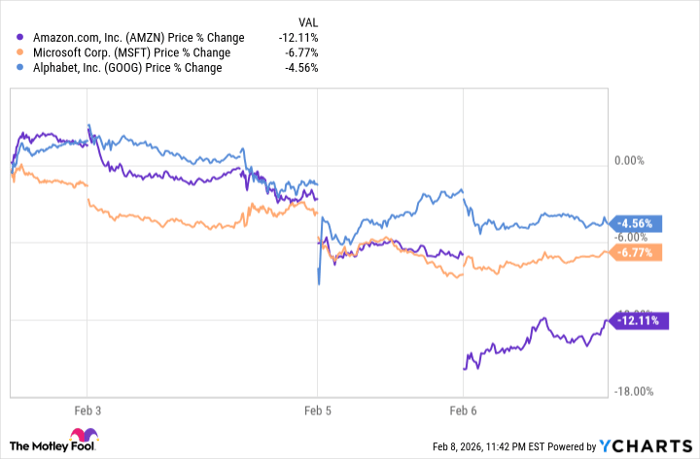
Despite some outstanding reports from the big hyperscalers last week, including Alphabet, Microsoft, and Amazon, the market sent their stock prices down on worries about overspending on artificial intelligence (AI).
Where to invest $1,000 right now? Our analyst team just revealed what they believe are the 10 best stocks to buy right now, when you join Stock Advisor. See the stocks »
Data by YCharts.
Here's how each company said it plans to spend:
- Alphabet: $180 billion in 2026, up from $91 billion in 2025.
- Microsoft: Spent $37.5 billion in the fiscal second quarter, up from $34.9 billion in the first quarter. The company has said it plans to increase total AI capacity by over 80% within the next two years.
- Amazon: $200 billion in 2026, up from $125 billion last year.
Patient, forward-looking investors can see the opportunity to buy these stocks today as they prepare for the future. But savvy investors will also recognize that these spending sprees are going to benefit suppliers, who will be on the receiving end of the spending. Companies like Taiwan Semiconductor Manufacturing (NYSE: TSM), Nvidia (NASDAQ: NVDA), and Applied Digital (NASDAQ: APLD) could be huge winners. Here's why.

Image source: Getty Images.
1. Taiwan Semiconductor Manufacturing (TSMC)
TSMC works with all of the above spenders as well as pretty much every major chip designer. It manufactures the specially designed chips and is therefore an integral piece of the AI process. Since it has a hand in so much AI development, it stands to benefit from this windfall of AI spending.
Management discussed this on the fourth-quarter earnings call. It let shareholders know that it was also increasing capacity to meet rising demand, and that the company has always enjoyed high growth opportunities after this kind of investment. Capex was $41 billion in 2025, and it expects that to rise to about $54 billion this year.
The market greeted this news with the enthusiasm it didn't give to Amazon and its peers, because how it's going to benefit is clear, whereas the results for the hyperscalers are still fuzzy and in the future. TSMC has a capital-intensive business in general, but its model hasn't changed over time, and it's efficient and profitable. It also recently moved some production to the U.S., where it can avoid tariffs and be closer to many of its clients. The market is excited about that expansion as well.
2. Nvidia
As the leading provider of graphics processing units (GPUs), Nvidia is poised to maintain its massive growth. The hyperscalers are spending on more powerful chips and platforms for greater compute, and they're populating their massive data centers with the vertically integrated solutions that are increasingly becoming Nvidia's bread and butter.
Once a client buys pieces of Nvidia's powerful infrastructure, it becomes part of the company's streamlined ecosystem that provides seamless solutions. All the parts work together, creating high barriers to entry for the competition. Nvidia's large clients, who are spending the most money, need its most powerful, and expensive, products to stay competitive.
Nvidia continues to launch new and more powerful products to raise the bar. As of the end of its fiscal 2026 third quarter (ended Oct. 26, 2025), its cloud-based products are sold out, and its installed base of GPUs is fully utilized. It's ramping up the launch of the Vera Rubin system for the back half of the year, and it's expected to provide even more power while staying compatible with the rest of Nvidia's products.
Management believes that it's still in the early innings across AI development, from accelerated computing to generative AI models and agentic AI. It envisions AI spend reaching $3 trillion to $4 trillion by the end of the decade, up from the $660 billion or so the large companies are planning for this year, and remaining the primary choice for its clients.
3. Applied Digital
Applied Digital has pivoted from supplying crypto-mining solutions to providing AI infrastructure, like hosting data centers. It's enjoying the exploding demand for its products, and it's benefiting from long-term commitments, including a $5 billion deal for the next 15 years. This should keep revenue pouring in steadily for the next few years at least.
The company has been reporting outstanding growth, including a 250% year-over-year sales increase in fiscal Q2 2026 (ended Nov. 30, 2025). Although it's still unprofitable, net loss improved by 76% in the quarter to $31 million. Adjusted net income was slightly positive, and with skyrocketing revenue, that's likely to turn into a generally accepted accounting principles (GAAP) profit very shortly.
Like the hyperscalers and the other companies on this list, Applied Digital is building out to handle the increasing demand, and it's well-positioned to keep up its growth as its clients continue to spend.
Should you buy stock in Taiwan Semiconductor Manufacturing right now?
Before you buy stock in Taiwan Semiconductor Manufacturing, consider this:
The Motley Fool Stock Advisor analyst team just identified what they believe are the 10 best stocks for investors to buy now… and Taiwan Semiconductor Manufacturing wasn’t one of them. The 10 stocks that made the cut could produce monster returns in the coming years.
Consider when Netflix made this list on December 17, 2004... if you invested $1,000 at the time of our recommendation, you’d have $429,385!* Or when Nvidia made this list on April 15, 2005... if you invested $1,000 at the time of our recommendation, you’d have $1,165,045!*
Now, it’s worth noting Stock Advisor’s total average return is 913% — a market-crushing outperformance compared to 196% for the S&P 500. Don't miss the latest top 10 list, available with Stock Advisor, and join an investing community built by individual investors for individual investors.
See the 10 stocks »
*Stock Advisor returns as of February 12, 2026.
Jennifer Saibil has positions in Taiwan Semiconductor Manufacturing. The Motley Fool has positions in and recommends Alphabet, Amazon, Microsoft, Nvidia, and Taiwan Semiconductor Manufacturing. The Motley Fool has a disclosure policy.
Recommended Articles


