




Crude Oil sells a deal Tehran hasn't signed
- Crude Oil remains sharply lower on the week as markets price in a US-Iran agreement.
- Iranian leadership has reportedly not approved the framework currently on the table.
- Renewed Strait of Hormuz hostilities drove a volatile, two-way session.
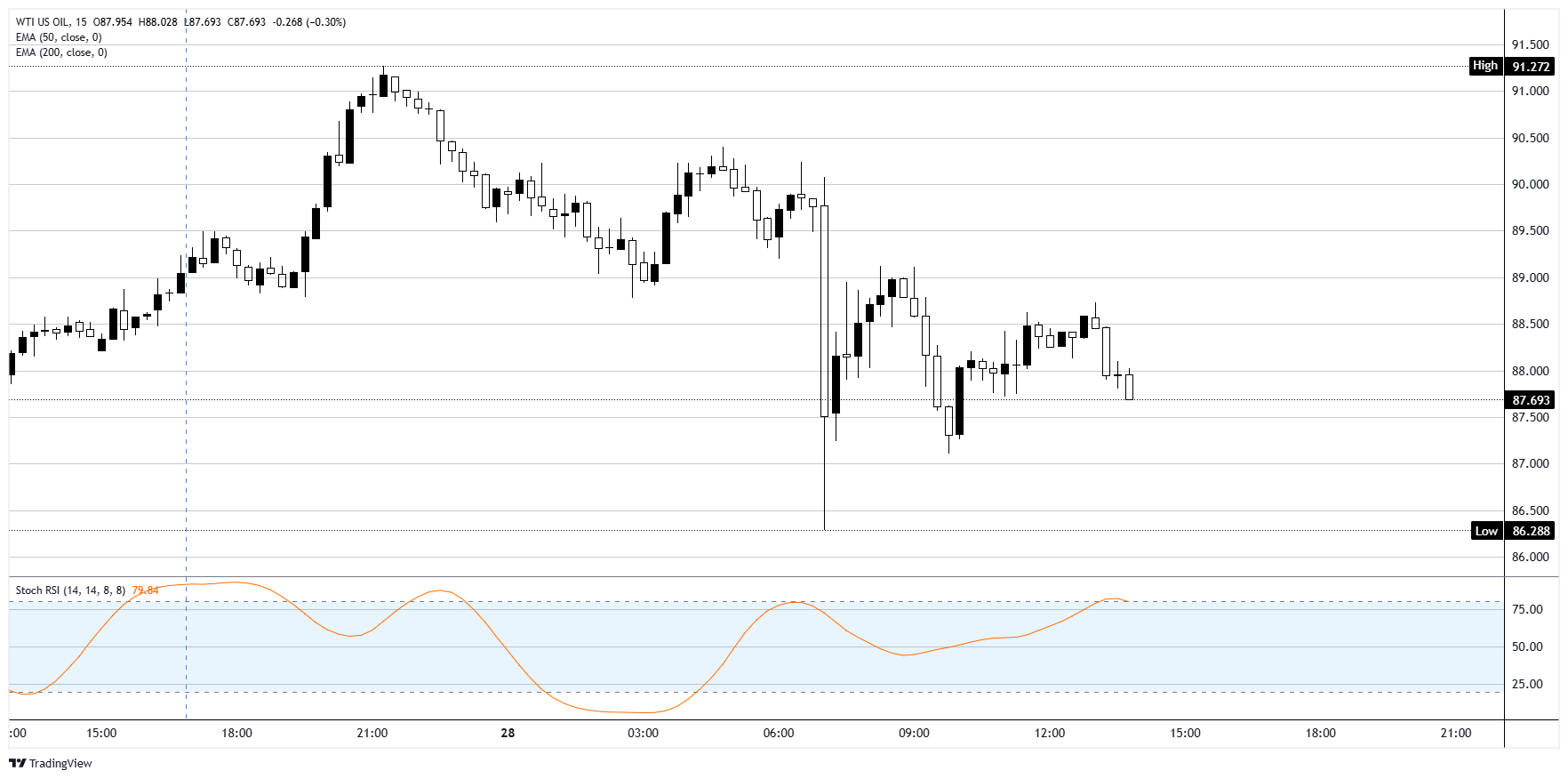
Crude Oil is doing what it has done all month: discounting a peace deal that the people who actually have to sign it have not agreed to. West Texas Intermediate (WTI) spot is consolidating near $88.50 after a brutal overnight session that printed a low close to $86.50, while Brent sits around $92.50, off its own low near $90.50. The editorial read is simple. The tape is treating an unsigned, unapproved framework as a done deal, and every fresh "progress" headline knocks another few dollars off a war premium that, by any honest accounting, has not actually been removed.
The deal Tehran hasn't actually agreed to
This is where the skepticism earns its keep. Reporting this week points to a draft 60-day memorandum of understanding (MOU) that would guarantee shipping through the Strait of Hormuz and see Iran clear mines from the waterway, but the same reporting concedes the framework still needs sign-off from Iranian leadership, and from the White House. Negotiators believing they have a draft is not the same as principals approving one. Supreme Leader Mojtaba Khamenei has reportedly held the line that enriched uranium stays inside Iran, directly contradicting Washington's central demand, while Tehran continues to treat control of Hormuz, frozen assets, and sanctions relief as leverage rather than settled points. Even the US side has been conspicuously non-committal, with the Treasury declining to confirm a deal is on the table. Markets are pricing certainty into a process the principals themselves describe as an open question.
Whipsaw between the table and the Strait
Thursday's price action captured the whole problem in a single session. Crude Oil dropped hard into the European morning on the latest MOU headlines, WTI tagging the $86.50 area, before reversing sharply as the war reasserted itself. The US reportedly destroyed several drones near Hormuz, Kuwait intercepted a missile, and the Islamic Revolutionary Guard Corps (IRGC) warned it would respond to any disruption in the strait. Futures, more widely watched than spot, swung back above $91.00 on WTI and toward $96.00 on Brent on the re-escalation. The consensus view is that the market is being whipsawed by signals out of Washington and Tehran that contradict each other within hours, which is precisely what you get when a war premium is priced off rumor rather than resolution.
Premium bleeding, not gone
The daily structure tells the same story. WTI is trading below its 50-day Exponential Moving Average (EMA) near $92.00 but holds well above the 200 EMA around $77.00, and Brent mirrors it, capped under its 50 EMA close to $97.50 while sitting above the 200 EMA near $82.00. The daily Stochastic Relative Strength Index (Stoch RSI) on Brent has drifted toward oversold near 24, hinting the down-leg is stretched in the short term. Crucially, even at these levels both benchmarks remain far above the $60 to $70 zone that prevailed before the conflict. The premium is bleeding, not gone, and that gap is the market's running bet on a clean resolution.
Levels and the trade
Bias stays lower while the deal narrative dominates, but this is a tape to fade extremes, not chase. On WTI, $86.00 is the line in the sand; a clean break opens the air pocket back toward the pre-war range, while reclaiming $91.00 signals the war premium is rebuilding. Brent's equivalents sit near $90.50 support and $96.00 resistance. Treat any deal "confirmation" with suspicion until Tehran's leadership actually signs, because re-escalation is one IRGC statement away. The delayed Energy Information Administration (EIA) inventory report, pushed to Thursday after the holiday, lands later in the session; the American Petroleum Institute (API) already flagged a draw of roughly 2.8 million barrels, but in this regime a build or draw is noise next to the next Hormuz headline.
WTI 15-minute chart
WTI Oil FAQs
WTI Oil is a type of Crude Oil sold on international markets. The WTI stands for West Texas Intermediate, one of three major types including Brent and Dubai Crude. WTI is also referred to as “light” and “sweet” because of its relatively low gravity and sulfur content respectively. It is considered a high quality Oil that is easily refined. It is sourced in the United States and distributed via the Cushing hub, which is considered “The Pipeline Crossroads of the World”. It is a benchmark for the Oil market and WTI price is frequently quoted in the media.
Like all assets, supply and demand are the key drivers of WTI Oil price. As such, global growth can be a driver of increased demand and vice versa for weak global growth. Political instability, wars, and sanctions can disrupt supply and impact prices. The decisions of OPEC, a group of major Oil-producing countries, is another key driver of price. The value of the US Dollar influences the price of WTI Crude Oil, since Oil is predominantly traded in US Dollars, thus a weaker US Dollar can make Oil more affordable and vice versa.
The weekly Oil inventory reports published by the American Petroleum Institute (API) and the Energy Information Agency (EIA) impact the price of WTI Oil. Changes in inventories reflect fluctuating supply and demand. If the data shows a drop in inventories it can indicate increased demand, pushing up Oil price. Higher inventories can reflect increased supply, pushing down prices. API’s report is published every Tuesday and EIA’s the day after. Their results are usually similar, falling within 1% of each other 75% of the time. The EIA data is considered more reliable, since it is a government agency.
OPEC (Organization of the Petroleum Exporting Countries) is a group of 12 Oil-producing nations who collectively decide production quotas for member countries at twice-yearly meetings. Their decisions often impact WTI Oil prices. When OPEC decides to lower quotas, it can tighten supply, pushing up Oil prices. When OPEC increases production, it has the opposite effect. OPEC+ refers to an expanded group that includes ten extra non-OPEC members, the most notable of which is Russia.
Recommended Articles


